115195
论文已发表
注册即可获取德孚的最新动态
IF 收录期刊
- 3.6 Breast Cancer (Dove Med Press)
- 4.3 Clin Epidemiol
- 2.6 Cancer Manag Res
- 3.2 Infect Drug Resist
- 4.1 Clin Interv Aging
- 6.1 Drug Des Dev Ther
- 4.1 Int J Chronic Obstr
- 8.7 Int J Nanomed
- 2.5 Int J Women's Health
- 3.2 Neuropsych Dis Treat
- 2.4 OncoTargets Ther
- 2.6 Patient Prefer Adher
- 2.6 Ther Clin Risk Manag
- 3.1 J Pain Res
- 3.5 Diabet Metab Synd Ob
- 4.5 Psychol Res Behav Ma
- 3.4 Nat Sci Sleep
- 2.4 Pharmgenomics Pers Med
- 2.6 Risk Manag Healthc Policy
- 4.6 J Inflamm Res
- 2.3 Int J Gen Med
- 3.9 J Hepatocell Carcinoma
- 3.3 J Asthma Allergy
- 2.5 Clin Cosmet Investig Dermatol
- 3.0 J Multidiscip Healthc

中国食管胃交界处腺癌患者免疫特性与临床病理的关系
Authors Wang Y, Wang S, Zhu C, Cao H, Zhang Z, Zhao E
Received 23 October 2019
Accepted for publication 9 April 2020
Published 11 May 2020 Volume 2020:12 Pages 3259—3269
DOI https://doi.org/10.2147/CMAR.S235722
Checked for plagiarism Yes
Review by Single-blind
Peer reviewer comments 2
Editor who approved publication: Dr Antonella D'Anneo
Purpose: Adenocarcinoma of the esophagogastric junction (AEG) patient immune characteristics were analyzed in this study, and these features were compared with patient clinical pathology and prognosis.
Patients and Methods: The clinicopathological data and prognostic information of 96 AEG patients who were admitted to Ren Ji Hospital between December 2008 and December 2015 were collected. PD-1/PD-L1, Tim-3/Gal-9, and CD3/CD8/Foxp3 expression in these patients, as well as the correlation of the expression of these molecules with clinicopathological data and survival time, were analyzed. Comparisons of count data were performed using the chi-square test or Fisher’s exact test. The survival rate and survival curves were calculated and drawn, respectively, with the Kaplan–Meier method, and the Log rank test was used for survival analysis.
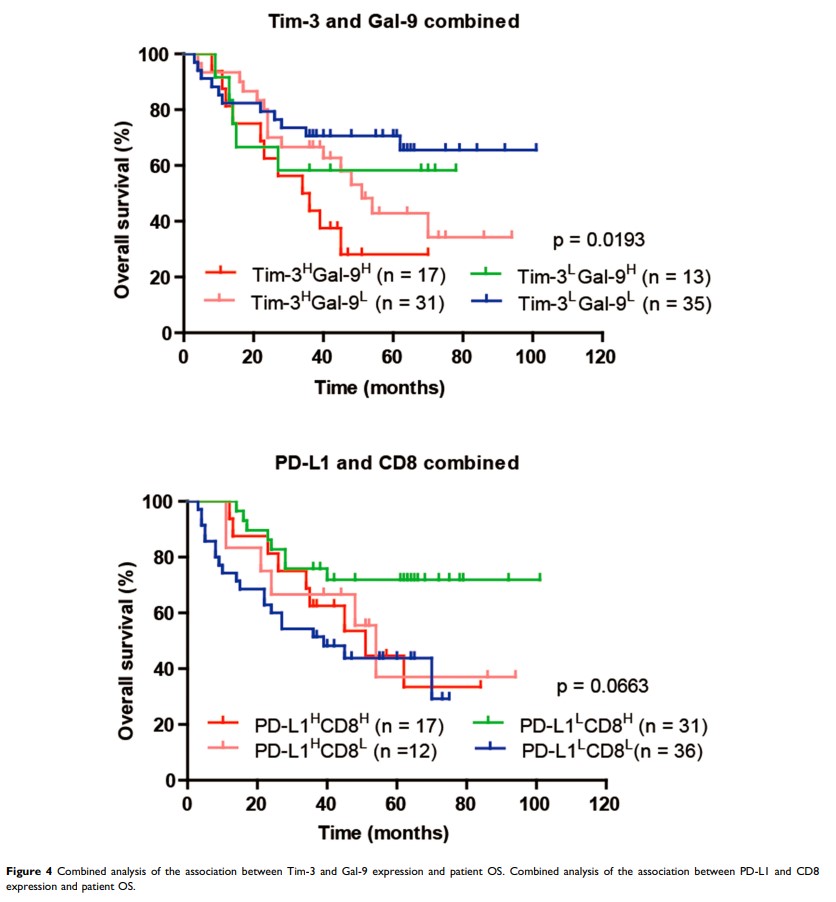
Results: The positive rate for PD-L1 and Gal-9 in these AEG patients was 30.21% and 31.25%, respectively. Tim-3 positivity had a close relationship with patient Siewert type. CD8+ T cell infiltration and patient TNM stage, as well as CD3+CD8+ T cell infiltration and patient Lauren type, had a close relationship based on analysis of the correlation between immune factor expression and clinicopathological data. The group with high CD8+ T cell infiltration had an improved survival rate, while the combined analysis of Tim-3 and Gal-9 expression showed that the double-positive group had a significantly poorer prognosis than groups with other Tim-3 and Gal-9 expression patterns. The PD-L1 expression level had a close relationship with T cell infiltration in AEG patients, especially CD3+ and CD8+ T cell infiltration.
Conclusion: Tim-3 expression was higher in patients with Siewert type I tumors than in patients with tumors of other Siewert types. Patients with high CD8+ T cell infiltration had a better prognosis than patients with low CD8+ T cell infiltration, and CD8+ T cell infiltration was closely related to AEG patient TNM stage. The Tim-3 and Gal-9 double-positive group showed poor prognosis, and immune therapy could be recommended for these AEG patients.
Keywords: AEG, adenocarcinoma of the esophagogastric junction, Siewert type, immune characteristic, survival prognosis