115195
论文已发表
注册即可获取德孚的最新动态
IF 收录期刊
- 3.6 Breast Cancer (Dove Med Press)
- 4.3 Clin Epidemiol
- 2.6 Cancer Manag Res
- 3.2 Infect Drug Resist
- 4.1 Clin Interv Aging
- 6.1 Drug Des Dev Ther
- 4.1 Int J Chronic Obstr
- 8.7 Int J Nanomed
- 2.5 Int J Women's Health
- 3.2 Neuropsych Dis Treat
- 2.4 OncoTargets Ther
- 2.6 Patient Prefer Adher
- 2.6 Ther Clin Risk Manag
- 3.1 J Pain Res
- 3.5 Diabet Metab Synd Ob
- 4.5 Psychol Res Behav Ma
- 3.4 Nat Sci Sleep
- 2.4 Pharmgenomics Pers Med
- 2.6 Risk Manag Healthc Policy
- 4.6 J Inflamm Res
- 2.3 Int J Gen Med
- 3.9 J Hepatocell Carcinoma
- 3.3 J Asthma Allergy
- 2.5 Clin Cosmet Investig Dermatol
- 3.0 J Multidiscip Healthc

在全膝关节置换术后恢复阶段,罗哌卡因输注方案对连续股神经阻滞的有效性比较:随机双盲试验
Authors Zhang Y, Liu L, Zheng L, Chen J, Huang L, Wang Q, Shi K
Received 24 January 2020
Accepted for publication 27 March 2020
Published 12 May 2020 Volume 2020:13 Pages 997—1005
DOI https://doi.org/10.2147/JPR.S247158
Checked for plagiarism Yes
Review by Single-blind
Peer reviewer comments 2
Editor who approved publication: Dr Robert B. Raffa
Purpose: Continuous femoral nerve block (cFNB) is effective for analgesia after total knee arthroplasty (TKA). However, it is not clear which low-dose regimen of ropivacaine infusion for cFNB provides adequate analgesia and enables rapid recovery. The aim of this study was to compare the effects of different cFNB regimens on rehabilitation of patients after TKA.
Patients and Methods: Sixty patients scheduled for TKA were enrolled in this trial. After surgery, patients in the 0.1%, 0.15%, and 0.2% groups received infusion of 10 mL of 0.1%, 6.7 mL of 0.15%, and 5 mL of 0.2% ropivacaine per hour, respectively (n=20), at the dose of 10 mg/h for 48 h. The primary endpoint was time to readiness for discharge. The secondary endpoints were time to first walk, manual muscle testing (MMT) scores, numerical rating scale (NRS) scores at rest and movement, morphine consumption, rescue analgesia, and the incidence of adverse events.
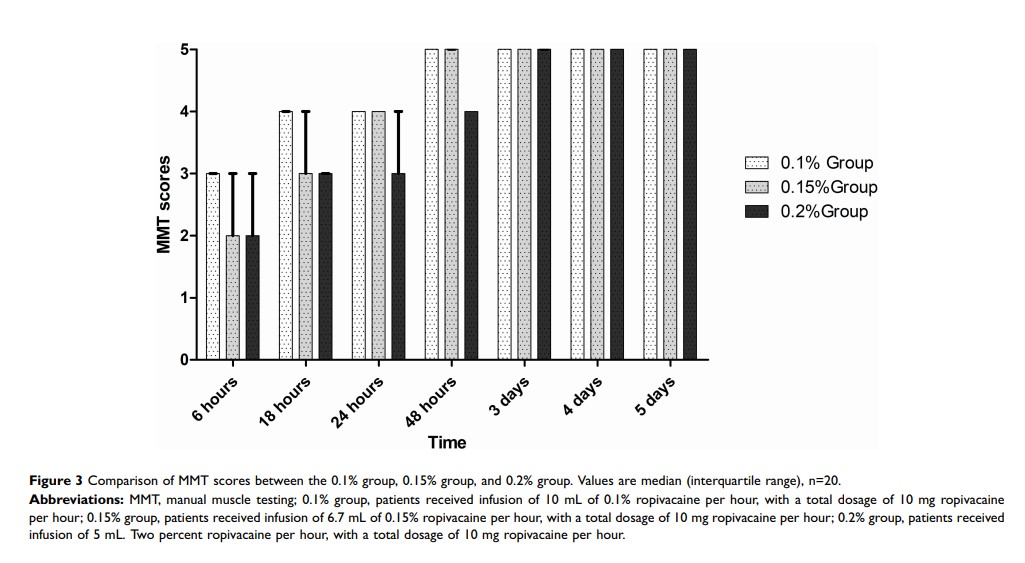
Results: The time to readiness for discharge and the time to first walk of the 0.1% group were significantly longer than that of the 0.15% and 0.2% groups. MMT scores of the 0.2% group at 18 h after surgery were significantly lower than those of the 0.1% group. MMT scores of the 0.2% group at 24 and 48 h after surgery were also significantly lower than those of the 0.1% and 0.15% groups. NRS scores at rest and at movement in the 0.1% group were significantly higher than those in the 0.15% and 0.2% groups.
Conclusion: Patients administered the regimens of 0.15% and 0.2% ropivacaine infusion for cFNB were ready for discharge earlier than the 0.1% group after TKA, at the dose of 10 mg/h for 48 h. The regimen of 0.15% ropivacaine, which is associated with less quadriceps muscle strength weakness than 0.2%, is recommended for postoperative analgesia after TKA.
Keywords: analgesia, ultrasound, regional anesthesia, quadriceps muscle strength