115195
论文已发表
注册即可获取德孚的最新动态
IF 收录期刊
- 3.6 Breast Cancer (Dove Med Press)
- 4.3 Clin Epidemiol
- 2.6 Cancer Manag Res
- 3.2 Infect Drug Resist
- 4.1 Clin Interv Aging
- 6.1 Drug Des Dev Ther
- 4.1 Int J Chronic Obstr
- 8.7 Int J Nanomed
- 2.5 Int J Women's Health
- 3.2 Neuropsych Dis Treat
- 2.4 OncoTargets Ther
- 2.6 Patient Prefer Adher
- 2.6 Ther Clin Risk Manag
- 3.1 J Pain Res
- 3.5 Diabet Metab Synd Ob
- 4.5 Psychol Res Behav Ma
- 3.4 Nat Sci Sleep
- 2.4 Pharmgenomics Pers Med
- 2.6 Risk Manag Healthc Policy
- 4.6 J Inflamm Res
- 2.3 Int J Gen Med
- 3.9 J Hepatocell Carcinoma
- 3.3 J Asthma Allergy
- 2.5 Clin Cosmet Investig Dermatol
- 3.0 J Multidiscip Healthc

Wnt3a 抑制剂通过下调大鼠脊髓 NMDA 受体来减轻瑞芬太尼诱导的痛觉过敏
Authors Gao Y, Zhou S, Pan Y, Gu L, He Y, Sun J
Received 21 February 2020
Accepted for publication 30 April 2020
Published 19 May 2020 Volume 2020:13 Pages 1049—1058
DOI https://doi.org/10.2147/JPR.S250663
Checked for plagiarism Yes
Review by Single-blind
Peer reviewer comments 2
Editor who approved publication: Dr Robert B. Raffa
Purpose: The upregulation of spinal NMDA receptor is a crucial mechanism in remifentanil-induced hyperalgesia (RIH). Wnt3a/β-catenin pathway plays an important role in neuropathic pain. We hypothesized that wnt3a inhibitor (iwp-2) could downregulate the expression of NR2B subunit in NMDA receptor, in order to relieve RIH.
Materials and Methods: The study has 2 phases. The phase 1 study is designed by different doses of iwp-2 groups to create an appropriate iwp-2 dose used in RIH alleviation. The phase 2 study is designed to prove that the wnt3a inhibitor could downregulate the activation of the NR2B to inhibit RIH in rats. Thermal hyperalgesia (PWTL) and mechanical allodynia (PWMT) were evaluated after RIH. The area under the PWTL and PWMT curves (AUC) were calculated. The amount of activated NR2B subunit, c-fos, NF-κB, β-catenin, wnt3a and p-GSK-3β (Ser9) were detected in the lumbar spinal cord.
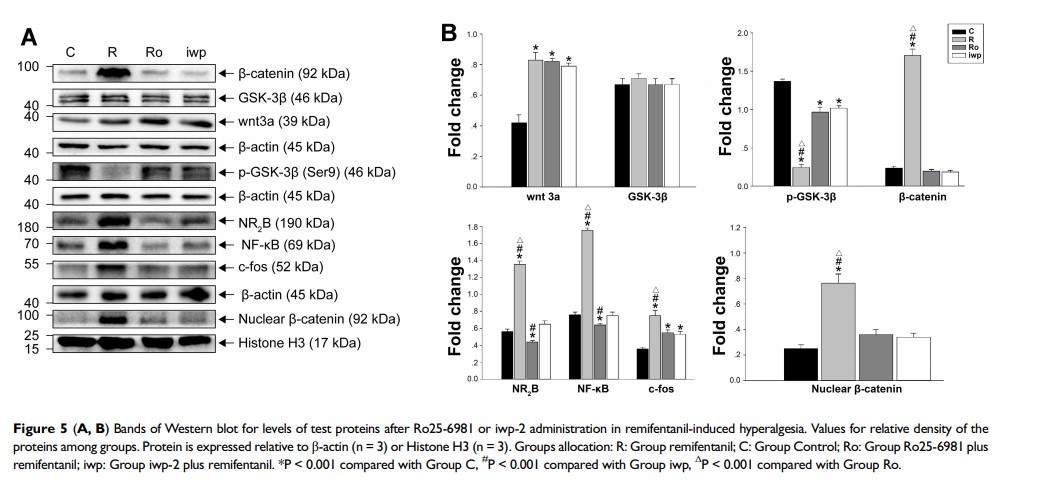
Results: Remifentanil infusion could induce overexpression of β-catenin and wnt3a in rats. Iwp-2 (60μM, 120μM, 180μM) could dose-dependently inhibit thermal hyperalgesia and mechanical allodynia in rats. In phase 2 study, both NR2B subunit antagonist Ro25-6981 and iwp-2 decreased the amount of activated NR2B, enhanced p-GSK-3β (Ser9), reduced β-catenin, c-fos and NF-κB in the lumbar spinal cord (p < 0.001). In comparison with the group iwp-2, the group of Ro25-6981 had more benefit in reversing hyperalgesia, including higher AUC value of PWTL (p = 0.022) and PWMT (p = 0.035).
Conclusion: Remifentanil exposure could induce overexpression of wnt3a and enhance the production of β-catenin in the spinal dorsal horn. Inhibition of wnt3a response was capable of attenuating RIH in alleviating hyperalgesia-related behavioral parameters, as well as reducing overexpression of c-fos, NF-κB, NR2B in spinal dorsal horn.
Keywords: remifentanil, hyperalgesia, iwp-2, NR2B, wnt3a/β-catenin