115195
论文已发表
注册即可获取德孚的最新动态
IF 收录期刊
- 3.6 Breast Cancer (Dove Med Press)
- 4.3 Clin Epidemiol
- 2.6 Cancer Manag Res
- 3.2 Infect Drug Resist
- 4.1 Clin Interv Aging
- 6.1 Drug Des Dev Ther
- 4.1 Int J Chronic Obstr
- 8.7 Int J Nanomed
- 2.5 Int J Women's Health
- 3.2 Neuropsych Dis Treat
- 2.4 OncoTargets Ther
- 2.6 Patient Prefer Adher
- 2.6 Ther Clin Risk Manag
- 3.1 J Pain Res
- 3.5 Diabet Metab Synd Ob
- 4.5 Psychol Res Behav Ma
- 3.4 Nat Sci Sleep
- 2.4 Pharmgenomics Pers Med
- 2.6 Risk Manag Healthc Policy
- 4.6 J Inflamm Res
- 2.3 Int J Gen Med
- 3.9 J Hepatocell Carcinoma
- 3.3 J Asthma Allergy
- 2.5 Clin Cosmet Investig Dermatol
- 3.0 J Multidiscip Healthc

血液嗜酸性粒细胞增多症及其在住院 COPD 急性加重患者中的稳定性与较低的全因死亡率风险有关
Authors Zhang Y, Liang LR, Zhang S, Lu Y, Chen YY, Shi HZ, Lin YX
Received 20 January 2020
Accepted for publication 8 April 2020
Published 19 May 2020 Volume 2020:15 Pages 1123—1134
DOI https://doi.org/10.2147/COPD.S245056
Checked for plagiarism Yes
Review by Single-blind
Peer reviewer comments 2
Editor who approved publication: Prof. Dr. Chunxue Bai
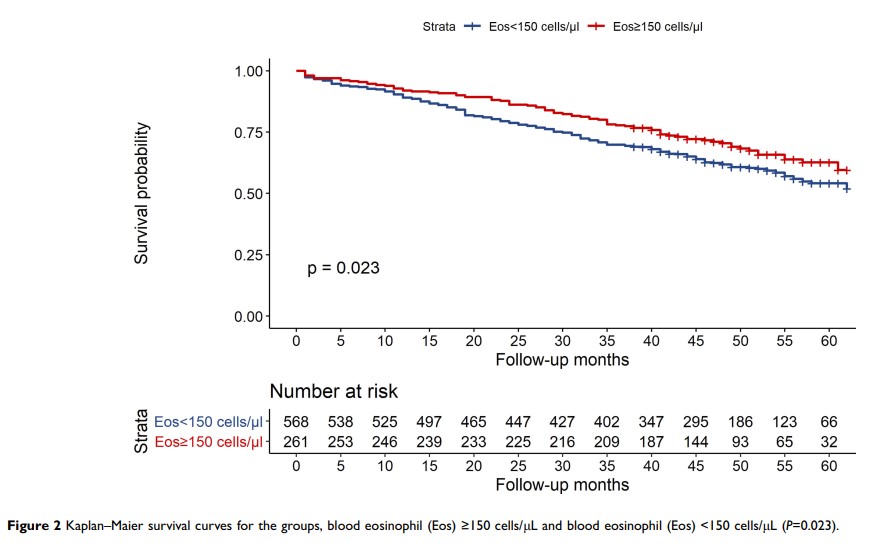
Purpose: Peripheral blood eosinophilic counts are susceptible to many factors and have variability over time. There are limited studies on association of blood eosinophilia with long-term mortality of chronic obstructive pulmonary disease (COPD) patients and these results remain controversial. Our aims were to explore the association of blood eosinophilia at index hospitalization and stability of blood eosinophilia stability over 5 years with all-cause mortality of patients hospitalized for acute exacerbation of COPD (AECOPD).
Patients and Methods: Eight hundred twenty-nine patients hospitalized for AECOPD between 2013 and 2014 were included in this study and grouped into two groups according to blood eosinophil with 150 cells/μL used as the cutoff value to form eosinophilic and non-eosinophilic groups. Two hundred forty-one COPD inpatients with at least three blood eosinophils measured from different hospitalizations were used for analysis of longitudinally eosinophilic stability and divided into three groups according to the same cutoff value: predominantly (PE), intermittently (IE) and rarely (RE) eosinophilic groups. Cox regression analysis was used to determine the association of blood eosinophilia and all-cause mortality.
Results: In patients hospitalized for AECOPD, 261 (31.5%) at baseline and 41 (17%) based on at least three measurements of blood eosinophils had increased blood eosinophils. For all-cause mortality, eosinophilic COPD patients at index hospitalization had a lower all-cause mortality compared with non-eosinophilic COPD patients (hazard ratio 0.77, 95% confidence interval 0.6– 0.99, P =0.04). In patients readmitted for AECOPD by longitudinal eosinophil stability, with the RE group used as reference, the PE group was associated with a lower all-cause mortality of AECOPD patients (hazard ratio 0.43, 95% confidence interval 0.22– 0.85, P =0.016), compared to the IE group (hazard ratio 0.72, 95% confidence interval 0.47– 1.11, P =0.133).
Conclusion: Patients with increased eosinophils (using eosinophil 150 cells/μL as a cutoff value), especially predominantly increased eosinophil levels based on multiple measurements, had a lower risk of all-cause mortality. Blood eosinophilia can be used as a biomarker in hospitalized COPD exacerbations for predicting the risk of all-cause mortality.
Keywords: acute exacerbation, chronic obstructive pulmonary disease, blood eosinophilia, mortality