115195
论文已发表
注册即可获取德孚的最新动态
IF 收录期刊
- 3.6 Breast Cancer (Dove Med Press)
- 4.3 Clin Epidemiol
- 2.6 Cancer Manag Res
- 3.2 Infect Drug Resist
- 4.1 Clin Interv Aging
- 6.1 Drug Des Dev Ther
- 4.1 Int J Chronic Obstr
- 8.7 Int J Nanomed
- 2.5 Int J Women's Health
- 3.2 Neuropsych Dis Treat
- 2.4 OncoTargets Ther
- 2.6 Patient Prefer Adher
- 2.6 Ther Clin Risk Manag
- 3.1 J Pain Res
- 3.5 Diabet Metab Synd Ob
- 4.5 Psychol Res Behav Ma
- 3.4 Nat Sci Sleep
- 2.4 Pharmgenomics Pers Med
- 2.6 Risk Manag Healthc Policy
- 4.6 J Inflamm Res
- 2.3 Int J Gen Med
- 3.9 J Hepatocell Carcinoma
- 3.3 J Asthma Allergy
- 2.5 Clin Cosmet Investig Dermatol
- 3.0 J Multidiscip Healthc

肿瘤浸润免疫细胞在结肠癌预后中的意义
Authors Wu D, Ding Y, Wang T, Cui P, Huang L, Min Z, Xu M
Received 18 February 2020
Accepted for publication 5 May 2020
Published 22 May 2020 Volume 2020:13 Pages 4581—4589
DOI https://doi.org/10.2147/OTT.S250416
Checked for plagiarism Yes
Review by Single-blind
Peer reviewer comments 2
Editor who approved publication: Prof. Dr. Nicola Silvestris
Objective: Increasing evidence has indicated an association between immune infiltration in colon cancer and clinical outcomes. The aim of this research is to comprehensively investigate the effect of 22 tumor-infiltrating immune cells (TIICs) on the prognosis of colon cancer patients.
Methods: In our research, CIBERSORT algorithm was used to calculate the proportion of 22 TIICs in 369 colon cancer cases and 39 normal cases from the TCGA cohort. Cox regression analysis was used to analyze the effect of 22 TIICs on the prognosis of colon cancer. Immune risk scoring model was constructed based on the statistical correlation between TIICs subpopulation and survival. Meanwhile, multivariate Cox regression analysis was utilized to investigate whether the immune risk score model was an independent factor for predicting the prognosis of colon cancer. Nomogram was constructed to comprehensively predict the survival rate of colon cancer. P< 0.05 was considered to be statistically significant.
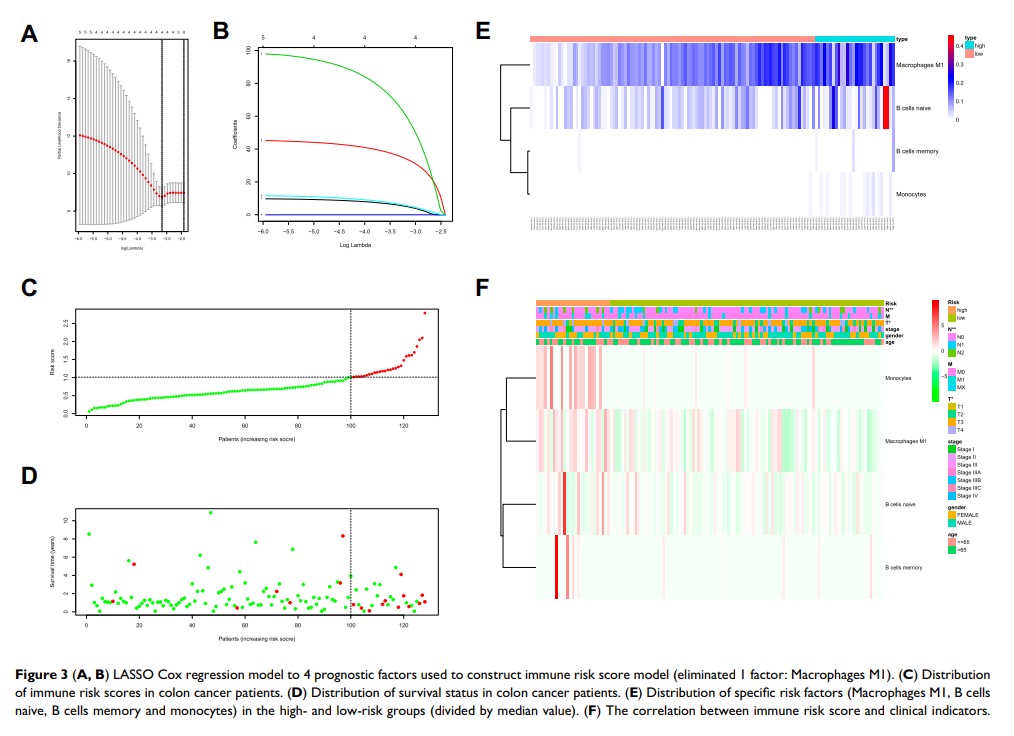
Results: The results of the difference analysis showed that except for 12 TIICs, the remaining immune cells exhibited no differential infiltration between normal and colon cancer tissues (p< 0. 05). Univariate Cox regression analysis revealed 5 immune cells statistically correlated with colon cancer-related survival risk, including B cells naive, B cells memory, monocytes, macrophages M0, macrophages M1 (P< 0.05). In addition, a four-cell based immune risk scoring model was constructed through LASSO Cox regression analysis. KM curve indicated that patients in highrisk were associated with poor outcomes (p< 0.001). ROC curve indicated that the immune risk score model was reliable in predicting survival risk (AUC=0.848). Our model showed satisfying AUC and survival correlation in the validation dataset (3-year over survival (OS) AUC=0.941, 5-year OS AUC=0.865, P=0.022). Furthermore, multivariate Cox regression analysis confirmed that the immune risk score model was an independent factor for predicting the prognosis of colon cancer (hazard ratio (HR) =5.017, 95% confidence interval (CI) =2.336– 10.777; P< 0.001). Ultimately, a nomogram was established to comprehensively predict the survival of colon cancer patients with the results of multivariate Cox regression analysis.
Conclusion: Collectively, tumor-infiltrating immune cells played an essential role in the prognosis of colon cancer. Furthermore, immune risk score was an independent predictive factor of colon cancer, indicating a poor survival.
Keywords: colon cancer, TIICs, prognosis, immune risk score model, nomogram