115195
论文已发表
注册即可获取德孚的最新动态
IF 收录期刊
- 3.6 Breast Cancer (Dove Med Press)
- 4.3 Clin Epidemiol
- 2.6 Cancer Manag Res
- 3.2 Infect Drug Resist
- 4.1 Clin Interv Aging
- 6.1 Drug Des Dev Ther
- 4.1 Int J Chronic Obstr
- 8.7 Int J Nanomed
- 2.5 Int J Women's Health
- 3.2 Neuropsych Dis Treat
- 2.4 OncoTargets Ther
- 2.6 Patient Prefer Adher
- 2.6 Ther Clin Risk Manag
- 3.1 J Pain Res
- 3.5 Diabet Metab Synd Ob
- 4.5 Psychol Res Behav Ma
- 3.4 Nat Sci Sleep
- 2.4 Pharmgenomics Pers Med
- 2.6 Risk Manag Healthc Policy
- 4.6 J Inflamm Res
- 2.3 Int J Gen Med
- 3.9 J Hepatocell Carcinoma
- 3.3 J Asthma Allergy
- 2.5 Clin Cosmet Investig Dermatol
- 3.0 J Multidiscip Healthc

作为潜在 PPARγ 激动剂的胡椒碱衍生物的合成及生物活性
Authors Wang Y, Yao Y, Liu J, Wu L, Liu T, Cui J, Lee DYW
Received 12 November 2019
Accepted for publication 11 May 2020
Published 26 May 2020 Volume 2020:14 Pages 2069—2078
DOI https://doi.org/10.2147/DDDT.S238245
Checked for plagiarism Yes
Review by Single-blind
Peer reviewer comments 2
Editor who approved publication: Dr Sukesh Voruganti
Introduction: Peroxisome proliferator-activated receptor γ (PPARγ ) plays a key role in glucose, which is a ligand-mediated transcription factor. The lipid homeostasis often serves as a pharmacological target for new drug discovery and development.
Materials and Methods: In the research, we synthesized a series of piperine derivatives and then used a fluorescence polarization-based PPARγ ligand screening assay to evaluate the agonistic activity of PPARγ . Then, we cultured human normal hepatocytes, which were treated with 100μM compounds 2a, 2t or 3d. Then, the levels of PPARγ gene were determined so as to show whether the compounds could activate or inhibit the expression of PPARγ .
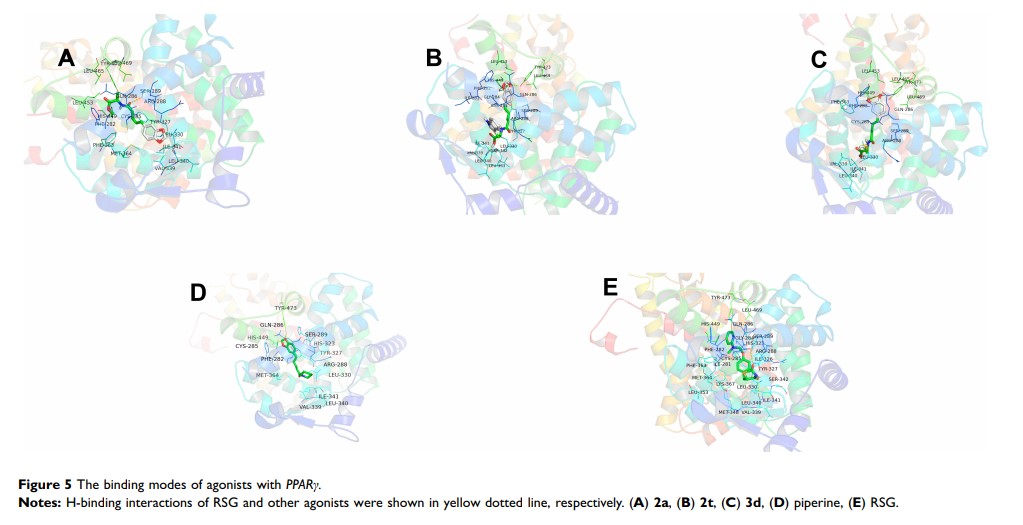
Results: A total of 30 piperine derivatives were synthesized and evaluated. Compound 2a was identified as a potential PPARγ agonist with IC50 at 2.43 μM, which is 2 times more potent than the positive control rosiglitazone with IC50 at 5.61μM. The human hepatocytes cells were cultured and treated with compounds 2a, 2t or 3d as described in the “Materials and Methods” section. We found that compounds 2a, 2t and 3d could activate PPARγ by 11.8, 1.9 and 7.0 times compared with the “blank”, with compound 2a activation being the most significant. Molecular docking studies indicated that the piperine derivative 2a stably interacts with the amino acid residues of the PPARγ complex active site, which is consistent with the results of the in vitro PPARγ ligand screening assay.
Keywords: PPARγ , piperine derivatives, ligand screening assay, molecular docking