115195
论文已发表
注册即可获取德孚的最新动态
IF 收录期刊
- 3.6 Breast Cancer (Dove Med Press)
- 4.3 Clin Epidemiol
- 2.6 Cancer Manag Res
- 3.2 Infect Drug Resist
- 4.1 Clin Interv Aging
- 6.1 Drug Des Dev Ther
- 4.1 Int J Chronic Obstr
- 8.7 Int J Nanomed
- 2.5 Int J Women's Health
- 3.2 Neuropsych Dis Treat
- 2.4 OncoTargets Ther
- 2.6 Patient Prefer Adher
- 2.6 Ther Clin Risk Manag
- 3.1 J Pain Res
- 3.5 Diabet Metab Synd Ob
- 4.5 Psychol Res Behav Ma
- 3.4 Nat Sci Sleep
- 2.4 Pharmgenomics Pers Med
- 2.6 Risk Manag Healthc Policy
- 4.6 J Inflamm Res
- 2.3 Int J Gen Med
- 3.9 J Hepatocell Carcinoma
- 3.3 J Asthma Allergy
- 2.5 Clin Cosmet Investig Dermatol
- 3.0 J Multidiscip Healthc

LncRNA XIST 通过调节 miR-124-3p/iASPP 信号通路促进人脊索瘤细胞的生长
Authors Hai B, Pan X, Du C, Mao T, Jia F, Liu Y, Ma Y, Liu X, Zhu B
Received 2 March 2020
Accepted for publication 30 April 2020
Published 26 May 2020 Volume 2020:13 Pages 4755—4765
DOI https://doi.org/10.2147/OTT.S252195
Checked for plagiarism Yes
Review by Single-blind
Peer reviewer comments 2
Editor who approved publication: Dr Federico Perche
Introduction: Chordoma is a malignant primary bone tumor that is found in the spine and skull. X-inactive specific transcript (XIST) is a long non-coding RNA (lncRNA) is known to be involved in the development of various cancers, but its precise function and mechanism in human chordoma have not been elucidated. Here, we investigated the role of lncRNA XIST in chordoma progression.
Methods: Quantitative real time-polymerase chain reaction (qRT-PCR) was performed to determine lncRNA XIST expression in human chordoma tissues and matched-noncancerous tissues. Western blot was used to determine protein expression. Silencing and overexpression of lncRNA XIST were carried out by RNA interference (RNAi) and lentiviral transduction, respectively. Cell Counting Kit-8 (CCK-8) assay and flow cytometry were employed to examine the effects of lncRNA XIST on growth of human chordoma cells. Lastly, the role of lncRNA XIST in vivo was explored using a xenograft model.
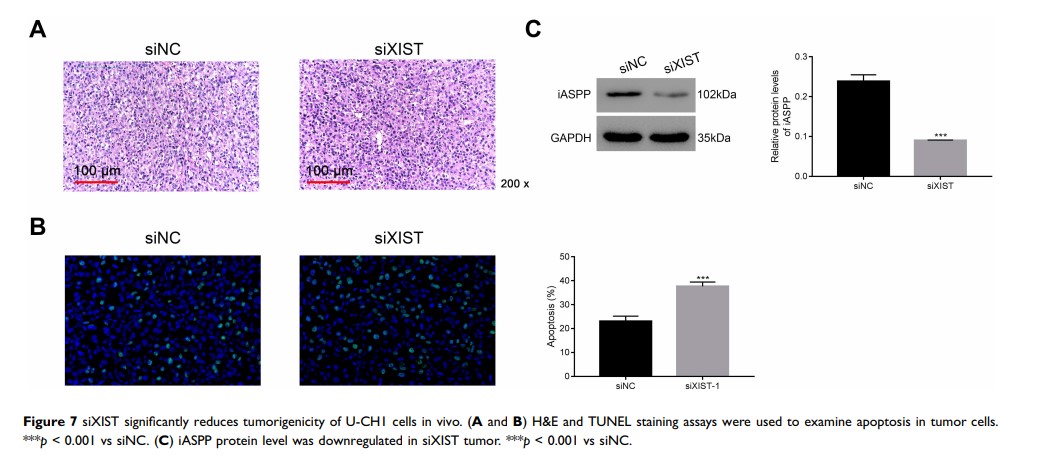
Results: We found that lncRNA XIST expression was upregulated in chordoma and strongly correlated with poor patient prognosis. Moreover, lncRNA XIST promoted proliferation and inhibited apoptosis of chordoma cells. Mechanistically, upregulation of lncRNA XIST led to a decrease in miR-124-3p expression, thereby promoting the expression of the miR-124-3p target gene, inhibitor of apoptosis-stimulating protein of p53 (iASPP). Addition of miR-124-3p inhibitor or mimic reversed the effects induced by lncRNA XIST silencing or overexpression on chordoma cell proliferation. Lastly, using a xenograft mouse model, we found that silencing of lncRNA XIST decreased tumorigenicity in vivo, as shown by increased tumor cell apoptosis.
Conclusion: Our findings demonstrate a key role for lncRNA XIST in chordoma progression by regulating miR124-3p/iAPSS pathway.
Keywords: chordoma, lncRNA XIST, miR124-3p, iASPP, proliferation, apoptosis