115195
论文已发表
注册即可获取德孚的最新动态
IF 收录期刊
- 3.6 Breast Cancer (Dove Med Press)
- 4.3 Clin Epidemiol
- 2.6 Cancer Manag Res
- 3.2 Infect Drug Resist
- 4.1 Clin Interv Aging
- 6.1 Drug Des Dev Ther
- 4.1 Int J Chronic Obstr
- 8.7 Int J Nanomed
- 2.5 Int J Women's Health
- 3.2 Neuropsych Dis Treat
- 2.4 OncoTargets Ther
- 2.6 Patient Prefer Adher
- 2.6 Ther Clin Risk Manag
- 3.1 J Pain Res
- 3.5 Diabet Metab Synd Ob
- 4.5 Psychol Res Behav Ma
- 3.4 Nat Sci Sleep
- 2.4 Pharmgenomics Pers Med
- 2.6 Risk Manag Healthc Policy
- 4.6 J Inflamm Res
- 2.3 Int J Gen Med
- 3.9 J Hepatocell Carcinoma
- 3.3 J Asthma Allergy
- 2.5 Clin Cosmet Investig Dermatol
- 3.0 J Multidiscip Healthc

对喉鳞状细胞癌伴淋巴血管浸润的患者行术后同步放化疗与术后单独放疗的比较:倾向评分匹配研究
Authors Yu S, Zhu Y, Shi X, Hu K, Bai C, Diao W, Zhu X, Gao Z, Chen X
Received 20 February 2020
Accepted for publication 9 May 2020
Published 29 May 2020 Volume 2020:12 Pages 4063—4071
DOI https://doi.org/10.2147/CMAR.S250621
Checked for plagiarism Yes
Review by Single-blind
Peer reviewer comments 2
Editor who approved publication: Dr Antonella D'Anneo
Purpose: To date, no guidelines have been proposed for the ideal treatment of postoperative larynx squamous cell carcinoma (LSCC) patients with lymphovascular invasion due to a lack of similar studies. The present study was conducted to compare the survival and toxicity in LSCC patients with lymphovascular invasion receiving either postoperative radiotherapy (PORT) or postoperative chemoradiotherapy (POCRT). The results can be applied for more appropriate treatment of these patients.
Patients and Methods: Three hundred eighty-eight eligible LSCC patients with lymphovascular invasion were enrolled in this retrospective study. Survival and treatment-related toxicities were compared in the POCRT and PORT group using propensity score matching (PSM) methodology (1:1).
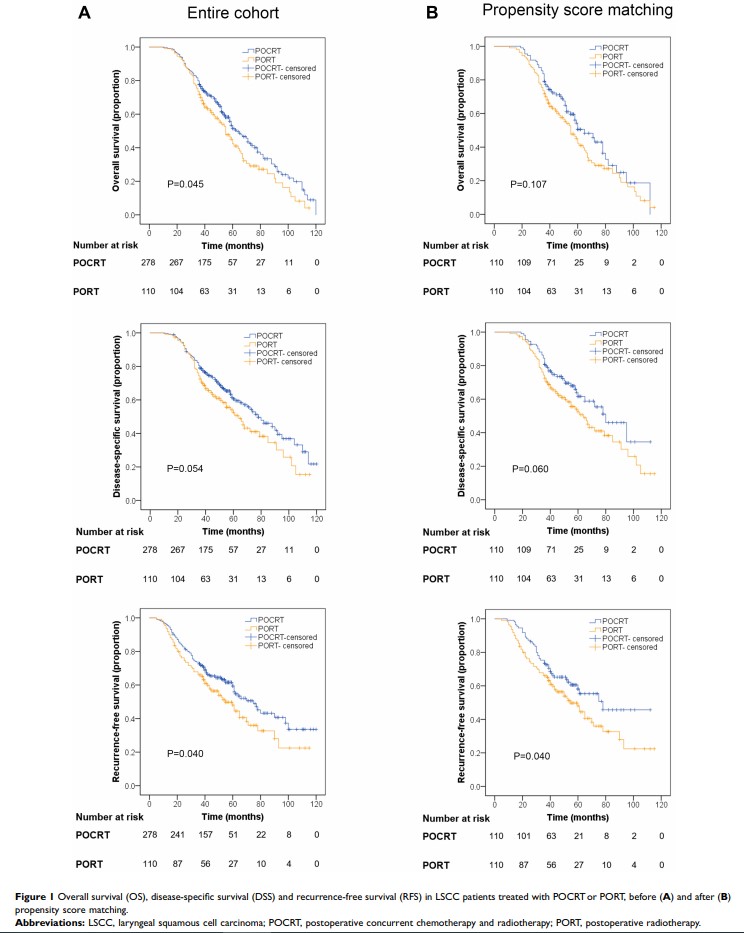
Results: Five-year overall survival (OS), disease-specific survival (DSS), and recurrence-free survival (RFS) of all patients were 48.7%, 58.2%, and 56.0%, respectively. Significantly, higher RFS rates (P=0.040) were found in the POCRT group than the PORT group in the PSM cohort. In the multivariate analysis, higher OS, DSS, and RFS rates were observed in the POCRT group than the PORT group (P=0.049, 0.024, and 0.011 respectively). Patients in the POCRT group presented more acute toxicities than those in the PORT group such as hematological toxicities (25.0% vs 0.9%, P< 0.001) and mucositis (35.0% vs 19.1%, P=0.002).
Conclusion: In the context of no ideal treatment for LSCC patients with lymphovascular invasion, the present study proposes POCRT as a preferable modality compared with PORT, as POCRT was associated with higher RFS rates. Higher RFS, DFS, and OS rates were also observed in the POCRT group in the multivariate analysis.
Keywords: head and neck carcinoma, larynx carcinoma, lymphovascular invasion, propensity score, chemoradiotherapy, survival