115195
论文已发表
注册即可获取德孚的最新动态
IF 收录期刊
- 3.6 Breast Cancer (Dove Med Press)
- 4.3 Clin Epidemiol
- 2.6 Cancer Manag Res
- 3.2 Infect Drug Resist
- 4.1 Clin Interv Aging
- 6.1 Drug Des Dev Ther
- 4.1 Int J Chronic Obstr
- 8.7 Int J Nanomed
- 2.5 Int J Women's Health
- 3.2 Neuropsych Dis Treat
- 2.4 OncoTargets Ther
- 2.6 Patient Prefer Adher
- 2.6 Ther Clin Risk Manag
- 3.1 J Pain Res
- 3.5 Diabet Metab Synd Ob
- 4.5 Psychol Res Behav Ma
- 3.4 Nat Sci Sleep
- 2.4 Pharmgenomics Pers Med
- 2.6 Risk Manag Healthc Policy
- 4.6 J Inflamm Res
- 2.3 Int J Gen Med
- 3.9 J Hepatocell Carcinoma
- 3.3 J Asthma Allergy
- 2.5 Clin Cosmet Investig Dermatol
- 3.0 J Multidiscip Healthc

原位静电纺丝用于肠道止血
Authors Zhou T, Wang Y, Lei F, Yu J
Received 11 December 2019
Accepted for publication 9 April 2020
Published 29 May 2020 Volume 2020:15 Pages 3869—3875
DOI https://doi.org/10.2147/IJN.S241909
Checked for plagiarism Yes
Review by Single-blind
Peer reviewer comments 3
Editor who approved publication: Dr Mian Wang
Introduction: During routine surgery, rapid hemostasis, especially the rapid hemostasis of internal organs, is very important. The emergence of in-situ electrospinning technology has fundamentally solved this problem. It exhibits a high speed of hemostasis, and no bleeding occurs after surgery. Thus, it is of great significance. The use of sutures in some human organs, such as the intestines and bladder, is inadequate because fluid leakage occurs due to the presence of pinholes.
Methods: Three types of large intestine wounds with an opening of about 1 cm were investigated. They were untreated, treated by needle and threaded, and treated by hand-held electrospinning, respectively.
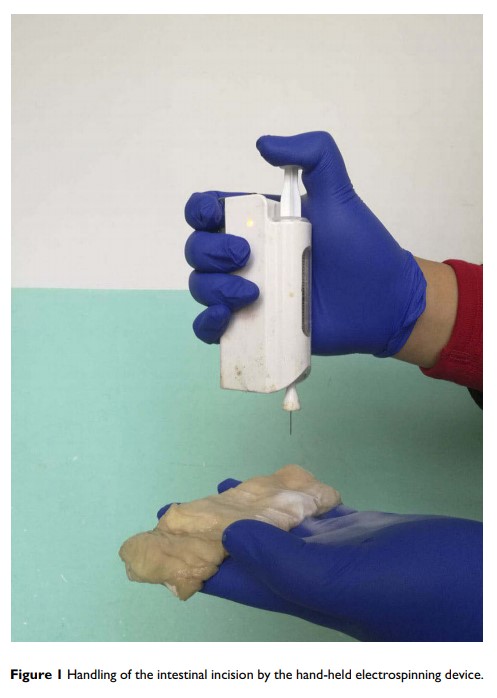
Results: The results show that hand-held electrospinning technique effectively prevented the exudation of fluids in the intestinal tract. The average diameter of the nanofibrous membrane was about 0.5 μm with hole of several micrometers. It can be elongated 90% without breakage. The hand-held electrospinning device could be used with nitrile gloves, preventing the risk of infection caused by exposed hands.
Discussion: This work can provide a reference for future animal experiments and clinical experiments. However, safety should be investigated before application.
Keywords: electrospinning, hemostasis, nanofibers