115195
论文已发表
注册即可获取德孚的最新动态
IF 收录期刊
- 3.6 Breast Cancer (Dove Med Press)
- 4.3 Clin Epidemiol
- 2.6 Cancer Manag Res
- 3.2 Infect Drug Resist
- 4.1 Clin Interv Aging
- 6.1 Drug Des Dev Ther
- 4.1 Int J Chronic Obstr
- 8.7 Int J Nanomed
- 2.5 Int J Women's Health
- 3.2 Neuropsych Dis Treat
- 2.4 OncoTargets Ther
- 2.6 Patient Prefer Adher
- 2.6 Ther Clin Risk Manag
- 3.1 J Pain Res
- 3.5 Diabet Metab Synd Ob
- 4.5 Psychol Res Behav Ma
- 3.4 Nat Sci Sleep
- 2.4 Pharmgenomics Pers Med
- 2.6 Risk Manag Healthc Policy
- 4.6 J Inflamm Res
- 2.3 Int J Gen Med
- 3.9 J Hepatocell Carcinoma
- 3.3 J Asthma Allergy
- 2.5 Clin Cosmet Investig Dermatol
- 3.0 J Multidiscip Healthc

胃癌伴神经内分泌分化(NEDGC)患者的临床病理特征和预后因素
Authors Wang YP, Hong J, Wang J, Bei YB, Hao HK, Hua LC
Received 9 March 2020
Accepted for publication 13 May 2020
Published 3 June 2020 Volume 2020:12 Pages 4217—4225
DOI https://doi.org/10.2147/CMAR.S253175
Checked for plagiarism Yes
Review by Single-blind
Peer reviewer comments 2
Editor who approved publication: Dr Eileen O'Reilly
Aim: Gastric carcinoma with neuroendocrine differentiation (NEDGC) is a relatively rare pathologic diagnosis in clinical practice, which has no specific guidelines or treatment recommendations yet. In this study, we aim to investigate the clinicopathological characteristics and prognostic factors of this disease.
Patients and Methods: We retrospectively analyzed clinicopathological data from a series of 82 NEDGC patients who underwent surgery for gastrectomy at Huashan Hospital Fudan University between January 2007 and December 2018. Furthermore, a series of 50 cases were used to analyze 3-year overall survival (OS).
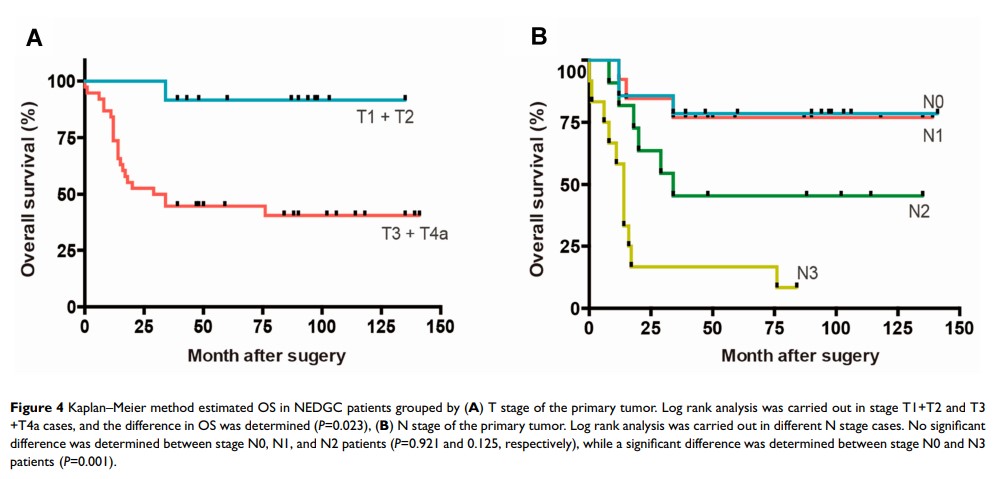
Results: Ages of the patients ranged from 26 to 83 years (M:F, 4.8:1). The majority of patients suffered from some symptoms (97.6%), as the most common one was abdominal pain (48.8%). Most of the tumors were ≥ 5 cm (53.7%), in the lower part of the stomach (47.5%), and with advanced T (87.8% ≥T3) and N (67.1% ≥N1) stage. As to the neuroendocrine markers, Syn showed a slight advantage on sensitivity than CgA (79.3 and 75.6%, respectively). The 3-year OS was 54%. Advanced T stage (≥T3) of the primary tumor, positive lymphovascular invasion (LVI), large tumor size (5.5cm), high neutrophil-to-lymphocyte ratio (NLR, 2.51), and low prealbumin level (173.87 mg/L) were associated with inferior OS based on the univariate analysis. Low preoperative hemoglobin level (113.87g/L), laparoscopic-assisted gastrectomy, and advanced N stage (N3) were three independent risk factors for 3-year OS of NEDGC patients in both univariate and multivariate analysis.
Conclusion: The TN staging system for gastric adenocarcinoma also has a prognostic value for NEDGC patients, while N3 stage works as an independent predictor of patients’ survival. Since most of the NEDGC patients were in advanced stage, proper indications to perform operative laparoscopy should be selected.
Keywords: gastric cancer, neuroendocrine cell differentiation, prognosis, surgical treatment