115195
论文已发表
注册即可获取德孚的最新动态
IF 收录期刊
- 3.6 Breast Cancer (Dove Med Press)
- 4.3 Clin Epidemiol
- 2.6 Cancer Manag Res
- 3.2 Infect Drug Resist
- 4.1 Clin Interv Aging
- 6.1 Drug Des Dev Ther
- 4.1 Int J Chronic Obstr
- 8.7 Int J Nanomed
- 2.5 Int J Women's Health
- 3.2 Neuropsych Dis Treat
- 2.4 OncoTargets Ther
- 2.6 Patient Prefer Adher
- 2.6 Ther Clin Risk Manag
- 3.1 J Pain Res
- 3.5 Diabet Metab Synd Ob
- 4.5 Psychol Res Behav Ma
- 3.4 Nat Sci Sleep
- 2.4 Pharmgenomics Pers Med
- 2.6 Risk Manag Healthc Policy
- 4.6 J Inflamm Res
- 2.3 Int J Gen Med
- 3.9 J Hepatocell Carcinoma
- 3.3 J Asthma Allergy
- 2.5 Clin Cosmet Investig Dermatol
- 3.0 J Multidiscip Healthc

UPF3a 表达在人大肠癌中的功能及其临床意义
Authors Bao X, Huang Y, Xu W, Xiong G
Received 2 January 2020
Accepted for publication 19 April 2020
Published 8 June 2020 Volume 2020:12 Pages 4271—4281
DOI https://doi.org/10.2147/CMAR.S244486
Checked for plagiarism Yes
Review by Single-blind
Peer reviewer comments 2
Editor who approved publication: Dr Sanjeev Srivastava
Background: Nonsense-mediated mRNA decay (NMD) can degrade mRNAs with a premature termination codon (PTC), and undegraded mRNAs with PTC mutations can induce a genetic compensation response (GCR) by upregulating its compensatory genes. UPF3a refers to up-frame shift 3A (UPF3a) participating in NMD pathway and GCR. It inhibits the NMD pathway while it stimulates GCR. Notably, the role of UPF3a in cancer remains unclear.
Purpose: The identification and discovery of prognostic markers for colorectal cancer (CRC) are of great clinical significance. The aim of this study was to investigate clinical significance of UPF3a expression in CRC.
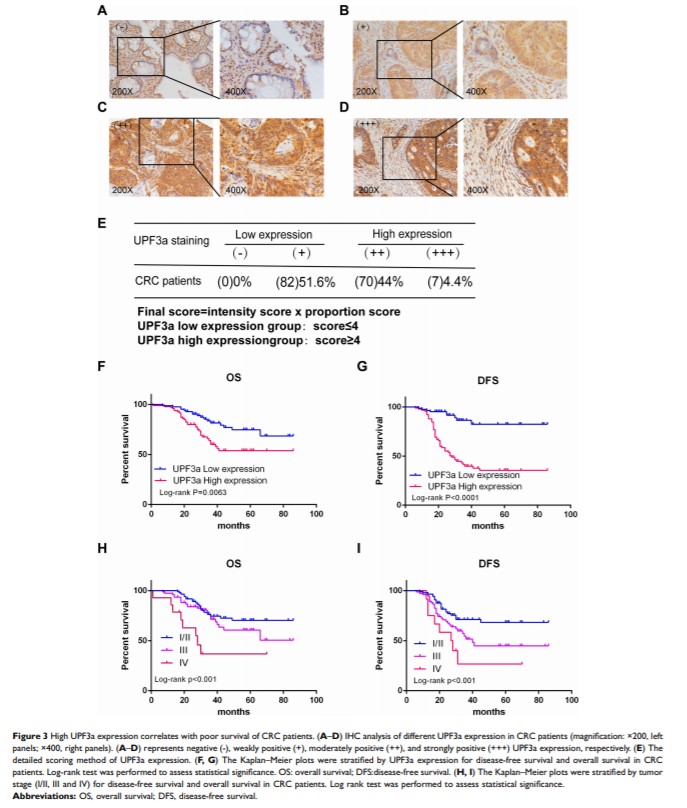
Materials and Methods: UPF3a expression was examined in fresh CRC tissues and pared distant metastatic tissues using quantitative real-time PCR, Western blotting and immunohistochemistry staining. Tissue microarray immunohistochemical staining was used to study the relationship of UPF3a with clinicopathological features in 158 CRC patient samples collected from January 2008 to December 2012, and prognosis of CRC was analyzed.
Results: The expression of UPF3a was higher in metastatic tissues than that in primary sites. Moreover, high expression of UPF3a was significantly associated with TNM stage (p=0.009), liver metastasis and recurrence (p< 0.001) in CRC patients. The Cancer Genome Atlas (TCGA) database showed the same trend. In CRC cells, knockdown of UPF3a led to a decline in the migration potential. Kaplan–Meier survival analysis revealed that high UPF3a expression, TNM stage were significantly associated (all P< 0.01) with poor prognosis for patients. Furthermore, univariate and multivariate Cox analysis revealed that high UPF3a expression was independent risk factor for both overall survival and disease-free survival of CRC patients (all P< 0.01).
Conclusion: Results showed that high levels of UPF3a could lead to aggressiveness and poor CRC prognosis. Targeted UPF3a can act as a novel and effective gene therapy for CRC patients to make a better prognosis.
Keywords: UPF3a, colorectal cancer, TCGA, NMD pathway, genetic compensation response, metastasis