115195
论文已发表
注册即可获取德孚的最新动态
IF 收录期刊
- 3.6 Breast Cancer (Dove Med Press)
- 4.3 Clin Epidemiol
- 2.6 Cancer Manag Res
- 3.2 Infect Drug Resist
- 4.1 Clin Interv Aging
- 6.1 Drug Des Dev Ther
- 4.1 Int J Chronic Obstr
- 8.7 Int J Nanomed
- 2.5 Int J Women's Health
- 3.2 Neuropsych Dis Treat
- 2.4 OncoTargets Ther
- 2.6 Patient Prefer Adher
- 2.6 Ther Clin Risk Manag
- 3.1 J Pain Res
- 3.5 Diabet Metab Synd Ob
- 4.5 Psychol Res Behav Ma
- 3.4 Nat Sci Sleep
- 2.4 Pharmgenomics Pers Med
- 2.6 Risk Manag Healthc Policy
- 4.6 J Inflamm Res
- 2.3 Int J Gen Med
- 3.9 J Hepatocell Carcinoma
- 3.3 J Asthma Allergy
- 2.5 Clin Cosmet Investig Dermatol
- 3.0 J Multidiscip Healthc

靶向 STAT3 的新型纳米复合物在体内表现出有前景的抗卵巢癌作用
Authors Zhang X, Lu T, Ma Y, Li R, Pang Y, Mao H, Liu P
Received 27 January 2020
Accepted for publication 6 May 2020
Published 8 June 2020 Volume 2020:13 Pages 5069—5082
DOI https://doi.org/10.2147/OTT.S247398
Checked for plagiarism Yes
Review by Single-blind
Peer reviewer comments 2
Editor who approved publication: Dr Federico Perche
Background: Cationic solid lipid nanoparticles (SLN) have attracted intensive interest as an effective gene delivery system for its high biocompatibility, stability and low cytotoxicity. In our previous study, we successfully prepared SLN-STAT3 decoy ODN complexes and made a primary study on its antitumor behavior in ovarian cancer cells in vitro. However, there is little information available so far about the effect of SLN-STAT3 decoy ODN complexes on ovarian cancer in vivo, either little information about the pharmacological toxicology in vivo.
Material and Methods: We applied nanotechnology to improve the gene delivery system and synthesize SLN-STAT3 decoy ODN complexes. Xenograft mouse models were established to assess the antitumor effects of SLN-STAT3 decoy ODN on the tumor growth of ovarian cancer in vivo. To analyze the mechanisms of SLN-STAT3 decoy ODN, we investigated apoptosis, autophagy, epithelial–mesenchymal transition (EMT) in tumor tissues of nude mice and investigated the effects and toxicology of SLN-STAT3 decoy ODN complexes on the vital organs of nude mice.
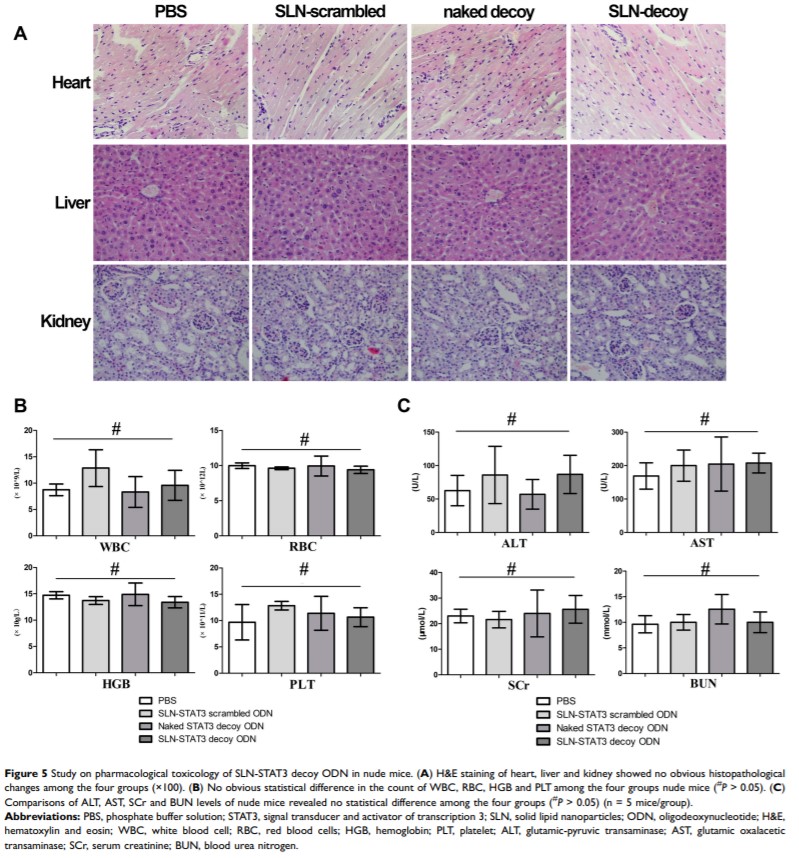
Results: The results showed that SLN-STAT3 decoy ODN complexes markedly inhibited tumor growth in vivo. SLN-STAT3 decoy ODN complexes could induce cell apoptosis through downregulating Bcl-2, survivin and pro caspase 3, but upregulating Bax and cleaved caspase 3. These complexes could also regulate autophagy through upregulating LC3A-II, LC3B-II and beclin-1, but downregulating p-Akt and p-mTOR. Moreover, these complexes could inhibit cancer cell invasion through reversing EMT. Besides, SLN-STAT3 decoy ODN complexes showed no obvious toxicity on vital organs and hematological parameters of nude mice.
Conclusion: The molecular mechanisms that SLN-STAT3 decoy ODN complexes inhibit tumor growth involved activating the apoptotic cascade, regulating autophagy, and reversing EMT program; and these complexes showed no obvious toxicity on nude mice. Our study indicated that the nanocomplexes SLN-STAT3 decoy ODN might be a promising therapeutic approach for ovarian cancer treatment.
Keywords: STAT3, decoy ODN, SLN, ovarian cancer, in vivo