115195
论文已发表
注册即可获取德孚的最新动态
IF 收录期刊
- 3.6 Breast Cancer (Dove Med Press)
- 4.3 Clin Epidemiol
- 2.6 Cancer Manag Res
- 3.2 Infect Drug Resist
- 4.1 Clin Interv Aging
- 6.1 Drug Des Dev Ther
- 4.1 Int J Chronic Obstr
- 8.7 Int J Nanomed
- 2.5 Int J Women's Health
- 3.2 Neuropsych Dis Treat
- 2.4 OncoTargets Ther
- 2.6 Patient Prefer Adher
- 2.6 Ther Clin Risk Manag
- 3.1 J Pain Res
- 3.5 Diabet Metab Synd Ob
- 4.5 Psychol Res Behav Ma
- 3.4 Nat Sci Sleep
- 2.4 Pharmgenomics Pers Med
- 2.6 Risk Manag Healthc Policy
- 4.6 J Inflamm Res
- 2.3 Int J Gen Med
- 3.9 J Hepatocell Carcinoma
- 3.3 J Asthma Allergy
- 2.5 Clin Cosmet Investig Dermatol
- 3.0 J Multidiscip Healthc

一项回顾性队列研究所显示的,术前血浆 D-二聚体水平对上尿路上皮癌患者的预后价值
Authors Chen X, Ji H, Wang J, Zhao G, Zheng B, Niu Z, He W
Received 1 April 2020
Accepted for publication 13 May 2020
Published 8 June 2020 Volume 2020:13 Pages 5047—5055
DOI https://doi.org/10.2147/OTT.S254514
Checked for plagiarism Yes
Review by Single-blind
Peer reviewer comments 2
Editor who approved publication: Prof. Dr. Nicola Silvestris
Purpose: Elevated plasma D-dimer levels were thought to be associated with decreasing survival in various cancers. The relationship between plasma D-dimer levels and clinicopathology and the optimal D-dimer cutoff as a prognostic predictor has not been determined in patients with upper tract urothelial carcinoma (UTUC). We aimed to investigate the prognostic value of preoperative plasma D-dimer levels as a predictor of patient outcomes in UTUC following radical nephroureterectomy.
Patients and Methods: We retrospectively reviewed data for 232 patients. The D-dimer cutoff value was set at 0.36 mg/L, and we used the Kaplan–Meier method and Cox’s proportional hazards regression models to analyze the association between D-dimer levels and oncological outcomes. Multivariate Cox regression was used to develop a nomogram, which we evaluated for accuracy using a receiver operating characteristic curve, calibration plot, and decision curve analysis.
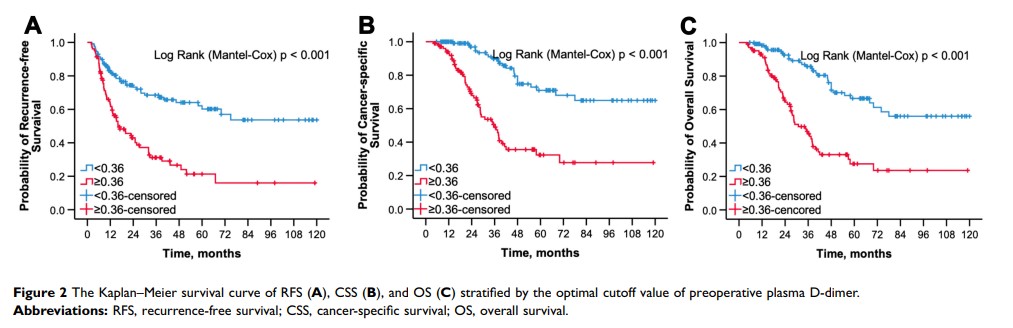
Results: Plasma D-dimer levels ≥ 0.36 mg/L were significantly associated with advanced tumor status regarding size, location, hydronephrosis, tumor grade, lymph node involvement, grade, and stage (all p < 0.05). The Kaplan–Meier analysis showed that plasma D-dimer levels ≥ 0.36 mg/L predicted worse oncological outcomes vs levels < 0.36 mg/L (all p < 0.001). Univariate and multivariate analyses showed that elevated preoperative plasma D-dimer level was an independent predictor of recurrence-free survival (hazard ratio (HR): 1.67, 95% confidence interval (CI): 1.07– 2.63; p = 0.025), cancer-specific survival (HR: 2.34, 95% CI: 1.30– 4.19; p = 0.004), and overall survival (HR: 1.98, 95% CI: 1.18– 3.34; p = 0.010). We also developed a nomogram predicting 3- and 5-year overall survival probability.
Conclusion: D-dimer levels may be a useful prognostic predictor of survival and improve risk stratification and precisely individualize treatment for patients with UTUC.
Keywords: urothelial carcinoma, upper urinary tract, prognosis, predictors, D-dimer, nomogram