115195
论文已发表
注册即可获取德孚的最新动态
IF 收录期刊
- 3.6 Breast Cancer (Dove Med Press)
- 4.3 Clin Epidemiol
- 2.6 Cancer Manag Res
- 3.2 Infect Drug Resist
- 4.1 Clin Interv Aging
- 6.1 Drug Des Dev Ther
- 4.1 Int J Chronic Obstr
- 8.7 Int J Nanomed
- 2.5 Int J Women's Health
- 3.2 Neuropsych Dis Treat
- 2.4 OncoTargets Ther
- 2.6 Patient Prefer Adher
- 2.6 Ther Clin Risk Manag
- 3.1 J Pain Res
- 3.5 Diabet Metab Synd Ob
- 4.5 Psychol Res Behav Ma
- 3.4 Nat Sci Sleep
- 2.4 Pharmgenomics Pers Med
- 2.6 Risk Manag Healthc Policy
- 4.6 J Inflamm Res
- 2.3 Int J Gen Med
- 3.9 J Hepatocell Carcinoma
- 3.3 J Asthma Allergy
- 2.5 Clin Cosmet Investig Dermatol
- 3.0 J Multidiscip Healthc

原发性胃肠道非霍奇金淋巴瘤的回顾性分析:临床特征、预后因素和治疗结果
Received 4 February 2020
Accepted for publication 21 May 2020
Published 10 June 2020 Volume 2020:13 Pages 5345—5352
DOI https://doi.org/10.2147/OTT.S248381
Checked for plagiarism Yes
Review by Single-blind
Peer reviewer comments 2
Editor who approved publication: Dr Tohru Yamada
Introduction: Primary gastrointestinal non-Hodgkin lymphoma (PGIL) is a rare hematopoietic malignancy with limited data to guide management.
Methods: We analyzed the clinical characteristics and survival of 219 newly diagnosed PGIL patients.
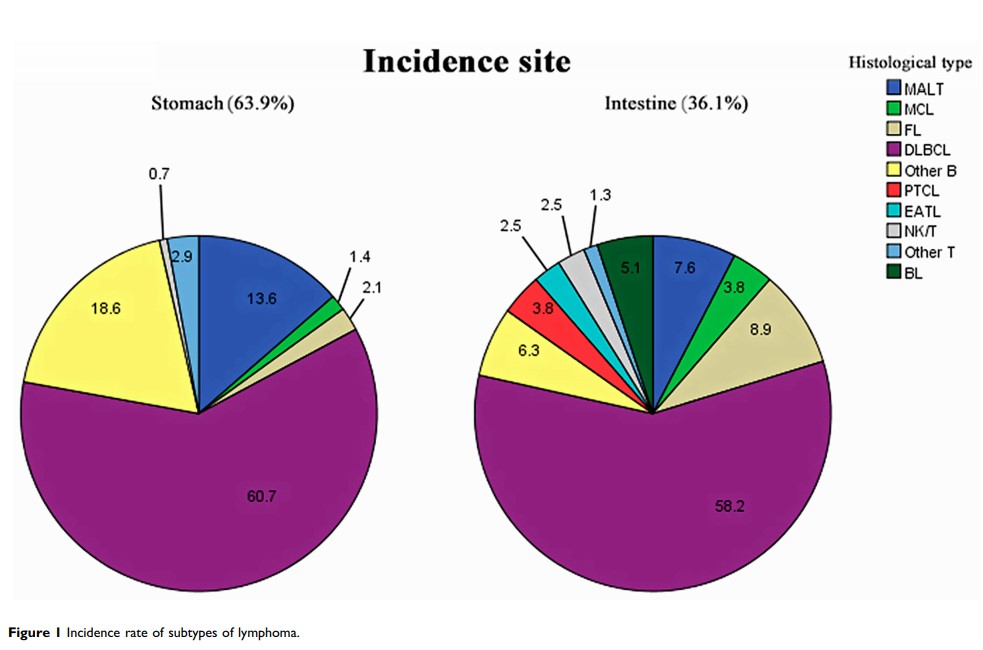
Results: Our single-center data showed that the incidence rate of primary gastric lymphoma (PGL) was higher than that of primary intestine lymphoma (PIL). Most PGIL was B-cell originated and DLBCL was the most common pathological type both in PGL and PIL group. Univariate and multivariate analysis showed that IPI score and pathology were independent prognostic factors. The overall survival (OS) and progression-free survival (PFS) of patients with MYC rearrangement were much shorter compared to patients without MYC rearrangement indicating that MYC translocation was related to decreased survival. Neither OS nor PFS differed between patients who received chemotherapy with or without surgery. However, patients who received surgery alone had a poor prognosis.
Conclusion: Chemotherapy is the front-line treatment for PGIL while surgery was conducted to relieve tumor-related complications or make diagnosis. MYC rearrangement predicted poor prognosis of PGIL patients.
Keywords: primary gastrointestinal lymphomas, prognosis, MYC rearrangement