115195
论文已发表
注册即可获取德孚的最新动态
IF 收录期刊
- 3.6 Breast Cancer (Dove Med Press)
- 4.3 Clin Epidemiol
- 2.6 Cancer Manag Res
- 3.2 Infect Drug Resist
- 4.1 Clin Interv Aging
- 6.1 Drug Des Dev Ther
- 4.1 Int J Chronic Obstr
- 8.7 Int J Nanomed
- 2.5 Int J Women's Health
- 3.2 Neuropsych Dis Treat
- 2.4 OncoTargets Ther
- 2.6 Patient Prefer Adher
- 2.6 Ther Clin Risk Manag
- 3.1 J Pain Res
- 3.5 Diabet Metab Synd Ob
- 4.5 Psychol Res Behav Ma
- 3.4 Nat Sci Sleep
- 2.4 Pharmgenomics Pers Med
- 2.6 Risk Manag Healthc Policy
- 4.6 J Inflamm Res
- 2.3 Int J Gen Med
- 3.9 J Hepatocell Carcinoma
- 3.3 J Asthma Allergy
- 2.5 Clin Cosmet Investig Dermatol
- 3.0 J Multidiscip Healthc

宫颈癌新辅助化疗后行机器人辅助全子宫切除术的围手术期并发症和安全性评估
Authors Chang WF, Luo AJ, Yuan YF, Chen Y, Xin ZR, Xu SS
Received 28 December 2019
Accepted for publication 22 May 2020
Published 12 June 2020 Volume 2020:12 Pages 4483—4492
DOI https://doi.org/10.2147/CMAR.S243986
Checked for plagiarism Yes
Review by Single-blind
Peer reviewer comments 3
Editor who approved publication: Dr Sanjeev Srivastava
Purpose: To evaluate the perioperative complications of patients with cervical cancer who are treated with robot-assisted radical hysterectomy (RRH) and to further evaluate the safety of patients undergoing NACT.
Methods: A total of 805 consecutive cervical cancer patients undergoing RRH were involved in this report. Their clinical characteristics were retrieved from hospital medical records. Perioperative complications were subdivided into intraoperative and postoperative complications, which were graded according to the Clavien–Dindo classification (CDC), and the complications of grade III and above were defined as severe complications. Furthermore, the two-level logistic regression model was used to estimate the risk factors of perioperative and severe complications and to further confirm the relationship between NACT and perioperative and severe complications.
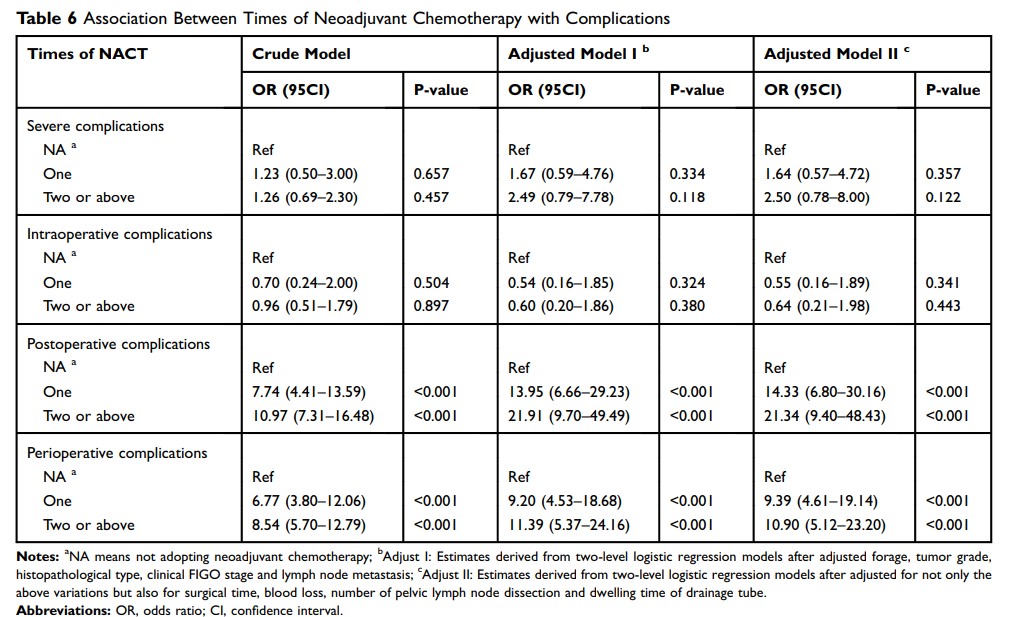
Results: The perioperative complication rate and severe complications were 45.09% and 7.83%, respectively. Poorly differentiated tumor and NACT were identified as independent risk factors for perioperative complications by multifactor analysis. Furthermore, we concentrated on the relations between NACT and complications. The risk of perioperative complications of the group with NACT (OR = 11.08, 95% CI: 5.70– 21.54) was significantly higher than the group without NACT, especially in postoperative complications (OR=17.65, 95% CI: 8.63– 36.08), even after adjusting confounding factors. However, there was no statistically significant difference in terms of severe complications (OR=1.68, 95% CI: 0.64– 4.41) and intraoperative complications (OR=0.51, 95% CI: 0.18– 1.41). Moreover, as the times of NACT increase, the impact on perioperative complications is more pronounced. A similar trend was observed in postoperative complications, while this statistical difference was still not observed in intraoperative and severe complications.
Conclusion: This result demonstrates the feasibility and safety of RRH of cervical carcinoma after NACT in generally, since it only causes mild complications, not severe complications.
Keywords: cervical carcinoma, robot-assisted radical hysterectomy, neoadjuvant chemotherapy, Clavien–Dindo classification, perioperative complications