115195
论文已发表
注册即可获取德孚的最新动态
IF 收录期刊
- 3.6 Breast Cancer (Dove Med Press)
- 4.3 Clin Epidemiol
- 2.6 Cancer Manag Res
- 3.2 Infect Drug Resist
- 4.1 Clin Interv Aging
- 6.1 Drug Des Dev Ther
- 4.1 Int J Chronic Obstr
- 8.7 Int J Nanomed
- 2.5 Int J Women's Health
- 3.2 Neuropsych Dis Treat
- 2.4 OncoTargets Ther
- 2.6 Patient Prefer Adher
- 2.6 Ther Clin Risk Manag
- 3.1 J Pain Res
- 3.5 Diabet Metab Synd Ob
- 4.5 Psychol Res Behav Ma
- 3.4 Nat Sci Sleep
- 2.4 Pharmgenomics Pers Med
- 2.6 Risk Manag Healthc Policy
- 4.6 J Inflamm Res
- 2.3 Int J Gen Med
- 3.9 J Hepatocell Carcinoma
- 3.3 J Asthma Allergy
- 2.5 Clin Cosmet Investig Dermatol
- 3.0 J Multidiscip Healthc

miR-423 通过激活 NF-κB 信号传导促进乳腺癌侵袭
Authors Dai T, Zhao X, Li Y, Yu L, Li Y, Zhou X, Gong Q
Received 29 October 2019
Accepted for publication 19 April 2020
Published 12 June 2020 Volume 2020:13 Pages 5467—5478
DOI https://doi.org/10.2147/OTT.S236514
Checked for plagiarism Yes
Review by Single-blind
Peer reviewer comments 3
Editor who approved publication: Prof. Dr. Nicola Silvestris
Objective: Breast cancer has become the most common malignancy among women worldwide; therefore, novel diagnostic and prognostic markers and therapeutic targets are urgently required. NF-κB signaling plays a pivotal role in enhancing breast cancer malignant phenotypes, especially cancer invasion and metastasis, which is the main cause of death in cancer patients. TNIP2, an important inhibitor of the NF-κB pathway, is known to involve a negative feedback loop of the NF-κB signaling cascade and to regulate tumor aggressiveness in various cancer types. However, the mRNA level of TNIP2 is barely altered in breast cancer; thus, the mechanism that regulates TNIP2 in breast cancer still needs to be elucidated.
Methods: We analyzed the expression and prognosis of miR-423 in a TCGA BRCA miRNA cohort and in clinical specimens. We detected the invasive capacity through a Matrigel-coated Transwell penetration assay, a three-dimensional (3D) spheroid invasion assay and a wound healing assay. Then, we applied luciferase assays, real-time PCR assays and Western blotting to further study the mechanism.
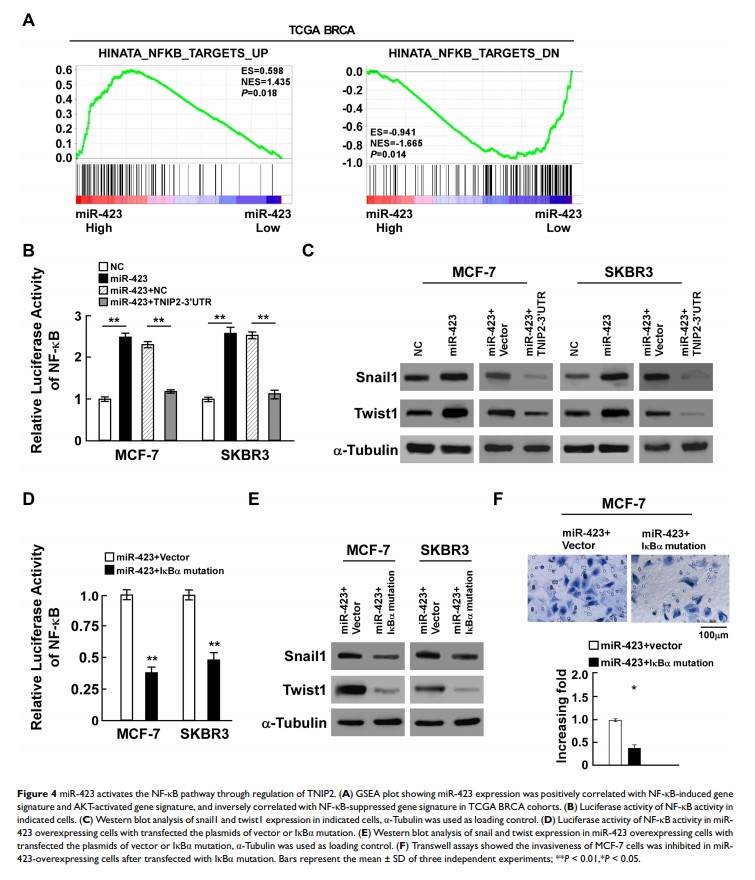
Results: In this study, analysis of the TCGA BRCA miRNA cohort and clinical specimens demonstrated that miR-423 was upregulated in human breast cancers and was positively correlated with clinical stage, poor overall survival and metastasis classification. Moreover, the invasiveness of breast cancer cells was enhanced by ectopic expression of miR-423 and inhibited by miR-423 downregulation. Mechanistically, upregulation of miR-423 led to activation of the NF-κB signaling pathway and elevated expression of snail and twist, while repression of miR-423 inhibited this pathway. Furthermore, the results indicated that TNIP2 is a target gene of miR-423, and suppression of TNIP2 resulted in increased invasiveness in miR-423-silenced cells.
Conclusion: Our results suggest that miR-423 is a crucial factor that enhances breast cancer cell invasion through the NF-κB signaling pathway and shed light on miR-423 as a promising prognostic and therapeutic marker for metastatic breast cancer.
Keywords: breast cancer, miR-423, TNIP2, NF-κB signaling pathway