115195
论文已发表
注册即可获取德孚的最新动态
IF 收录期刊
- 3.6 Breast Cancer (Dove Med Press)
- 4.3 Clin Epidemiol
- 2.6 Cancer Manag Res
- 3.2 Infect Drug Resist
- 4.1 Clin Interv Aging
- 6.1 Drug Des Dev Ther
- 4.1 Int J Chronic Obstr
- 8.7 Int J Nanomed
- 2.5 Int J Women's Health
- 3.2 Neuropsych Dis Treat
- 2.4 OncoTargets Ther
- 2.6 Patient Prefer Adher
- 2.6 Ther Clin Risk Manag
- 3.1 J Pain Res
- 3.5 Diabet Metab Synd Ob
- 4.5 Psychol Res Behav Ma
- 3.4 Nat Sci Sleep
- 2.4 Pharmgenomics Pers Med
- 2.6 Risk Manag Healthc Policy
- 4.6 J Inflamm Res
- 2.3 Int J Gen Med
- 3.9 J Hepatocell Carcinoma
- 3.3 J Asthma Allergy
- 2.5 Clin Cosmet Investig Dermatol
- 3.0 J Multidiscip Healthc

LINC01224 通过 microRNA-485-5p 介导的 PAK4 上调在卵巢上皮癌中表现出促癌活性
Authors Xing S, Zhang Y, Zhang J
Received 19 March 2020
Accepted for publication 12 May 2020
Published 16 June 2020 Volume 2020:13 Pages 5643—5655
DOI https://doi.org/10.2147/OTT.S254662
Checked for plagiarism Yes
Review by Single-blind
Peer reviewer comments 2
Editor who approved publication: Dr XuYu Yang
Purpose: Long intergenic non-protein coding RNA 1224 (LINC01224) plays vital roles in the tumorigenesis and progression of hepatocellular carcinoma. Here, we determined LINC01224 expression in epithelial ovarian cancer (EOC) tissues and cells. We also assessed the effects of LINC01224 knockdown on the malignant phenotype of EOC cells both in vitro and in vivo. Furthermore, the detailed molecular mechanisms underlying the oncogenic actions of LINC01224 in EOC cells were elucidated.
Methods: Quantitative real-time polymerase chain reaction (qRT-PCR) was used to detect LINC01224 expression in EOC tissues and cells. EOC cells were transfected with small interfering RNAs, and cell proliferation, apoptosis, migration, and invasion were assessed using Cell Counting Kit-8 assay, flow cytometry, cell migration assays, and cell invasion assays, respectively. Using tumor xenografts, the effects of LINC01224 silencing on EOC tumor growth were analyzed in vivo. The mechanism underlying LINC01224 regulation of malignant processes in EOC cells was explored using bioinformatics, RNA immunoprecipitation assay, qRT-PCR, Western blotting, and rescue experiments.
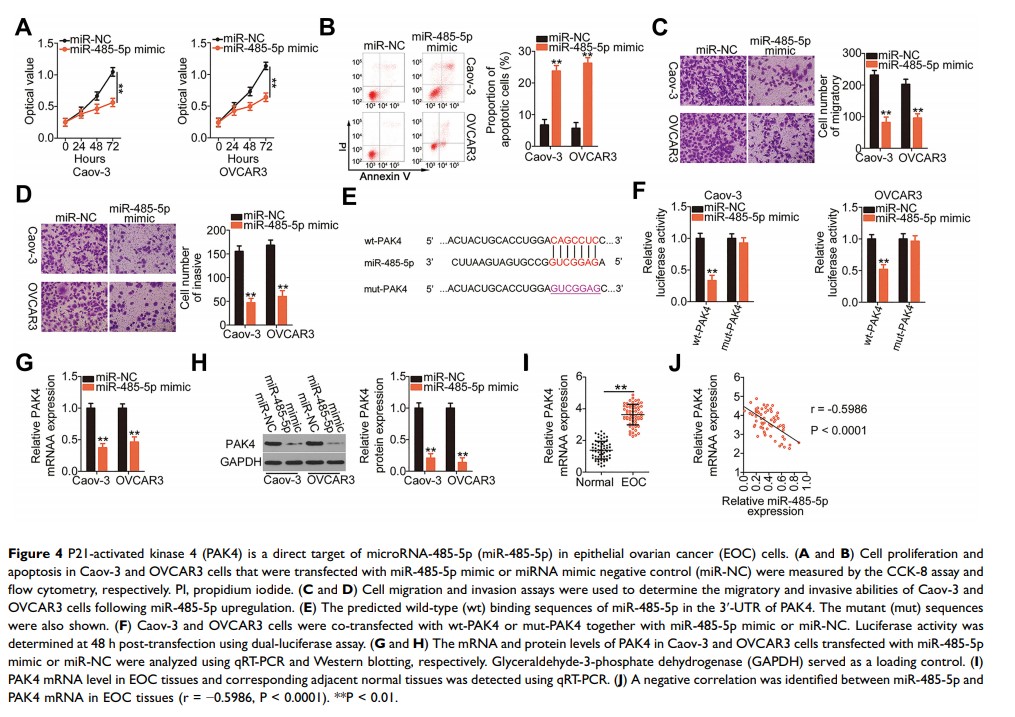
Results: LINC01224 expression was upregulated in EOC tissues and cells. LINC01224 upregulation was correlated to tumor size, the International Federation of Gynecology and Obstetrics stage, and lymph node metastasis. LINC01224 depletion in EOC cells suppressed cell proliferation, migration, and invasion and facilitated cell apoptosis in vitro. LINC01224 downregulation also hindered EOC tumor growth in vivo. Mechanistically, LINC01224 served as a competing endogenous RNA for microRNA-485-5p (miR-485-5p) and consequently increased p21-activated kinase 4 (PAK4) expression in EOC cells. Furthermore, miR-485-5p inhibition or PAK4 upregulation significantly abrogated the effects of LINC01224 depletion in EOC cells.
Conclusion: LINC01224/miR-485-5p/PAK4 formed a competing endogenous RNA network regulating the aggressive behavior of EOC. Therefore, targeting this pathway may be an attractive therapeutic strategy for EOC.
Keywords: long intergenic non-protein coding RNA 1224, p21-activated kinase 4, epithelial ovarian cancer, anticancer therapy