115195
论文已发表
注册即可获取德孚的最新动态
IF 收录期刊
- 3.6 Breast Cancer (Dove Med Press)
- 4.3 Clin Epidemiol
- 2.6 Cancer Manag Res
- 3.2 Infect Drug Resist
- 4.1 Clin Interv Aging
- 6.1 Drug Des Dev Ther
- 4.1 Int J Chronic Obstr
- 8.7 Int J Nanomed
- 2.5 Int J Women's Health
- 3.2 Neuropsych Dis Treat
- 2.4 OncoTargets Ther
- 2.6 Patient Prefer Adher
- 2.6 Ther Clin Risk Manag
- 3.1 J Pain Res
- 3.5 Diabet Metab Synd Ob
- 4.5 Psychol Res Behav Ma
- 3.4 Nat Sci Sleep
- 2.4 Pharmgenomics Pers Med
- 2.6 Risk Manag Healthc Policy
- 4.6 J Inflamm Res
- 2.3 Int J Gen Med
- 3.9 J Hepatocell Carcinoma
- 3.3 J Asthma Allergy
- 2.5 Clin Cosmet Investig Dermatol
- 3.0 J Multidiscip Healthc

分离自杨桃 L. 根的苯并醌通过抑制 TLR4/NF-κB 信号通路对链脲佐菌素诱导的糖尿病小鼠的保护作用
Authors Qin L, Zhang X, Zhou X, Wu X, Huang X, Chen M, Wu Y, Lu S, Zhang H, Xu X, Wei X, Zhang S, Huang R
Received 13 December 2019
Accepted for publication 19 May 2020
Published 22 June 2020 Volume 2020:13 Pages 2129—2138
DOI https://doi.org/10.2147/DMSO.S241998
Checked for plagiarism Yes
Review by Single-blind
Peer reviewer comments 3
Editor who approved publication: Dr Antonio Brunetti
Background: Studies have demonstrated that the roots of Averrhoa carambola L. (Oxalidaceae) , a traditional Chinese medicine, can be used to treat diabetes and diabetes-related diseases. Nevertheless, the potential beneficial effects and mechanism of benzoquinone isolated from the roots of Averrhoa carambola L. (BACR) on diabetes remain unclear.
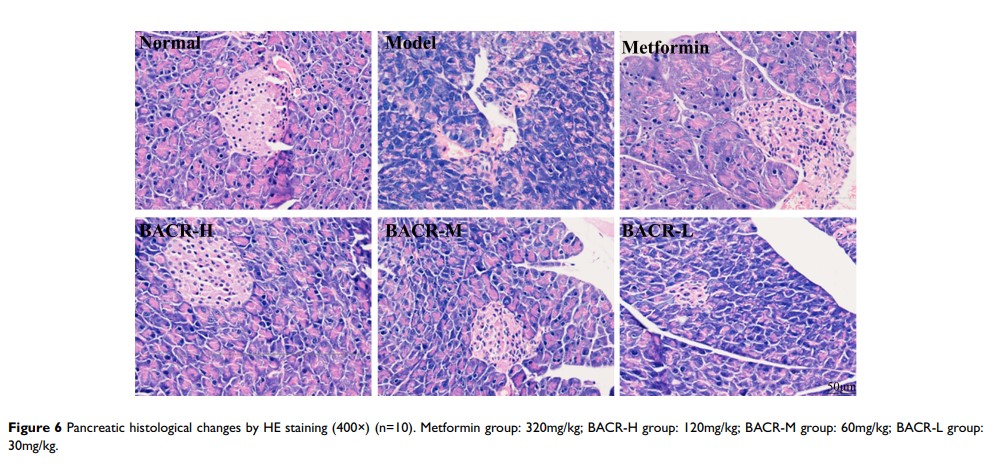
Methods: Diabetic Kunming mice were injected with STZ (120 mgkg− 1) in the tail vein. Fasting blood glucose (FBG) and the change of body weight were measured after oral administration of BACR (120, 60, 30 mg/kg/d) every week. The levels of the total cholesterol (TC), triglyceride (TG), free fatty acids (FFA), glucosylated hemoglobin (GHb), fasting insulin (FINS), tumor necrosis factor-α (TNF-α) and interleukin-6 (IL-6) were measured. The histological examination of pancreatic tissues and the TLR4/NF-κB pathway was analyzed by RT-PCR, immunohistochemistry and Western blot.
Results: The study found that clearly the BACR obviously reduced the blood glucose, serum lipids, GHb and FINS. In addition, BACR treatment markedly reduced the release of inflammatory factors, including IL-6 and TNF-α, and down-regulated the expression of the TLR4/NF-κB pathway.
Conclusion: BACR has potential benefits for the treatment of diabetes by ameliorating metabolic functions and attenuating the inflammatory response via inhibition of the activation of theTLR4/NF-κB pathway.
Keywords: benzoquinone of Averrhoa carambola L. root, diabetes, inflammation, TLR4/NF-κB pathway