115195
论文已发表
注册即可获取德孚的最新动态
IF 收录期刊
- 3.6 Breast Cancer (Dove Med Press)
- 4.3 Clin Epidemiol
- 2.6 Cancer Manag Res
- 3.2 Infect Drug Resist
- 4.1 Clin Interv Aging
- 6.1 Drug Des Dev Ther
- 4.1 Int J Chronic Obstr
- 8.7 Int J Nanomed
- 2.5 Int J Women's Health
- 3.2 Neuropsych Dis Treat
- 2.4 OncoTargets Ther
- 2.6 Patient Prefer Adher
- 2.6 Ther Clin Risk Manag
- 3.1 J Pain Res
- 3.5 Diabet Metab Synd Ob
- 4.5 Psychol Res Behav Ma
- 3.4 Nat Sci Sleep
- 2.4 Pharmgenomics Pers Med
- 2.6 Risk Manag Healthc Policy
- 4.6 J Inflamm Res
- 2.3 Int J Gen Med
- 3.9 J Hepatocell Carcinoma
- 3.3 J Asthma Allergy
- 2.5 Clin Cosmet Investig Dermatol
- 3.0 J Multidiscip Healthc

来自肺炎克雷伯菌的多药耐药质粒,载有 repA ,repB1 的 IncFIB 系列 pA1705-qnrS ,P911021-tetA 和 P1642-tetA 的结构基因组学
Authors Nazir A, Zhao Y, Li M, Manzoor R, Tahir RA, Zhang X, Qing H, Tong Y
Received 16 September 2019
Accepted for publication 26 December 2019
Published 22 June 2020 Volume 2020:13 Pages 1889—1903
DOI https://doi.org/10.2147/IDR.S228704
Checked for plagiarism Yes
Review by Single-blind
Peer reviewer comments 3
Editor who approved publication: Professor Suresh Antony
Background: Multidrug-resistant plasmids carrying replication genes have been widely present in various strains of Klebsiella pneumoniae. RepA and repB1 were found in plasmids belong to the IncFIB, but their detailed structural and genomic characterization was not reported yet. This is the first study that delivers structural and functional insights of repA- and repB1 -carrying IncFIB plasmids.
Methods: Klebsiella pneumoniae strains A1705, 911021, and 1642 were isolated from the human urine samples and bronchoalveolar fluids collected from different hospitals of China. Antibacterial susceptibility and plasmid transfer ability were tested to characterize the resistant phenotypes mediated by the pA1705-qnrS , p911021-tetA , and p1642-tetA . The complete nucleotide sequences of these plasmids were determined through high-throughput sequencing technology and comparative genomic analyses of plasmids belong to the same incompatibility group were executed to extract the genomic variations and features.
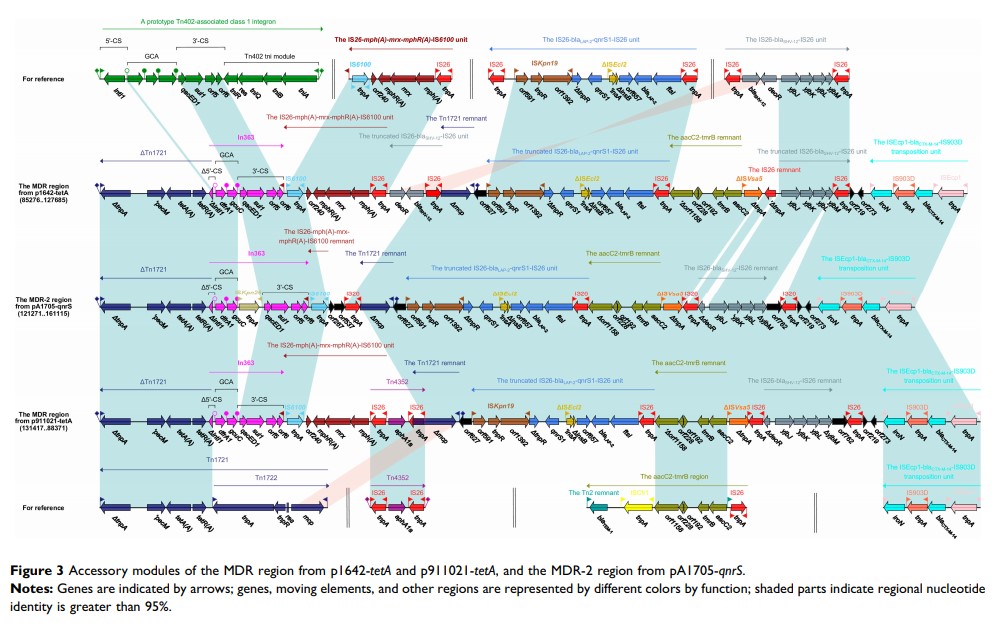
Results: The pA1705-qnrS , p911021-tetA , and p1642-tetA are defined as non-conjugative plasmids, having two replication genes, repA and repB1 associated with IncFIB family, and unknown incompatible group, respectively. Comparative genomic analysis revealed that relatively small backbones of IncFIB plasmids integrated massive accessory module at one “hotspot” that was located between orf312 and repB1 . These IncFIB plasmids exhibited the distinct profiles of accessory modules including one or two multidrug-resistant regions, many complete and remnant mobile elements comprising integrons, transposons and insertion sequences. The clusters of resistant genes were recognized in this study against different classes of antibiotics including β-lactam, phenicol, aminoglycoside, tetracycline, quinolone, trimethoprim, sulfonamide, tunicamycin, and macrolide. It has been observed that all resistant genes were located in multidrug resistance regions.
Conclusion: It is concluded that multidrug-resistant repA and repB1 -carrying IncFIB plasmids are a key source to mediate the resistance through mobile elements among Klebsiella pneumoniae . Current findings provide a deep understanding of horizontal gene transfer among plasmids of the IncFIB family via mobile elements that will be utilized in further in vitro studies.
Keywords: plasmids, repA , repB1 , multidrug resistance, structural genomics, bioinformatics