115195
论文已发表
注册即可获取德孚的最新动态
IF 收录期刊
- 3.6 Breast Cancer (Dove Med Press)
- 4.3 Clin Epidemiol
- 2.6 Cancer Manag Res
- 3.2 Infect Drug Resist
- 4.1 Clin Interv Aging
- 6.1 Drug Des Dev Ther
- 4.1 Int J Chronic Obstr
- 8.7 Int J Nanomed
- 2.5 Int J Women's Health
- 3.2 Neuropsych Dis Treat
- 2.4 OncoTargets Ther
- 2.6 Patient Prefer Adher
- 2.6 Ther Clin Risk Manag
- 3.1 J Pain Res
- 3.5 Diabet Metab Synd Ob
- 4.5 Psychol Res Behav Ma
- 3.4 Nat Sci Sleep
- 2.4 Pharmgenomics Pers Med
- 2.6 Risk Manag Healthc Policy
- 4.6 J Inflamm Res
- 2.3 Int J Gen Med
- 3.9 J Hepatocell Carcinoma
- 3.3 J Asthma Allergy
- 2.5 Clin Cosmet Investig Dermatol
- 3.0 J Multidiscip Healthc

首次完全缓解后高风险弥漫性大 B 细胞淋巴瘤患者的自体细胞因子诱导的杀伤细胞免疫治疗
Authors Zhou M, Wang J, Li CP, Xu JY, Chen B
Received 19 March 2020
Accepted for publication 26 May 2020
Published 22 June 2020 Volume 2020:13 Pages 5879—5885
DOI https://doi.org/10.2147/OTT.S254291
Checked for plagiarism Yes
Review by Single-blind
Peer reviewer comments 3
Editor who approved publication: Dr Federico Perche
Purpose: To evaluate whether autologous cytokine-induced killer (CIK) cell immunotherapy improves the prognosis of patients with high-risk diffuse large B cell lymphoma (DLBCL) after the first complete remission (CR).
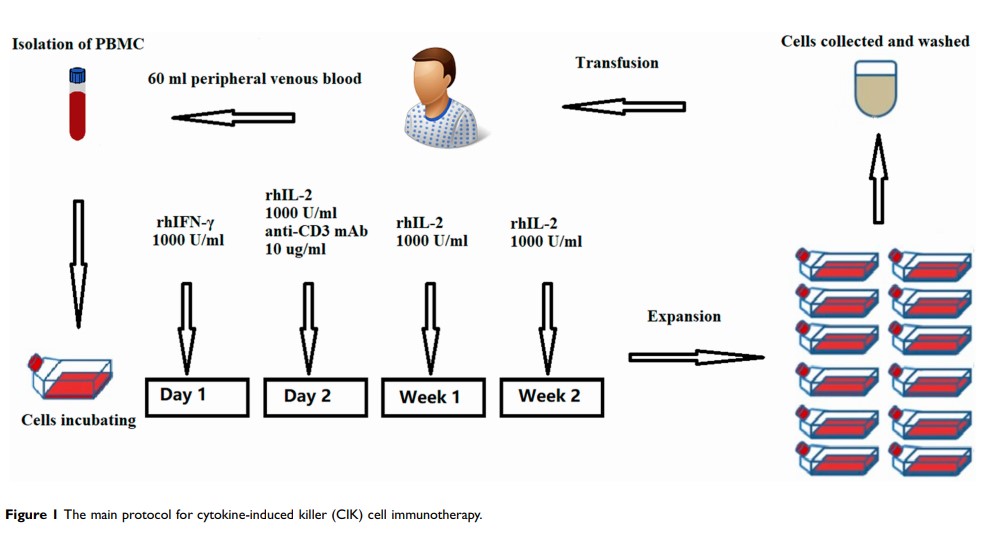
Patients and Methods: Peripheral blood mononuclear cells (PBMCs) were extracted from 20 patients with high-risk DLBCL (IPI≥ 3) after the first CR. Twenty CR patients who were age- and sex-matched during the same period were selected as controls. PBMCs were cultured with IFN-γ, IL-2 and anti-CD3 mAb to generate CIK cells. These obtained cells were then transfused back into the patients; the transfusion was repeated every 3 months up to a total of four courses. Changes in peripheral blood lymphocyte subgroups and survival were assessed.
Results: Compared with the baseline proportions, the proportion of CD3+ T cells, CD3+CD8+ T cells, and NK cells in the peripheral blood were significantly higher after transfusions (p < 0.05). The 5-year DFS was improved from 45.0 ± 11.1% to 79.3 ± 9.2% in the CIK group (HR favoring CIK, 0.29; 95% CI, 0.09 to 0.92; p = 0.035), and the 5-year OS was estimated at 90 ± 6.7% for CIK versus 55 ± 11.1% for control (HR favoring CIK, 0.20; 95% CI, 0.04 to 0.93; p = 0.040). No severe side effects were observed related to CIK treatment.
Conclusion: Autologous CIK cell immunotherapy has emerged as a safe and efficacious option to improve the prognosis of patients with high-risk DLBCL after the first CR.
Keywords: diffuse large B cell lymphoma, high risk, cytokine-induced killer cells, immunotherapy