115195
论文已发表
注册即可获取德孚的最新动态
IF 收录期刊
- 3.6 Breast Cancer (Dove Med Press)
- 4.3 Clin Epidemiol
- 2.6 Cancer Manag Res
- 3.2 Infect Drug Resist
- 4.1 Clin Interv Aging
- 6.1 Drug Des Dev Ther
- 4.1 Int J Chronic Obstr
- 8.7 Int J Nanomed
- 2.5 Int J Women's Health
- 3.2 Neuropsych Dis Treat
- 2.4 OncoTargets Ther
- 2.6 Patient Prefer Adher
- 2.6 Ther Clin Risk Manag
- 3.1 J Pain Res
- 3.5 Diabet Metab Synd Ob
- 4.5 Psychol Res Behav Ma
- 3.4 Nat Sci Sleep
- 2.4 Pharmgenomics Pers Med
- 2.6 Risk Manag Healthc Policy
- 4.6 J Inflamm Res
- 2.3 Int J Gen Med
- 3.9 J Hepatocell Carcinoma
- 3.3 J Asthma Allergy
- 2.5 Clin Cosmet Investig Dermatol
- 3.0 J Multidiscip Healthc

慢性阻塞性肺疾病患者使用软雾吸入器的技术评估:一个横断面研究
Authors Zhang W, Xu L, Gao S, Ding N, Shu P, Wang Z, Li Y
Received 10 March 2020
Accepted for publication 22 May 2020
Published 22 June 2020 Volume 2020:15 Pages 1471—1479
DOI https://doi.org/10.2147/COPD.S253338
Checked for plagiarism Yes
Review by Single-blind
Peer reviewer comments 2
Editor who approved publication: Dr Bai
Background: Proper inhaler technique is highly relevant to the effective management of chronic obstructive pulmonary disease (COPD). The tiotropium bromide spray (TBS) (Spiriva® Respimat®) is a soft mist inhaler (SMI) preferred by patients to pressurized metered-dose inhalers (pMDIs) and dry powder inhalers (DPIs) because of its convenience in use. However, the technique of using TBS inhaler in the real world is unclear.
Objective: To evaluate techniques in using TBS inhaler and investigate the association between the patient characteristics and the correct use of TBS inhaler.
Methods: This cross-sectional study enrolled 74 COPD patients who used TBS inhaler device for more than 3 months. The sociodemographic and clinical characteristics of the patients were recorded. The technique of using TBS inhaler was evaluated step by step. Incorrect use was defined as the patient’s inability to complete the key steps in the inhalation manoeuvre. The percentage of incorrect use was compared between the groups. Risk factors related to incorrect use were analyzed by logistic regression analysis.
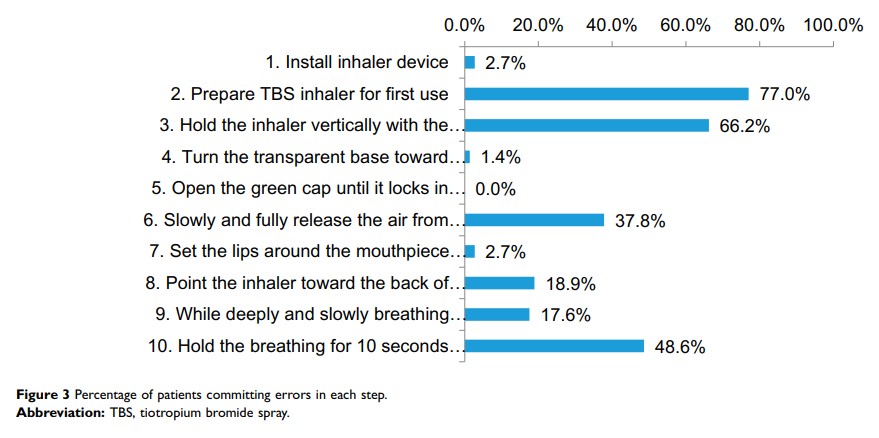
Results: Of the 74 participants, only 2 (2.7%) patients completed all the steps correctly, and 48 (64.9%) patients misused the key steps in the inhalation manoeuvre. Incorrect preparation of the TBS inhaler for the first use was the most frequently misused step, accounting for 77.0%. Factors associated with misuse of TBS inhaler included the educational background (p=0.010), living state (p=0.031) and COPD assessment test (CAT) score (p=0.005) of the patients. Additionally, logistic regression analysis showed that the COPD duration was significantly associated with the incorrect use (p=0.019). Compared with patients with a higher educational background, patients with an elementary school background [OR 11652.99, CI: 22.72– 5975697.72], junior high school background [OR 7187.78, CI: 16.41– 3146787] and high school background [OR 1563, CI: 4.27– 572329.67] were more likely to misuse TBS inhaler. Patients living with their spouses alone were also more likely to commit errors in using TBS inhaler as compared with those living with their children [OR 12.29, CI of 1.14– 1.96]. Clinical factors like the COPD symptoms were relative to the technical use of the device. Better technique was accompanied by a lower CAT score [OR 1.49, CI of 1.14– 1.96].
Conclusion: The incorrect use of TBS inhaler was common in COPD patients. Healthcare providers should not only teach the patients about the drug preparation but help them use the inhaler correctly. Special attention should be paid to patients with a short COPD duration and a low educational background and those who live without the company of their children. Proper use of TBS inhaler can significantly improve the symptom control of COPD patients.
Keywords: chronic obstructive pulmonary disease, inhaler technique, soft mist inhaler, incorrect use