115195
论文已发表
注册即可获取德孚的最新动态
IF 收录期刊
- 3.6 Breast Cancer (Dove Med Press)
- 4.3 Clin Epidemiol
- 2.6 Cancer Manag Res
- 3.2 Infect Drug Resist
- 4.1 Clin Interv Aging
- 6.1 Drug Des Dev Ther
- 4.1 Int J Chronic Obstr
- 8.7 Int J Nanomed
- 2.5 Int J Women's Health
- 3.2 Neuropsych Dis Treat
- 2.4 OncoTargets Ther
- 2.6 Patient Prefer Adher
- 2.6 Ther Clin Risk Manag
- 3.1 J Pain Res
- 3.5 Diabet Metab Synd Ob
- 4.5 Psychol Res Behav Ma
- 3.4 Nat Sci Sleep
- 2.4 Pharmgenomics Pers Med
- 2.6 Risk Manag Healthc Policy
- 4.6 J Inflamm Res
- 2.3 Int J Gen Med
- 3.9 J Hepatocell Carcinoma
- 3.3 J Asthma Allergy
- 2.5 Clin Cosmet Investig Dermatol
- 3.0 J Multidiscip Healthc

探索个人权力意识对于激发员工创造力的作用:基于自决理论衍生观点的双重调解模型
Authors Zhou H, He H
Received 7 April 2020
Accepted for publication 3 June 2020
Published 23 June 2020 Volume 2020:13 Pages 517—527
DOI https://doi.org/10.2147/PRBM.S257201
Checked for plagiarism Yes
Review by Single-blind
Peer reviewer comments 2
Editor who approved publication: Dr Einar Thorsteinsson
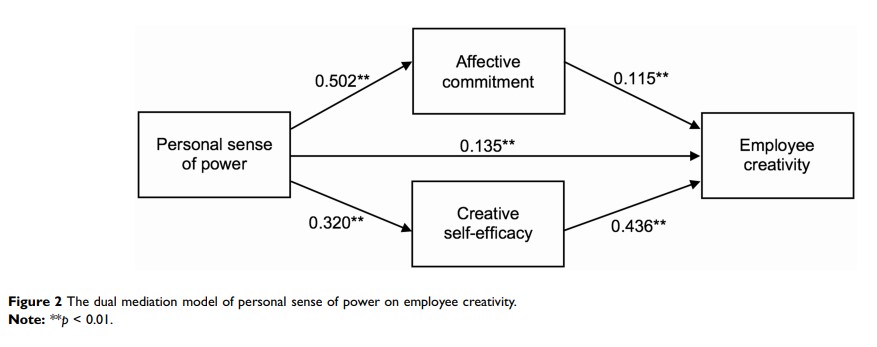
Purpose: Employee creativity is a key factor that helps organizations to gain competitive advantages. The aim of this study is to add to the knowledge of the antecedents of employee creativity. Based on the derivative view of self-determination theory, we analyzed how personal sense of power affects employee creativity, and the mediating role of affective commitment and creative self-efficacy.
Participants and Methods: The participants in this study were 227 on-the-job MBA students (120 males and 107 females, mean age was 32.256 years, age range was between 24 and 52 years) at a university in southwestern China. To collect data, a three-wave survey was conducted. Participants were asked to report: personal sense of power, demographic variables, and zhongyong at Time 1; affective commitment and creative self-efficacy at Time 2; creativity at Time 3. PROCESS was employed to test the hypotheses.
Results: Personal sense of power has a significant and positive impact on creativity (b = 0.333, SE = 0.052, p < 0.01). Both affective commitment (b = 0.058, 95% CI [0.024, 0.107]) and creative self-efficacy (b = 0.139, 95% CI [0.078, 0.224]) mediate the relationship between personal sense of power and creativity.
Conclusion: Personal sense of power was positively correlated with employee creativity while affective commitment and creative self-efficacy mediated their relationship.
Keywords: personal sense of power, employee creativity, affective commitment, creative self-efficacy, self-determination theory