115195
论文已发表
注册即可获取德孚的最新动态
IF 收录期刊
- 3.6 Breast Cancer (Dove Med Press)
- 4.3 Clin Epidemiol
- 2.6 Cancer Manag Res
- 3.2 Infect Drug Resist
- 4.1 Clin Interv Aging
- 6.1 Drug Des Dev Ther
- 4.1 Int J Chronic Obstr
- 8.7 Int J Nanomed
- 2.5 Int J Women's Health
- 3.2 Neuropsych Dis Treat
- 2.4 OncoTargets Ther
- 2.6 Patient Prefer Adher
- 2.6 Ther Clin Risk Manag
- 3.1 J Pain Res
- 3.5 Diabet Metab Synd Ob
- 4.5 Psychol Res Behav Ma
- 3.4 Nat Sci Sleep
- 2.4 Pharmgenomics Pers Med
- 2.6 Risk Manag Healthc Policy
- 4.6 J Inflamm Res
- 2.3 Int J Gen Med
- 3.9 J Hepatocell Carcinoma
- 3.3 J Asthma Allergy
- 2.5 Clin Cosmet Investig Dermatol
- 3.0 J Multidiscip Healthc

2015 年至 2017 年,腹腔、呼吸道和泌尿道感染中对碳青霉烯类耐药肠杆菌及粘杆菌素的敏感性分析
Authors Zhang H, Zhang J, Kang Y, Yang Q, Xu Y
Received 18 February 2020
Accepted for publication 28 May 2020
Published 23 June 2020 Volume 2020:13 Pages 1937—1948
DOI https://doi.org/10.2147/IDR.S250384
Checked for plagiarism Yes
Review by Single-blind
Peer reviewer comments 4
Editor who approved publication: Dr Joachim Wink
Purpose: To evaluate the susceptibility rates of carbapenem-resistant (CR)-Enterobacterales strains from Chinese intra-abdominal infections (IAI), respiratory tract infections (RTI) and urinary tract infections (UTI) between 2015 and 2017 to colistin.
Methods: In total, 7138 Enterobacterales including 1074 CR-Enterobacterales strains were isolated from IAI+UTI+RTI samples and collected in 21 hospitals across 7 regions of China. Antimicrobial susceptibilities were determined at a central laboratory using CLSI broth microdilution and interpretive standards.
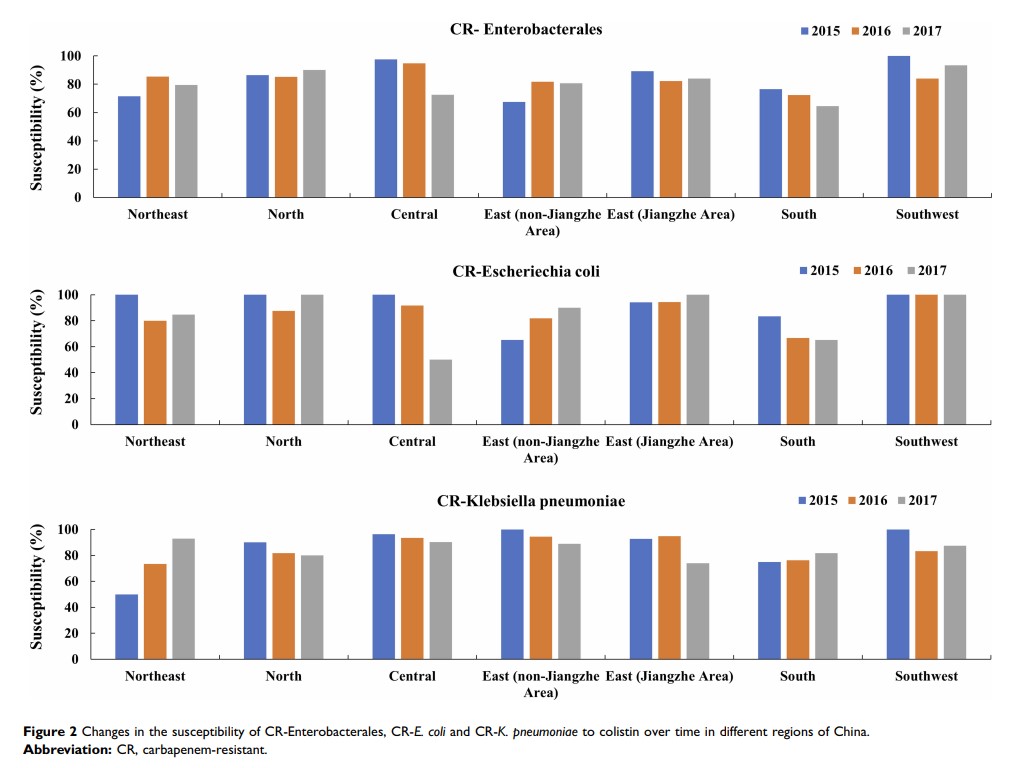
Results: From 2015 to 2017, E. coli (51.4%) and K. pneumoniae (30.0%) accounted for the majority of Enterobacterales isolated from IAIs, UTIs and RTIs. The percentage of CR strains within the species was highest for S. marcescens (27.9%), followed by K. pneumoniae (24.8%), P. mirabilis (22.6), K. oxytoca (19.5%), E. cloacae (17.7%), C. freundii (12.5%), K. aerogenes (11.0%) and lowest for E. coli (6.9%). Colistin susceptibilities were generally higher in CS than in CR isolates and were 83.5% for CR-E. coli , 88.6% for CR-K. pneumoniae , 79.2% for CR-E. cloacae and 87.5% for CR-K . aerogenes . For IAI and UTI isolates in particular, CR-E. coli and CR-K. pneumoniae showed a trend of decreasing susceptibility, which was especially noted for CR-E. coli in UTI isolates, and for both organisms in IAI isolates susceptibility dropped markedly in 2017.
Conclusion: Colistin was a last resort antibiotics for empirical CR-Enterobacterales treatments, since especially the percentage of CR-K. pneumoniae was 30.0% of all IAI, UTI and RTI isolates, with an incidence of 24.8% CR strains, of which 88.6% were susceptible to colistin. Also other analyzed CR-Enterobacterales showed colistin susceptibilities of ≥ 80.0%. However, resistance rates of IAI derived CR-K. pneumoniae and CR-E. coli , and CR-K. pneumoniae UTI isolates to colistin increased between 2015 and 2017, which should further be closely monitored.
Keywords: Enterobacterales, carbapenem, colistin, intra-abdominal infection, respiratory tract infection, urinary tract infection