115195
论文已发表
注册即可获取德孚的最新动态
IF 收录期刊
- 3.6 Breast Cancer (Dove Med Press)
- 4.3 Clin Epidemiol
- 2.6 Cancer Manag Res
- 3.2 Infect Drug Resist
- 4.1 Clin Interv Aging
- 6.1 Drug Des Dev Ther
- 4.1 Int J Chronic Obstr
- 8.7 Int J Nanomed
- 2.5 Int J Women's Health
- 3.2 Neuropsych Dis Treat
- 2.4 OncoTargets Ther
- 2.6 Patient Prefer Adher
- 2.6 Ther Clin Risk Manag
- 3.1 J Pain Res
- 3.5 Diabet Metab Synd Ob
- 4.5 Psychol Res Behav Ma
- 3.4 Nat Sci Sleep
- 2.4 Pharmgenomics Pers Med
- 2.6 Risk Manag Healthc Policy
- 4.6 J Inflamm Res
- 2.3 Int J Gen Med
- 3.9 J Hepatocell Carcinoma
- 3.3 J Asthma Allergy
- 2.5 Clin Cosmet Investig Dermatol
- 3.0 J Multidiscip Healthc

安罗替尼通过抑制 AKT/ERK 信号级联反应遏制大肠癌的增殖和血管生成
Authors Yang Q, Ni L, Imani S, Xiang Z, Hai R, Ding R, Fu S, Wu J, Wen Q
Received 2 March 2020
Accepted for publication 21 May 2020
Published 24 June 2020 Volume 2020:12 Pages 4937—4948
DOI https://doi.org/10.2147/CMAR.S252181
Checked for plagiarism Yes
Review by Single-blind
Peer reviewer comments 2
Editor who approved publication: Dr Sanjeev Srivastava
Background: Anlotinib is a highly potent multi-target tyrosine kinase inhibitor, with very good anti-tumor activity against a variety of solid tumors. However, its effect on colorectal cancer (CRC) is not yet clearly understood. The objective of this study was to investigate the anti-tumor effect and underlying mechanism of anlotinib in the pathogenesis of CRC.
Materials and Methods: Effects of anlotinib on CT26 cells proliferation and microvessel formation in endothelial cells were determined by MTT assay and tube formation assay. Cell migration and invasion were analyzed by using the wound healing assay and transwell assay. Cell cycle and apoptosis were detected by flow cytometry. A CRC xenograft mouse model was used for conducting in-vivo studies to verify the effect of anlotinib. The expression of Ki-67 and CD31 in the tumor tissue was detected by immunohistochemistry and protein expression was measured by Western blot.
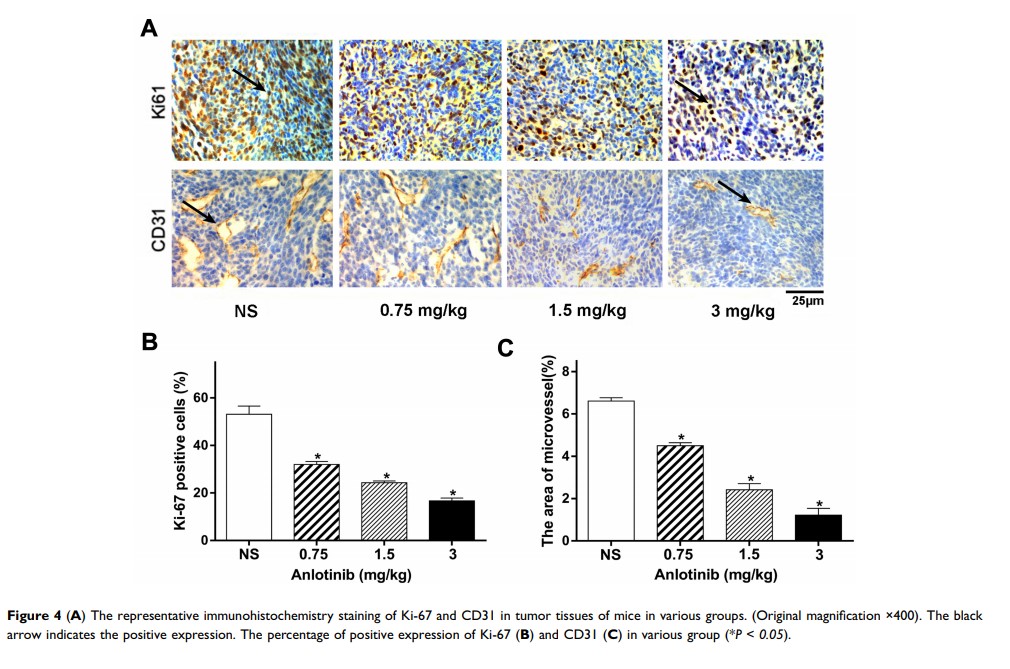
Results: In-vitro studies revealed that anlotinib inhibited the proliferation, migration, and invasion of CT26 cells and the tube formation of HUVECs in a dose-dependent manner. Anlotinib also significantly induced cell apoptosis and G2/M arrest. It effectively inhibited tumor growth and prolonged survival time in the CRC xenograft mouse model. Immunohistochemical analysis of the tumor tissue revealed that anlotinib downregulated CD31 and Ki-67 which are the biomarkers of microvessel density and proliferation. Furthermore, anlotinib was able to inhibit the activation of VEGFR-2/AKT and FGFR, PDGFRβ and their downstream signaling ERK.
Conclusion: The findings of the present study suggested that anlotinib suppressed cell proliferation and angiogenesis via inhibition of AKT/ERK signaling pathway in colorectal cancer and could be a novel therapeutic strategy for treatment of CRC.
Keywords: anlotinib, colorectal cancer, angiogenesis, proliferation, tyrosine kinase inhibitor