115195
论文已发表
注册即可获取德孚的最新动态
IF 收录期刊
- 3.6 Breast Cancer (Dove Med Press)
- 4.3 Clin Epidemiol
- 2.6 Cancer Manag Res
- 3.2 Infect Drug Resist
- 4.1 Clin Interv Aging
- 6.1 Drug Des Dev Ther
- 4.1 Int J Chronic Obstr
- 8.7 Int J Nanomed
- 2.5 Int J Women's Health
- 3.2 Neuropsych Dis Treat
- 2.4 OncoTargets Ther
- 2.6 Patient Prefer Adher
- 2.6 Ther Clin Risk Manag
- 3.1 J Pain Res
- 3.5 Diabet Metab Synd Ob
- 4.5 Psychol Res Behav Ma
- 3.4 Nat Sci Sleep
- 2.4 Pharmgenomics Pers Med
- 2.6 Risk Manag Healthc Policy
- 4.6 J Inflamm Res
- 2.3 Int J Gen Med
- 3.9 J Hepatocell Carcinoma
- 3.3 J Asthma Allergy
- 2.5 Clin Cosmet Investig Dermatol
- 3.0 J Multidiscip Healthc

lncRNA CASC9 的上调通过抑制 miR-335-3p 和激活 S100A14 表达来促进非小细胞肺癌的进展
Authors Zhao W, Chen T, Zhao Y
Received 15 February 2020
Accepted for publication 14 May 2020
Published 24 June 2020 Volume 2020:13 Pages 6027—6036
DOI https://doi.org/10.2147/OTT.S249973
Checked for plagiarism Yes
Review by Single-blind
Peer reviewer comments 2
Editor who approved publication: Dr Carlos E Vigil
Introduction: Non-small cell lung cancer (NSCLC) is a deadly cancer type worldwide and the main sub-type of lung cancer. Cancer susceptibility candidate-9 (CASC9) was reported to be a key player in cancer progression. However, its function and underlying mechanism in NSCLC remain unclear.
Materials and Methods: Expression level of CASC9 in NSCLC tissues and cells was measured with RT-qPCR. Biological roles of CASC9 in NSCLC were analyzed with a series of in vitro experiments. Potential mechanisms of CASC9 in NSCLC were analyzed by predicting and validating the possible targets of CASC9 in NSCLC.
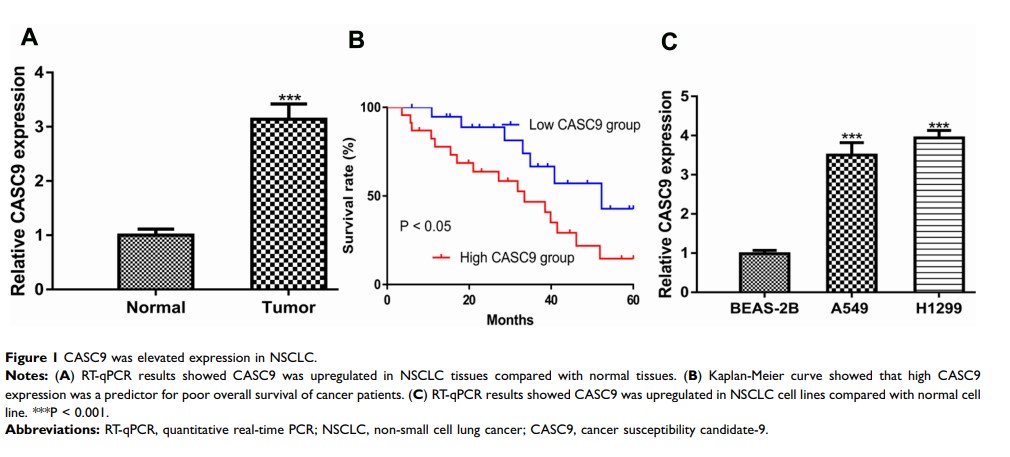
Results: In this study, we found CASC9 expression was upregulated in NSCLC tissues and cell lines. High CASC9 expression was identified as a predictor for poorer overall survival of NSCLC patients. Furthermore, functional assays showed CASC9 knockdown suppressed NSCLC cell proliferation, migration, and invasion, while CASC9 overexpression caused opposite effects. We also found microRNA-335-3p (miR-335-3p) could act as a target of CASC9 in NSCLC and the inhibition effect of CASC9 knockdown on NSCLC progression required the activity of miR-335-3p. In addition, we identified S100 calcium-binding protein A14 (S100A14) acts as a target of miR-335-3p.
Discussion: Taken together, our study suggested CASC9 could promote NSCLC progression via miR-335-3p/S100A14 axis. The CASC9/miR-335-3p/S100A14 regulatory triplets identified in this work might provide new therapeutic strategies for NSCLC treatment.
Keywords: non-small cell lung cancer, CASC9, miR-335-3p, S100A14, ceRNA