115195
论文已发表
注册即可获取德孚的最新动态
IF 收录期刊
- 3.6 Breast Cancer (Dove Med Press)
- 4.3 Clin Epidemiol
- 2.6 Cancer Manag Res
- 3.2 Infect Drug Resist
- 4.1 Clin Interv Aging
- 6.1 Drug Des Dev Ther
- 4.1 Int J Chronic Obstr
- 8.7 Int J Nanomed
- 2.5 Int J Women's Health
- 3.2 Neuropsych Dis Treat
- 2.4 OncoTargets Ther
- 2.6 Patient Prefer Adher
- 2.6 Ther Clin Risk Manag
- 3.1 J Pain Res
- 3.5 Diabet Metab Synd Ob
- 4.5 Psychol Res Behav Ma
- 3.4 Nat Sci Sleep
- 2.4 Pharmgenomics Pers Med
- 2.6 Risk Manag Healthc Policy
- 4.6 J Inflamm Res
- 2.3 Int J Gen Med
- 3.9 J Hepatocell Carcinoma
- 3.3 J Asthma Allergy
- 2.5 Clin Cosmet Investig Dermatol
- 3.0 J Multidiscip Healthc

红细胞分布宽度和肺腺癌中的上皮间质转化表型循环肿瘤细胞的临床意义
Authors Peng H, Tan X, Wang Y, Dai L, Liang G, Guo J, Chen M
Received 25 February 2020
Accepted for publication 20 May 2020
Published 26 June 2020 Volume 2020:12 Pages 5105—5117
DOI https://doi.org/10.2147/CMAR.S251271
Checked for plagiarism Yes
Review by Single-blind
Peer reviewer comments 3
Editor who approved publication: Dr Eileen O'Reilly
Objective: To determine the prognostic value of red cell distribution width (RDW) and circulating tumor cells with epithelial–mesenchymal transition phenotype (M-CTC) in lung adenocarcinoma (LUAD).
Patients and Methods: Clinical and laboratory data of 60 patients with LUAD were collected. CTCs were isolated from their peripheral blood using the CanPatrolTM CTC enrichment method. The indicators of RDW and neutrophil lymphocyte ratio (NLR) were calculated based on the laboratory standards.
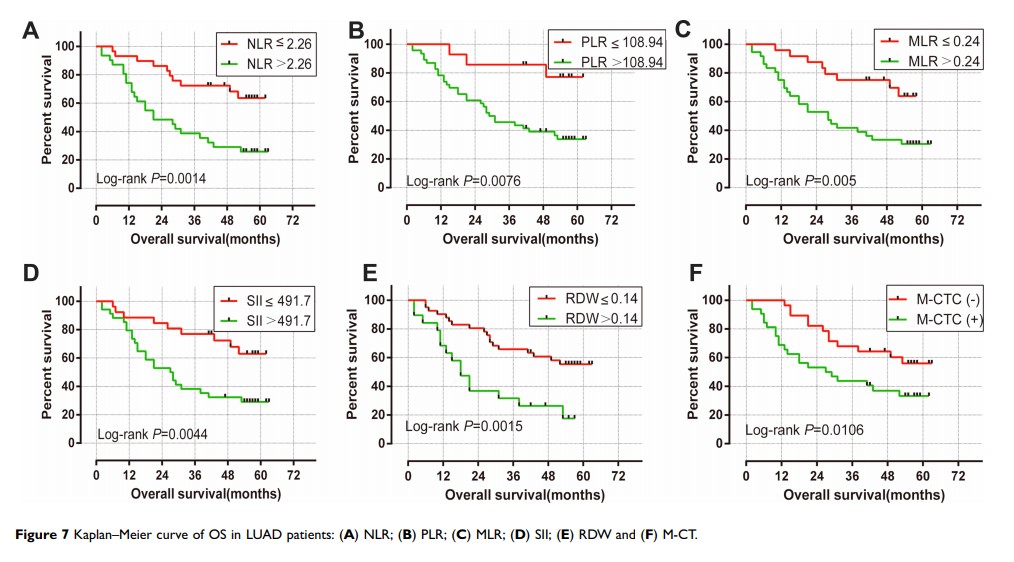
Results: A total of 60 LUAD patients were enrolled, of which 19 (31.7%) had high RDW (> 0.14) and 32 (53.3%) were positive for M-CTCs. There was no significant correlation between RDW and the clinical characteristics. M-CTC was not significantly associated with tumor size and differentiation, age, gender, tumor stage, and histological type but correlated significantly with lymphatic metastasis (P = 0.044), high NLR (> 2.26, P = 0.023), and high RDW (> 0.14, P = 0.036). Furthermore, the M-CTC+ LUAD patients had a significantly poor recurrence-free survival (RFS; Log rank P =0.001, HR = 2.749, 95% CI = 1.489– 5.078) and overall survival (OS; Log rank P =0.022, HR = 2.283, 95% CI = 1.128– 4.622) compared to the M-CTC− patients. Similarly, high RDW also correlated with worse RFS (Log rank P = 0.008, HR = 2.331, 95% CI = 1.248– 4.353) and OS (Log rank P = 0.004, HR = 0.004, 95% CI = 1.398– 5.525).
Conclusion: M-CTC is significantly related to RDW and NLR, and an independent prognostic factor in LUAD.
Keywords: circulating tumor cell, epithelial–mesenchymal, red cell distribution width, lung adenocarcinoma, survival