115195
论文已发表
注册即可获取德孚的最新动态
IF 收录期刊
- 3.6 Breast Cancer (Dove Med Press)
- 4.3 Clin Epidemiol
- 2.6 Cancer Manag Res
- 3.2 Infect Drug Resist
- 4.1 Clin Interv Aging
- 6.1 Drug Des Dev Ther
- 4.1 Int J Chronic Obstr
- 8.7 Int J Nanomed
- 2.5 Int J Women's Health
- 3.2 Neuropsych Dis Treat
- 2.4 OncoTargets Ther
- 2.6 Patient Prefer Adher
- 2.6 Ther Clin Risk Manag
- 3.1 J Pain Res
- 3.5 Diabet Metab Synd Ob
- 4.5 Psychol Res Behav Ma
- 3.4 Nat Sci Sleep
- 2.4 Pharmgenomics Pers Med
- 2.6 Risk Manag Healthc Policy
- 4.6 J Inflamm Res
- 2.3 Int J Gen Med
- 3.9 J Hepatocell Carcinoma
- 3.3 J Asthma Allergy
- 2.5 Clin Cosmet Investig Dermatol
- 3.0 J Multidiscip Healthc

阿帕替尼在晚期滑膜肉瘤中的疗效和安全性:单一机构中 21 位患者的病例系列
Authors Wang Y, Lu M, Zhou Y, Zhou S, Yu X, Tang F, Luo Y, Zhang W, Duan H, Min L, Tu C
Received 17 March 2020
Accepted for publication 11 June 2020
Published 1 July 2020 Volume 2020:12 Pages 5255—5264
DOI https://doi.org/10.2147/CMAR.S254296
Checked for plagiarism Yes
Review by Single-blind
Peer reviewer comments 2
Editor who approved publication: Dr Seema Singh
Background: Synovial sarcoma (SS) is a highly aggressive soft-tissue sarcoma (STS) with poor prognosis. Tyrosine kinase inhibitor (TKI) has shown a promising impact on advanced STS patients. This study aimed to evaluate the efficacy and safety of apatinib, an oral multi-TKI, which especially inhibited vascular endothelial growth factor receptor, as second-line therapy for patients with advanced SS.
Patients and Methods: This retrospective analysis included 21 advanced SS patients, who had a poor response to anthracycline-based chemotherapy alone or combined with ifosfamide at least one cycle. All the patients received an apatinib containing regimen between May 2016 and October 2019 in our institution. Apatinib 500– 750 mg (250 mg for patients younger than 10) was given daily. Tumor responses were assessed by response evaluation criteria in solid tumors. Survival analysis was performed by the Kaplan–Meier test, and a safety profile was recorded.
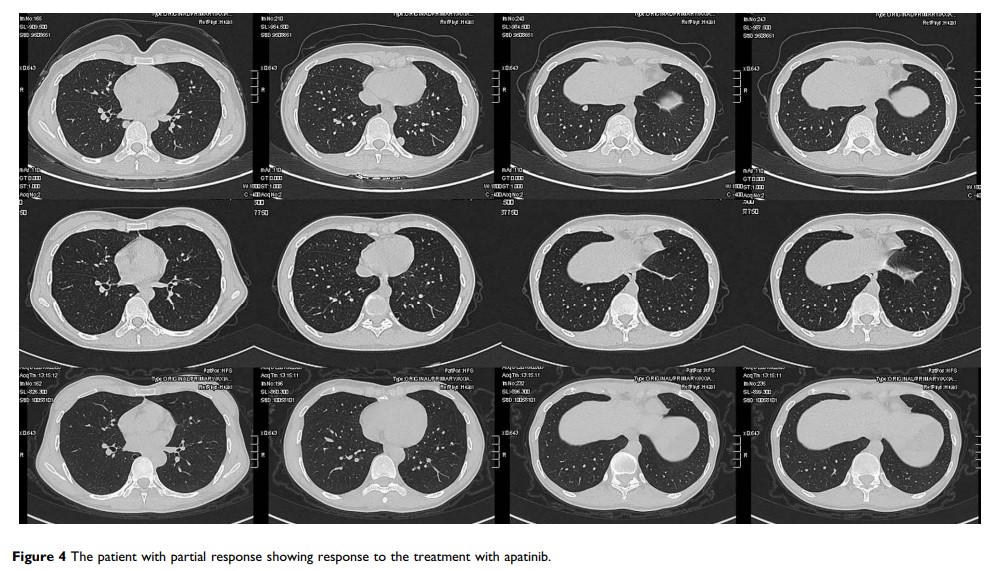
Results: The median follow-up was 15.2 months (95% CI, 12.2-NE). Nine (42.9%) patients had partial response (PR), and eight (38.1%) had stable disease. The median progression-free survival (PFS) was 13.1 months (95% CI, 6.7-NE). The 6- and 12-month PFS rates were 76.2% (95% CI, 60.0– 96.8) and 55.4% (95% CI, 37.3– 82.3), respectively. Additionally, the median overall survival (OS) was 15.5 months (95% CI, 10.7-NE). The 6- and 12-month OS rates were 81.0% (95% CI, 65.8, 99.6) and 64.9% (95% CI, 46.9– 90.0), respectively. Moreover, the objective response rate was 42.9% (9/21) for advanced SS patients. The disease control rate was 81.0% (17/21). For the nine patients with the best response of PR, the median duration of response was 7.7 months.
Conclusion: Apatinib was proved to be a potential second-line treatment option for advanced SS patients with chemo-resistance. Apatinib showed promising efficacy and acceptable safety profile in advanced SS, with considerable OS and particularly PFS. Indeed, further multicenter studies with a longer follow-up time are needed to fully determine the clinical application of apatinib in advanced SS.
Keywords: synovial sarcoma, apatinib, targeted therapy, efficacy, safety