115195
论文已发表
注册即可获取德孚的最新动态
IF 收录期刊
- 3.6 Breast Cancer (Dove Med Press)
- 4.3 Clin Epidemiol
- 2.6 Cancer Manag Res
- 3.2 Infect Drug Resist
- 4.1 Clin Interv Aging
- 6.1 Drug Des Dev Ther
- 4.1 Int J Chronic Obstr
- 8.7 Int J Nanomed
- 2.5 Int J Women's Health
- 3.2 Neuropsych Dis Treat
- 2.4 OncoTargets Ther
- 2.6 Patient Prefer Adher
- 2.6 Ther Clin Risk Manag
- 3.1 J Pain Res
- 3.5 Diabet Metab Synd Ob
- 4.5 Psychol Res Behav Ma
- 3.4 Nat Sci Sleep
- 2.4 Pharmgenomics Pers Med
- 2.6 Risk Manag Healthc Policy
- 4.6 J Inflamm Res
- 2.3 Int J Gen Med
- 3.9 J Hepatocell Carcinoma
- 3.3 J Asthma Allergy
- 2.5 Clin Cosmet Investig Dermatol
- 3.0 J Multidiscip Healthc

特定类型的高危人乳头瘤病毒模型在未明确诊断意义的非典型鳞状上皮细胞女性患者分类中的效率
Authors Wang Y, Gao S, Wang Y, Chen F, Deng H, Lu Y
Received 23 March 2020
Accepted for publication 26 May 2020
Published 1 July 2020 Volume 2020:12 Pages 5265—5275
DOI https://doi.org/10.2147/CMAR.S254330
Checked for plagiarism Yes
Review by Single-blind
Peer reviewer comments 2
Editor who approved publication: Dr Antonella D'Anneo
Purpose: To evaluate the performance of different high-risk human papillomavirus (HR-HPV) genotype models in triaging women with cytological diagnosis of atypical squamous cells of undetermined significance (ASCUS).
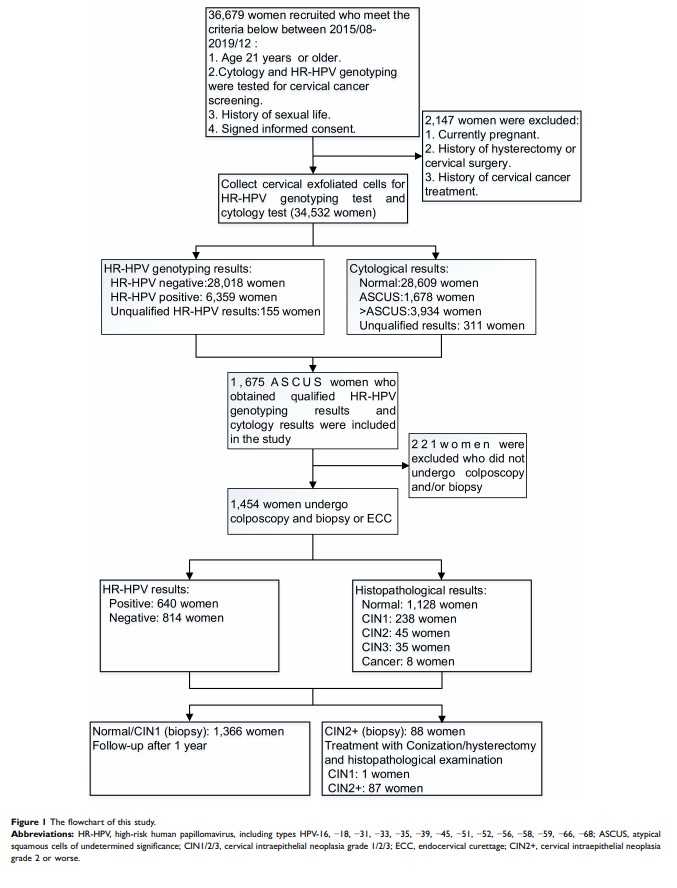
Patients and Methods: A total of 36,679 Chinese women who underwent cytology and HR-HPV genotyping assessments during cervical cancer screening were enrolled in this study. Women with cytology-proven ASCUS were referred for further screening by colposcopy and biopsy. The study endpoint was histological detection of cervical intraepithelial neoplasia grade 2 or worse (CIN2+) at any of the follow-up visits. The sensitivity, specificity, positive predictive values (PPVs), negative predictive values (NPVs), positive likelihood ratio (PLR) and negative likelihood ratio (NLR) of different HR-HPV genotype combination models were estimated.
Results: In all, 1675 (4.9%) women were identified as having ASCUS, 1454 women underwent colposcopy and biopsy, and 6.0% (87/1454) women were identified as having CIN2+ lesions. Among those with ASCUS who were identified as having CIN2+, the HR-HPV infection rate was 97.7%, and the prevalence rates of HPV-16, − 18, − 31, − 33, − 35, − 39, − 45, − 51, − 52, − 56, − 58, − 59, − 66 and − 68 were 48.3%, 8.0%, 6.9%, 4.6%, 1.1%, 2.3%, 3.4%, 3.4%, 26.4%, 1.1%, 17.2%, 2.3%, 0.0% and 0.0%, respectively. Compared to other HR-HPV-type combination models, the HPV16/18/31/33/52/58 model achieved a higher sensitivity [93.1 (87.8– 98.4)], specificity [73.0 (70.7– 75.4)], PPV [18.0 (14.5– 21.5)], NPV [99.4 (98.9– 99.9)], PLR [3.7 (3.1– 3.8)] and NLR [0.06 (0.03– 0.18)] for the triage of ASCUS patients, but the colposcopy referral rate (30.9%) was significantly lower than that of the recommended HR-HPV model (44.0%).
Conclusion: This study confirms that the specific HR-HPV genotype HPV16/18/31/33/52/58 is an alternative strategy for ASCUS triage and can effectively reduce the high burden of colposcopy referrals in China.
Keywords: human papillomavirus, high-risk, genotyping, atypical squamous cells of undetermined significance, cervical intraepithelial neoplasia