115195
论文已发表
注册即可获取德孚的最新动态
IF 收录期刊
- 3.6 Breast Cancer (Dove Med Press)
- 4.3 Clin Epidemiol
- 2.6 Cancer Manag Res
- 3.2 Infect Drug Resist
- 4.1 Clin Interv Aging
- 6.1 Drug Des Dev Ther
- 4.1 Int J Chronic Obstr
- 8.7 Int J Nanomed
- 2.5 Int J Women's Health
- 3.2 Neuropsych Dis Treat
- 2.4 OncoTargets Ther
- 2.6 Patient Prefer Adher
- 2.6 Ther Clin Risk Manag
- 3.1 J Pain Res
- 3.5 Diabet Metab Synd Ob
- 4.5 Psychol Res Behav Ma
- 3.4 Nat Sci Sleep
- 2.4 Pharmgenomics Pers Med
- 2.6 Risk Manag Healthc Policy
- 4.6 J Inflamm Res
- 2.3 Int J Gen Med
- 3.9 J Hepatocell Carcinoma
- 3.3 J Asthma Allergy
- 2.5 Clin Cosmet Investig Dermatol
- 3.0 J Multidiscip Healthc

序列全外显子组测序揭示了体细胞突变与非小细胞肺癌(NSCLC)患者对铂类药物反应之间的关联
Authors Guo AX, Xiao F, Shao WH, Zhan Y, Zhang L, Xiong J, Gao Y, Yin JY
Received 24 March 2020
Accepted for publication 28 May 2020
Published 3 July 2020 Volume 2020:13 Pages 6485—6496
DOI https://doi.org/10.2147/OTT.S254747
Checked for plagiarism Yes
Review by Single-blind
Peer reviewer comments 2
Editor who approved publication: Dr Sanjeev Srivastava
Purpose: Resistance is one of the main limitations of successful platinum treatment in non-small-cell lung cancer (NSCLC) patients. In this study, we aimed to identify somatic mutations associated with platinum response.
Patients and Methods: A total of 57 patients who received platinum-based chemotherapy only and 13 patients who received neoadjuvant chemotherapy (NAC) were enrolled. Somatic mutations were obtained from targeted and whole exome sequencing (WES).
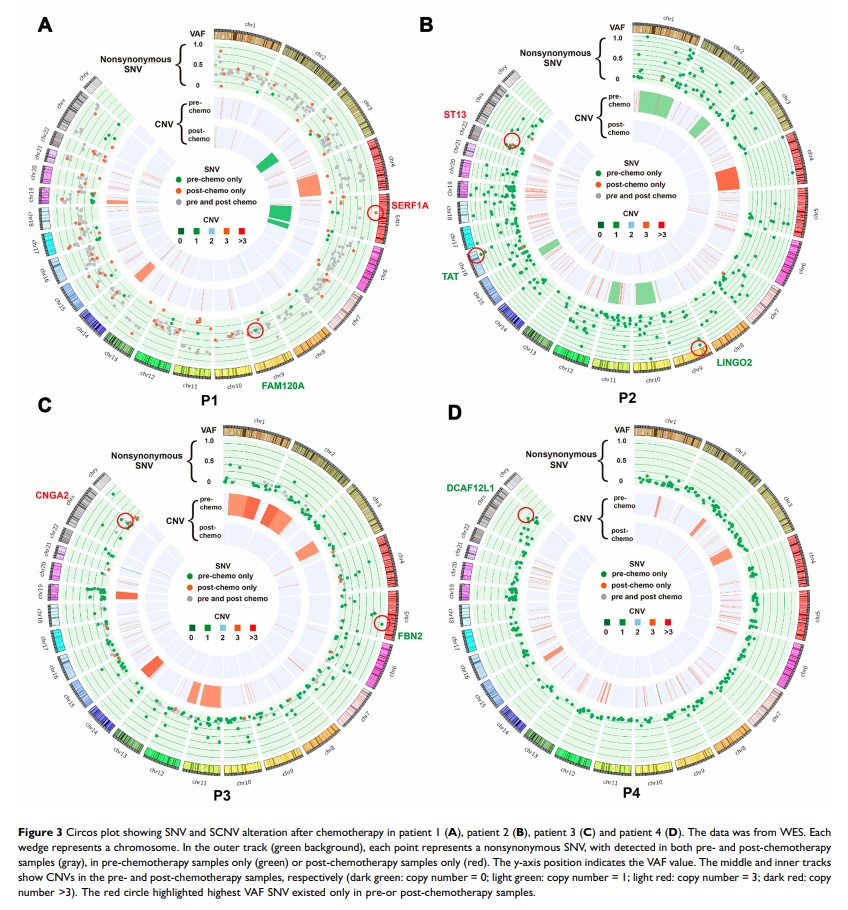
Results: Somatic mutations in a total of 225 genes were observed. Nonsynonymous variants in EGFR, TTN, TP53 and KRAS, and copy number variations (SCNVs) in chromosome 8q24.3 and 22q11.21 were identified to be associated with platinum response. Based on these mutations, the mutational signature associated with the failure of DNA double-strand break and calcium signaling pathways were identified to be associated with platinum response. Besides, we observed a decrease in tumor mutational burden after chemotherapy. We also evaluated the mutation spectrum consistency between cell-free DNA (cfDNA) and tissue DNA. Somatic mutations detected in cfDNA were consistent with that in tDNA, which indicated that plasma might be used for somatic mutation detection.
Conclusion: These results support that somatic mutations can affect platinum drug response and provide potential clinical biomarkers for NSCLC treatment.
Keywords: platinum, cfDNA, NSCLC, TTN, TP53