115195
论文已发表
注册即可获取德孚的最新动态
IF 收录期刊
- 3.6 Breast Cancer (Dove Med Press)
- 4.3 Clin Epidemiol
- 2.6 Cancer Manag Res
- 3.2 Infect Drug Resist
- 4.1 Clin Interv Aging
- 6.1 Drug Des Dev Ther
- 4.1 Int J Chronic Obstr
- 8.7 Int J Nanomed
- 2.5 Int J Women's Health
- 3.2 Neuropsych Dis Treat
- 2.4 OncoTargets Ther
- 2.6 Patient Prefer Adher
- 2.6 Ther Clin Risk Manag
- 3.1 J Pain Res
- 3.5 Diabet Metab Synd Ob
- 4.5 Psychol Res Behav Ma
- 3.4 Nat Sci Sleep
- 2.4 Pharmgenomics Pers Med
- 2.6 Risk Manag Healthc Policy
- 4.6 J Inflamm Res
- 2.3 Int J Gen Med
- 3.9 J Hepatocell Carcinoma
- 3.3 J Asthma Allergy
- 2.5 Clin Cosmet Investig Dermatol
- 3.0 J Multidiscip Healthc

北京的临床幽门螺杆菌分离株克拉霉素和左氧氟沙星耐药的表型和分子检测
Authors Lok CH, Zhu D, Wang J, Ren YT, Jiang X, Li SJ, Zhao XY
Received 11 February 2020
Accepted for publication 15 June 2020
Published 6 July 2020 Volume 2020:13 Pages 2145—2153
DOI https://doi.org/10.2147/IDR.S249370
Checked for plagiarism Yes
Review by Single-blind
Peer reviewer comments 2
Editor who approved publication: Dr Sahil Khanna
Introduction: Understanding drug resistance is important in drug selection for Helicobacter pylori (H. pylori ) eradication, and drug resistance data are lacking in Beijing.
Purpose: This cross-sectional study aimed to isolate H. pylori from patients with gastroduodenal diseases and to analyze drug resistance to clarithromycin (CLA) and levofloxacin (LEV), which are used frequently in China.
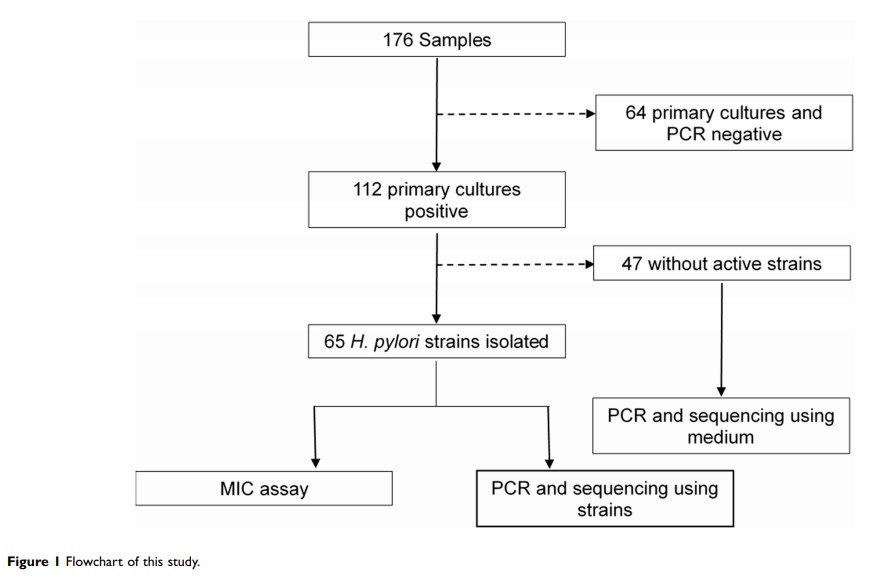
Patients and Methods: One hundred and seventy-six patients with gastroduodenal diseases undergoing gastroduodenoscopy were selected by convenient sampling. Gastric mucosa samples were cultured and sub-cultured using a new medium broth. Active H. pylori strains were confirmed by microscopy observation as Gram-negative curved bacilli with positive test results for urease, oxidase, and catalase, and H. pylori 16S rRNA amplification by polymerase chain reaction (PCR). CLA and LEV resistance was identified by minimum inhibitory concentration (MIC) tests and sequencing of 23S rRNA, gyrA , and gyrB genes.
Results: From the 176 clinical samples, 112 (112/176, 63.6%) were confirmed with H. pylori infection and 65 (65/176, 36.9%) active H. pylori strains were obtained and further confirmed by MIC assay. Overall, the rates of CLA-resistant and LEV-resistant mutations in the 112 samples were 50.9% and 33.0%, respectively. Mutation related to CLA resistance was A2143G in the 23S rRNA gene and mutations associated with LEV resistance were N87K, D91G, and D91Y in the gyrA gene. Of 112 samples, 22 (19.6%) presented dual resistance to CLA and LEV. Resistance of the H. pylori strains to CLA (r =0.846, P < 0.001) and LEV (r =0.936, P < 0.001) had a strong correlation in phenotypic and genotypic level.
Conclusion: The results indicated that resistance of CLA and LEV is severe among patients with gastroduodenitis. A good consistency could be found as to drug resistance between genotypic or phenotypic assay, suggested extending the detection of H. pylori drug resistance from the MIC method to a genotypic assay.
Keywords: Helicobacter pylori , clarithromycin, levofloxacin, antibiotic resistance