115195
论文已发表
注册即可获取德孚的最新动态
IF 收录期刊
- 3.6 Breast Cancer (Dove Med Press)
- 4.3 Clin Epidemiol
- 2.6 Cancer Manag Res
- 3.2 Infect Drug Resist
- 4.1 Clin Interv Aging
- 6.1 Drug Des Dev Ther
- 4.1 Int J Chronic Obstr
- 8.7 Int J Nanomed
- 2.5 Int J Women's Health
- 3.2 Neuropsych Dis Treat
- 2.4 OncoTargets Ther
- 2.6 Patient Prefer Adher
- 2.6 Ther Clin Risk Manag
- 3.1 J Pain Res
- 3.5 Diabet Metab Synd Ob
- 4.5 Psychol Res Behav Ma
- 3.4 Nat Sci Sleep
- 2.4 Pharmgenomics Pers Med
- 2.6 Risk Manag Healthc Policy
- 4.6 J Inflamm Res
- 2.3 Int J Gen Med
- 3.9 J Hepatocell Carcinoma
- 3.3 J Asthma Allergy
- 2.5 Clin Cosmet Investig Dermatol
- 3.0 J Multidiscip Healthc

麻醉技术对接受喉切除术的患者肺转移的影响
Authors Huang XW, Wang XD, Lai JL, Lu YL, Deng K, Lai RC
Received 18 December 2019
Accepted for publication 12 June 2020
Published 7 July 2020 Volume 2020:12 Pages 5515—5525
DOI https://doi.org/10.2147/CMAR.S242800
Checked for plagiarism Yes
Review by Single-blind
Peer reviewer comments 2
Editor who approved publication: Professor Lu-Zhe Sun
Background: Whether laryngeal cancer is directly implanted into the lungs during orotracheal intubation is still unclear. Therefore, this study aimed to find whether orotracheal intubation is an independent risk factor for postoperative pulmonary metastasis in patients undergoing laryngectomy.
Patients and Methods: Medical records from January 1, 2006, to December 31, 2016, were reviewed. According to similar propensity scores, patients who received orotracheal intubation (tracheal intubation group, n = 515) were matched 1:1 with those who received tracheotomy (tracheotomy group, n = 326) in the induction of general anesthesia. The primary outcome was postoperative pulmonary metastasis. Secondary outcomes included local recurrence, lymphatic metastasis, tracheostomal recurrence and overall survival.
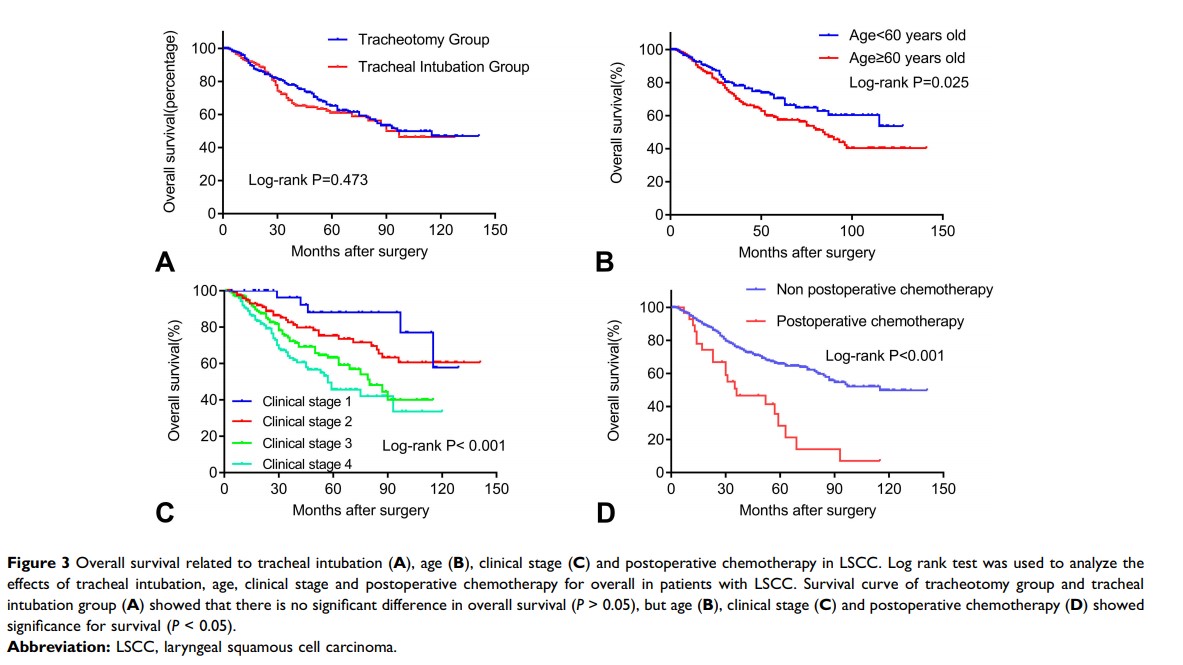
Results: Between the two groups, there was no significant difference in postoperative pulmonary metastasis (P = 0.688), local recurrence (P = 0.215), lymphatic metastasis (P = 0.480), tracheostomal recurrence (P = 0.246) or all-cause death (P = 0.299). The primary site of cancer was an independent risk factor for pulmonary metastasis [HR 0.29, 95% CI 0.13– 0.68; P = 0.013] and local recurrence (HR 2.69, 95% CI 1.39– 5.21; P = 0.003). Type of surgery (HR 3.13, 95% CI 2.03– 4.84; P < 0.001) and N classification of TNM (HR 0.27, 95% CI 0.10– 0.75; P = 0.012) were risk factors for local recurrence. Postoperative chemotherapy was an independent risk factor for lung metastasis (HR 7.58, 95% CI 3.11– 18.47; P < 0.001) and lymphatic metastasis (HR 5.18, 95% CI 2.57– 11.91; P < 0.001), and 5-year overall survival was associated with age (P = 0.028), clinical stage (P < 0.001) and postoperative chemotherapy (P = 0.003) but not with anesthetic technique (P = 0.473).
Conclusion: This retrospective study suggests that orotracheal intubation in laryngectomy is not a risk factor for postoperative pulmonary metastasis, local recurrence, lymphatic metastasis or overall survival.
Keywords: laryngectomy, lung metastasis, local recurrence, tracheal intubation, tracheotomy