115195
论文已发表
注册即可获取德孚的最新动态
IF 收录期刊
- 3.6 Breast Cancer (Dove Med Press)
- 4.3 Clin Epidemiol
- 2.6 Cancer Manag Res
- 3.2 Infect Drug Resist
- 4.1 Clin Interv Aging
- 6.1 Drug Des Dev Ther
- 4.1 Int J Chronic Obstr
- 8.7 Int J Nanomed
- 2.5 Int J Women's Health
- 3.2 Neuropsych Dis Treat
- 2.4 OncoTargets Ther
- 2.6 Patient Prefer Adher
- 2.6 Ther Clin Risk Manag
- 3.1 J Pain Res
- 3.5 Diabet Metab Synd Ob
- 4.5 Psychol Res Behav Ma
- 3.4 Nat Sci Sleep
- 2.4 Pharmgenomics Pers Med
- 2.6 Risk Manag Healthc Policy
- 4.6 J Inflamm Res
- 2.3 Int J Gen Med
- 3.9 J Hepatocell Carcinoma
- 3.3 J Asthma Allergy
- 2.5 Clin Cosmet Investig Dermatol
- 3.0 J Multidiscip Healthc

通过一项随机对照试验来比较股骨颈骨折患者在脊髓麻醉前使用 FNB 与 FICB 的异同
Authors Liang Y, Lv L, He L, Deng W, Chen C, Li J
Received 25 February 2020
Accepted for publication 26 June 2020
Published 10 July 2020 Volume 2020:15 Pages 1113—1119
DOI https://doi.org/10.2147/CIA.S251025
Checked for plagiarism Yes
Review by Single-blind
Peer reviewer comments 2
Editor who approved publication: Dr Zhi-Ying Wu
Background and Objectives: Patients with femoral neck fractures often suffer severe pain. This randomized controlled clinical study compared the effect of femoral nerve block (FNB) and fascia iliaca compartment block (FICB) in this population.
Patients and Methods: Forty-six patients were randomly assigned to one of the two groups: FNB group (femoral nerve block, n=23) or FICB group (fascia iliaca compartment block, n=23). Before positioning for spinal anesthesia, patients received FNB with 15 mL of 0.5% ropivacaine or FICB with 40 mL of 0.5% ropivacaine. Pain was evaluated using a visual analogue scale (VAS) at rest and during hip flexion after admission to the operation room; at 3, 5, 8, and 10 min after analgesia intervention; and during positioning for spinal anesthesia. Positioning was attempted after 10 min of analgesia intervention in each group. Time required to perform spinal anesthesia, quality of positioning, and patient satisfaction were documented.
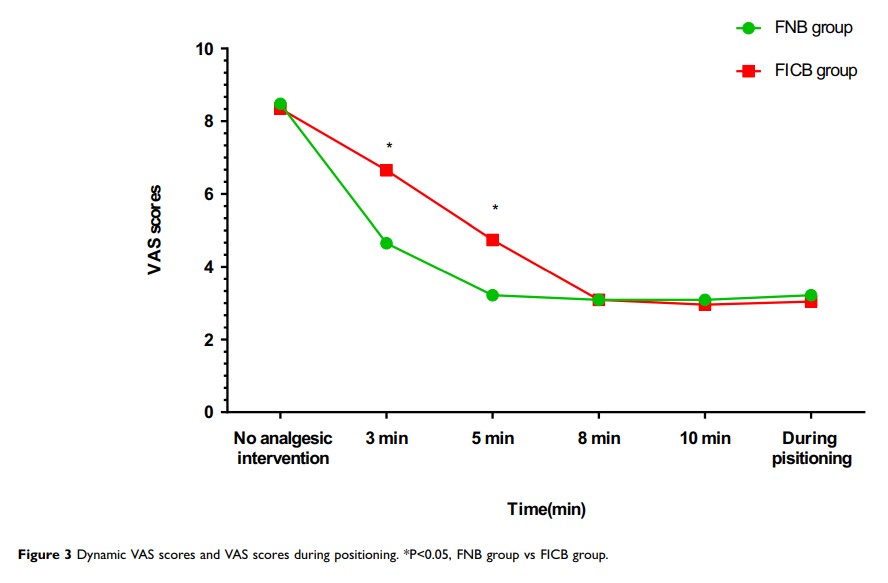
Results: The VAS scores in the FNB group were significantly lower than those in FICB group at 3 and 5 min after analgesia intervention (P=0.000). However, there were no significant differences in VAS between groups at 8 or 10 min or during positioning.
Conclusion: FNB and FICB produce similar analgesic effects in patients with femoral neck fractures, but FNB has a more rapid onset of pain relief.
Keywords: femoral neck fracture, femoral nerve block, fascia iliaca compartment block, analgesia