115195
论文已发表
注册即可获取德孚的最新动态
IF 收录期刊
- 3.6 Breast Cancer (Dove Med Press)
- 4.3 Clin Epidemiol
- 2.6 Cancer Manag Res
- 3.2 Infect Drug Resist
- 4.1 Clin Interv Aging
- 6.1 Drug Des Dev Ther
- 4.1 Int J Chronic Obstr
- 8.7 Int J Nanomed
- 2.5 Int J Women's Health
- 3.2 Neuropsych Dis Treat
- 2.4 OncoTargets Ther
- 2.6 Patient Prefer Adher
- 2.6 Ther Clin Risk Manag
- 3.1 J Pain Res
- 3.5 Diabet Metab Synd Ob
- 4.5 Psychol Res Behav Ma
- 3.4 Nat Sci Sleep
- 2.4 Pharmgenomics Pers Med
- 2.6 Risk Manag Healthc Policy
- 4.6 J Inflamm Res
- 2.3 Int J Gen Med
- 3.9 J Hepatocell Carcinoma
- 3.3 J Asthma Allergy
- 2.5 Clin Cosmet Investig Dermatol
- 3.0 J Multidiscip Healthc

具有视觉刺激响应的有结构性颜色变化的智能药物递送微粒
Authors Sun X, Liu L, Zou H, Yao C, Yan Z, Ye B
Received 9 February 2020
Accepted for publication 18 June 2020
Published 12 July 2020 Volume 2020:15 Pages 4959—4967
DOI https://doi.org/10.2147/IJN.S249009
Checked for plagiarism Yes
Review by Single-blind
Peer reviewer comments 4
Editor who approved publication: Dr Mian Wang
Background: Particle-based drug delivery systems (DDSs) have a demonstrated value for drug discovery and development. However, some problems remain to be solved, such as limited stimuli, visual-monitoring.
Aim: To develop an intelligent multicolor DDSs with both near-infrared (NIR) controlled release and macroscopic color changes.
Materials and Methods: Microparticles comprising GO/pNIPAM/PEGDA composite hydrogel inverse opal scaffolds, with dextran and calcium alginate hydrogel were synthesized using SCCBs as the template. The morphology of microparticle was observed under scanning electron microscopy, and FITC-dextran-derived green fluorescence images were determined using a confocal laser scanning microscope. During the drug release, FITC-dextran-derived green fluorescence images were captured using fluorescent inverted microscope. The relationship between the power of NIR and the drug release rate was obtained using the change in optical density (OD) values. Finally, the amount of drug released could be estimated quantitatively used the structural color or the reflection peak position.
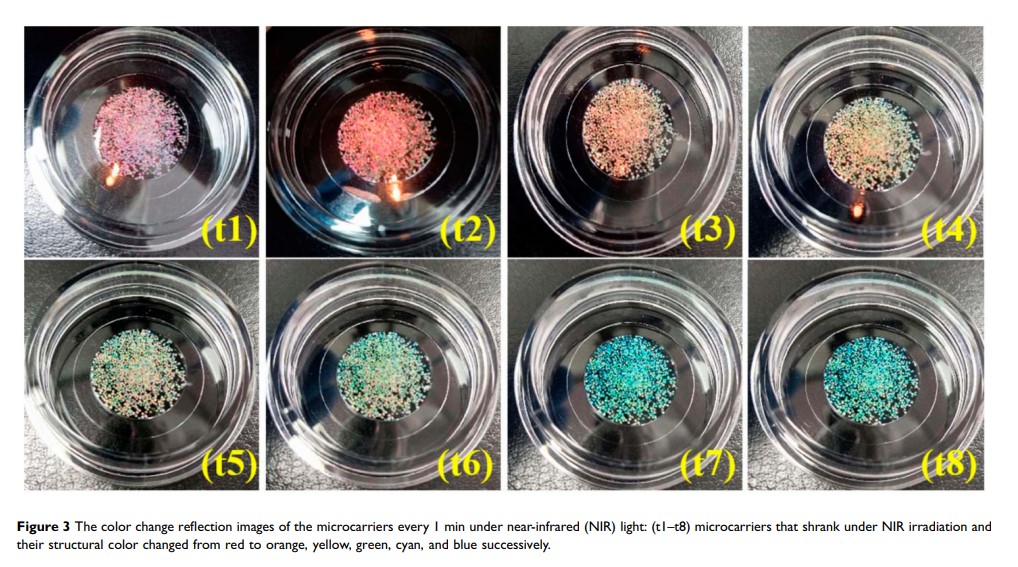
Results: A fixed concentration 8% (v/v) of PEGDA and 4mg/mL of GO was chosen as the optimal concentration based on the balance between appropriate volume shrinkage and structure color. The FITC-dextran was uniformly encapsulated in the particles by using 0.2 wt% sodium alginate. The microcarriers shrank because of the photothermal response and the intrinsic fluorescence intensity of FITC-dextran in the microparticles gradually decreased at the same time, indicating drug release. With an increasing duration of NIR irradiation, the microparticles gradually shrank, the reflection peak shifted toward blue and the structural color changed from red to orange, yellow, green, cyan, and blue successively. The drug release quantity can be predicted by the structural color of microparticles.
Conclusion: The multicolor microparticles have great potential in drug delivery systems because of its vivid reporting color, excellent photothermal effect, and the good stimuli responsivity.
Keywords: drug delivery, microparticles, color change, graphene oxide, photothermal effect