115195
论文已发表
注册即可获取德孚的最新动态
IF 收录期刊
- 3.6 Breast Cancer (Dove Med Press)
- 4.3 Clin Epidemiol
- 2.6 Cancer Manag Res
- 3.2 Infect Drug Resist
- 4.1 Clin Interv Aging
- 6.1 Drug Des Dev Ther
- 4.1 Int J Chronic Obstr
- 8.7 Int J Nanomed
- 2.5 Int J Women's Health
- 3.2 Neuropsych Dis Treat
- 2.4 OncoTargets Ther
- 2.6 Patient Prefer Adher
- 2.6 Ther Clin Risk Manag
- 3.1 J Pain Res
- 3.5 Diabet Metab Synd Ob
- 4.5 Psychol Res Behav Ma
- 3.4 Nat Sci Sleep
- 2.4 Pharmgenomics Pers Med
- 2.6 Risk Manag Healthc Policy
- 4.6 J Inflamm Res
- 2.3 Int J Gen Med
- 3.9 J Hepatocell Carcinoma
- 3.3 J Asthma Allergy
- 2.5 Clin Cosmet Investig Dermatol
- 3.0 J Multidiscip Healthc

中药射脂黄灵汤(Shezhi Huangling Decoction)通过调控 miR-1298-5p/TGIF1 轴抑制胶质瘤细胞的生长和转移
Authors Liu X, Ju J, Liu Q, Zhu Z, Liu C
Received 18 December 2019
Accepted for publication 3 June 2020
Published 13 July 2020 Volume 2020:12 Pages 5677—5687
DOI https://doi.org/10.2147/CMAR.S242856
Checked for plagiarism Yes
Review by Single-blind
Peer reviewer comments 2
Editor who approved publication: Dr Yong Teng
Purpose: In recent years, traditional Chinese medicine has achieved good results in treating gliomas. This research aimed to reveal the effect of Shezhi Huangling decoction (SD) on glioma cell process.
Methods: U87 and U251 cells were treated with different concentrations (10, 30 and 50 μg/mL) of SD or transfected with miR-1298-5p mimic, inhibitor and siRNA targeting TGIF1. Cell proliferation, migration, invasion and apoptosis were detected. The expression of miR-1298-5p was measured by qRT-PCR, while TGIF1 expression was examined by immunohistochemical analysis and Western blot.
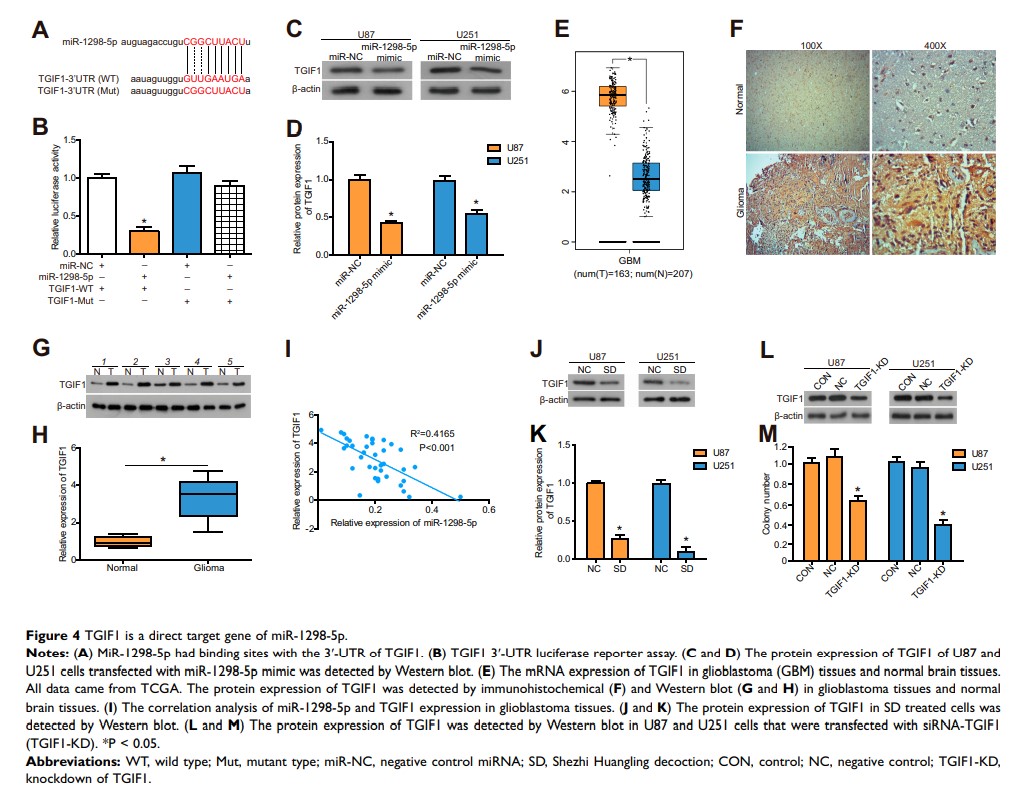
Results: SD treatment inhibited the proliferation, migration and invasion of glioma cells and induced the apoptosis. In addition, SD treatment induced the expression of miR-1298-5p in glioma cells. The low expression of miR-1298-5p was examined in glioma tissues and was significantly related to the high histological grade of glioma patients and predicted a poor prognosis. MiR-1298-5p directly targeted the 3ʹ-UTR of transforming growth factor β induced factor 1 (TGIF1) and reduced TGIF1 protein expression. MiR-1298-5p restricted the proliferation, migration and invasion of glioma cells and induced cell apoptosis by targeting TGIF1.
Conclusion: Our data reveal that SD acts as a cancer-inhibiting agent in glioma via miR-1298-5p/TGIF1 axis, suggesting a potential therapeutic application of SD in glioma.
Keywords: glioma, Chinese medicine, Shezhi Huangling decoction, miR-1298-5p, TGIF1