115195
论文已发表
注册即可获取德孚的最新动态
IF 收录期刊
- 3.6 Breast Cancer (Dove Med Press)
- 4.3 Clin Epidemiol
- 2.6 Cancer Manag Res
- 3.2 Infect Drug Resist
- 4.1 Clin Interv Aging
- 6.1 Drug Des Dev Ther
- 4.1 Int J Chronic Obstr
- 8.7 Int J Nanomed
- 2.5 Int J Women's Health
- 3.2 Neuropsych Dis Treat
- 2.4 OncoTargets Ther
- 2.6 Patient Prefer Adher
- 2.6 Ther Clin Risk Manag
- 3.1 J Pain Res
- 3.5 Diabet Metab Synd Ob
- 4.5 Psychol Res Behav Ma
- 3.4 Nat Sci Sleep
- 2.4 Pharmgenomics Pers Med
- 2.6 Risk Manag Healthc Policy
- 4.6 J Inflamm Res
- 2.3 Int J Gen Med
- 3.9 J Hepatocell Carcinoma
- 3.3 J Asthma Allergy
- 2.5 Clin Cosmet Investig Dermatol
- 3.0 J Multidiscip Healthc

基于网络药理学预测和验证左金丸治疗大肠癌的有效成分和潜在靶点
Authors Huang S, Zhang Z, Li W, Kong F, Yi P, Huang J, Mao D, Peng W, Zhang S
Received 23 February 2020
Accepted for publication 2 June 2020
Published 14 July 2020 Volume 2020:14 Pages 2725—2740
DOI https://doi.org/10.2147/DDDT.S250991
Checked for plagiarism Yes
Review by Single-blind
Peer reviewer comments 2
Editor who approved publication: Professor Jianbo Sun
Background: Zuojinwan (ZJW), a famous Chinese medicine formula, has been widely used to treat colorectal cancer (CRC). However, its bioactive compounds, potential targets, and molecular mechanism remain largely elusive.
Aim: A network pharmacology-based strategy combined with molecular docking studies and in vitro validation were employed to investigate bioactive compounds, potential targets, and molecular mechanism of ZJW against CRC.
Materials and Methods: Bioactive compounds and potential targets of ZJW, as well as related genes of CRC, were acquired from public databases. Important ingredients, potential targets, and signaling pathways were determined through bioinformatics analysis, including protein–protein interaction (PPI), the Gene Ontology (GO), and the Kyoto Encyclopedia of Genes and Genomes (KEGG). Subsequently, molecular docking and cell experiments were performed to further verify the findings.
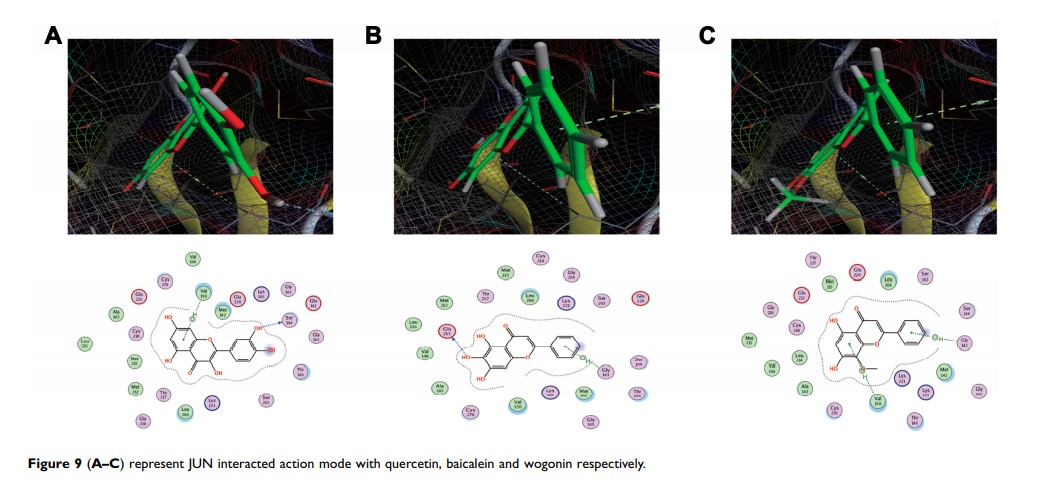
Results: A total of 36 bioactive ingredients of ZJW and 163 gene targets of ZJW were identified. The network analysis revealed that quercetin, baicalein, wogonin, beta-sitosterol, and isorhamnetin may be candidate agents. The AKT1, JUN, CDKN1A, BCL2L1, and NCOA1 could become potential drug targets. The KEGG indicated that PI3K-AKT signaling pathway may play an important role in the effect of ZJW against CRC. Molecular docking suggested that quercetin, baicalein, and wogonin combined well with AKT1 and JUN. The in vitro experiment showed that quercetin, the most important ingredient of ZJW, could induce apoptosis of HCT116 cells through PI3K-Akt signaling pathway. This finding was congruent with the prediction obtained through the network pharmacology approach.
Conclusion: This study comprehensively illuminated the active ingredients, potential targets, and molecular mechanism of ZJW against CRC. It also provided a promising approach to uncover the scientific basis and therapeutic mechanism of traditional Chinese medicine (TCM) formula treating for disease.
Keywords: Zuojinwan, colorectal cancer, network pharmacology, PI3K/AKT signal pathway