115195
论文已发表
注册即可获取德孚的最新动态
IF 收录期刊
- 3.6 Breast Cancer (Dove Med Press)
- 4.3 Clin Epidemiol
- 2.6 Cancer Manag Res
- 3.2 Infect Drug Resist
- 4.1 Clin Interv Aging
- 6.1 Drug Des Dev Ther
- 4.1 Int J Chronic Obstr
- 8.7 Int J Nanomed
- 2.5 Int J Women's Health
- 3.2 Neuropsych Dis Treat
- 2.4 OncoTargets Ther
- 2.6 Patient Prefer Adher
- 2.6 Ther Clin Risk Manag
- 3.1 J Pain Res
- 3.5 Diabet Metab Synd Ob
- 4.5 Psychol Res Behav Ma
- 3.4 Nat Sci Sleep
- 2.4 Pharmgenomics Pers Med
- 2.6 Risk Manag Healthc Policy
- 4.6 J Inflamm Res
- 2.3 Int J Gen Med
- 3.9 J Hepatocell Carcinoma
- 3.3 J Asthma Allergy
- 2.5 Clin Cosmet Investig Dermatol
- 3.0 J Multidiscip Healthc

放射治疗中的 HMGB1:调节肿瘤放射敏感性和免疫性的双头信号
Authors Liao Y, Liu S, Fu S, Wu J
Received 13 March 2020
Accepted for publication 19 June 2020
Published 14 July 2020 Volume 2020:13 Pages 6859—6871
DOI https://doi.org/10.2147/OTT.S253772
Checked for plagiarism Yes
Review by Single-blind
Peer reviewer comments 3
Editor who approved publication: Dr Carlos E Vigil
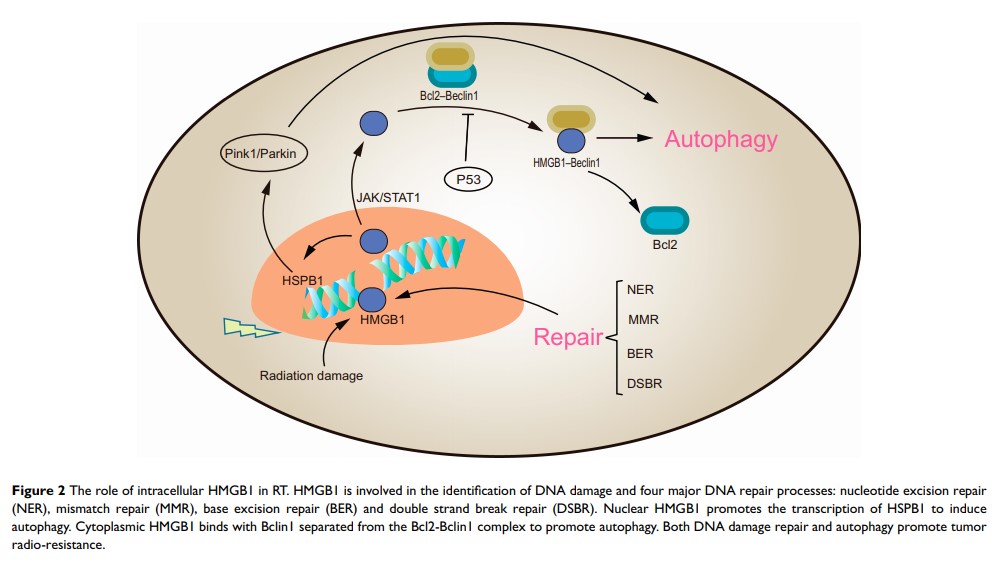
Abstract: Radiotherapy (RT) is a mainstay of cancer treatment. Recent studies have shown that RT not only directly induces cell death but also has late and sustained immune effects. High mobility group box 1 (HMGB1) is a nuclear protein released during RT, with location-dependent functions. It is essential for normal cellular function but also regulates the proliferation and migration of tumor cells by binding to high-affinity receptors. In this review, we summarize recent evidence on the functions of HMGB1 in RT according to the position, intracellular HMGB1 and extracellular HMGB1. Intracellular HMGB1 induces radiation tolerance in tumor cells by promoting DNA damage repair and autophagy. Extracellular HMGB1 plays a more intricate role in radiation-related immune responses, wherein it not only stimulates the anti-tumor immune response by facilitating the recognition of dying tumor cells but is also involved in maintaining immunosuppression. Factors that potentially affect the role of HMGB1 in RT-induced cytotoxicity have also been discussed in the context of possible therapeutic applications, which helps to develop effective and targeted radio-sensitization therapies.
Keywords: autophagy, DNA damage repair, high mobility group box 1, immune modulation, tumor radiosensitivity