115195
论文已发表
注册即可获取德孚的最新动态
IF 收录期刊
- 3.6 Breast Cancer (Dove Med Press)
- 4.3 Clin Epidemiol
- 2.6 Cancer Manag Res
- 3.2 Infect Drug Resist
- 4.1 Clin Interv Aging
- 6.1 Drug Des Dev Ther
- 4.1 Int J Chronic Obstr
- 8.7 Int J Nanomed
- 2.5 Int J Women's Health
- 3.2 Neuropsych Dis Treat
- 2.4 OncoTargets Ther
- 2.6 Patient Prefer Adher
- 2.6 Ther Clin Risk Manag
- 3.1 J Pain Res
- 3.5 Diabet Metab Synd Ob
- 4.5 Psychol Res Behav Ma
- 3.4 Nat Sci Sleep
- 2.4 Pharmgenomics Pers Med
- 2.6 Risk Manag Healthc Policy
- 4.6 J Inflamm Res
- 2.3 Int J Gen Med
- 3.9 J Hepatocell Carcinoma
- 3.3 J Asthma Allergy
- 2.5 Clin Cosmet Investig Dermatol
- 3.0 J Multidiscip Healthc

骨髓增生异常综合症患者的轻度/中度骨髓纤维化和单体核型分别与不良预后相关:长期随访数据
Authors Wang N, Xu H, Li Q, Fang X, Liu J, Sui X, Zhang L, Jiang Y, Wang X
Received 19 April 2020
Accepted for publication 25 June 2020
Published 16 July 2020 Volume 2020:12 Pages 5881—5891
DOI https://doi.org/10.2147/CMAR.S258875
Checked for plagiarism Yes
Review by Single-blind
Peer reviewer comments 4
Editor who approved publication: Dr Eileen O'Reilly
Purpose: The aim of our study was to evaluate the clinical characteristics of myelodysplastic syndrome (MDS) patients with concomitant mild-to-moderate myelofibrosis (MF), and to assess its independent prognostic role in MDS patients diagnosed by World Health Organization 2016 classification (WHO2016C) with long-term follow-up.
Patients and Methods: A total of 157 patients with primary MDS associated with or without MF were examined retrospectively with long-term follow-up. MF graded as MF-1/MF-2 was defined as “mild/moderate”. Cytogenetics testing and fluorescence in situ hybridization (FISH) were also conducted in all MDS patients.
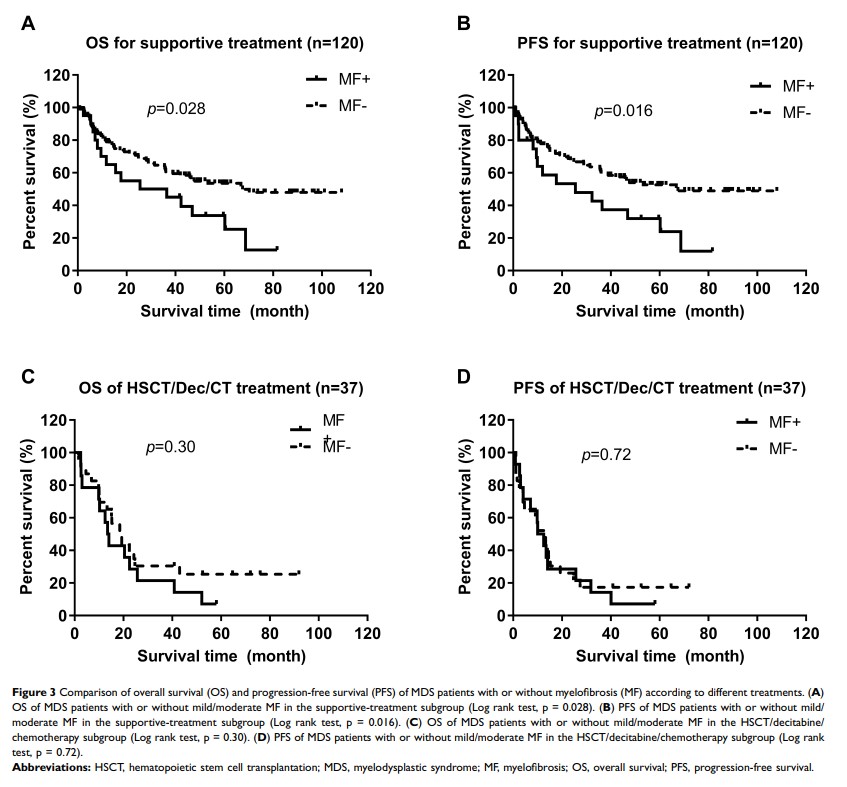
Results: Thirty-four (21.7%) of 157 MDS patients had MF. Also, 24 (15.3%) MDS patients based on WHO2016 criteria were defined as MF-1 and 10 (6.4%) as MF-2. MDS patients with MF-1/2 had a higher prevalence of death (p=0.002), leukemic progression (p=0.013), O blood type (p=0.039) as well as less hypercellular proliferation (p< 0.001) and less supportive treatment (p=0.003) compared with those without mild/moderate MF. Cytogenetics testing did not show a significant difference between MDS patients with and without MF. Multivariate analyses showed that MF (mild/moderate), a monosomal karyotype (MK) and % bone-marrow blasts were independently associated with shorter overall survival (OS) and progression-free survival (PFS). Age was an independent indicator of the adverse OS of MDS patients. Compared with those without MF, MDS patients with mild/moderate MF were significantly associated with worse OS and PFS in MK-negative subgroups and relatively low-risk Revised International Prognostic Scoring System for Myelodysplastic Syndromes (IPSS-R) stratification in long-term follow-up.
Conclusion: Mild/moderate myelofibrosis and monosomal karyotype are independent indicators of a poor clinical outcome in MDS patients. In long-term follow-up, MDS with mild/moderate MF can be a prognostic marker for MDS patients with a specific MK stratification and IPSS-R stratification.
Keywords: myelodysplastic syndromes, myelofibrosis, prognosis, cytogenetics