115195
论文已发表
注册即可获取德孚的最新动态
IF 收录期刊
- 3.6 Breast Cancer (Dove Med Press)
- 4.3 Clin Epidemiol
- 2.6 Cancer Manag Res
- 3.2 Infect Drug Resist
- 4.1 Clin Interv Aging
- 6.1 Drug Des Dev Ther
- 4.1 Int J Chronic Obstr
- 8.7 Int J Nanomed
- 2.5 Int J Women's Health
- 3.2 Neuropsych Dis Treat
- 2.4 OncoTargets Ther
- 2.6 Patient Prefer Adher
- 2.6 Ther Clin Risk Manag
- 3.1 J Pain Res
- 3.5 Diabet Metab Synd Ob
- 4.5 Psychol Res Behav Ma
- 3.4 Nat Sci Sleep
- 2.4 Pharmgenomics Pers Med
- 2.6 Risk Manag Healthc Policy
- 4.6 J Inflamm Res
- 2.3 Int J Gen Med
- 3.9 J Hepatocell Carcinoma
- 3.3 J Asthma Allergy
- 2.5 Clin Cosmet Investig Dermatol
- 3.0 J Multidiscip Healthc

中国高血压患者对降压药依从性的分析:使用中国健康保险协会数据库进行回顾性分析
Authors Cui B, Dong Z, Zhao M, Li S, Xiao H, Liu Z, Yan X
Received 24 December 2019
Accepted for publication 24 May 2020
Published 17 July 2020 Volume 2020:14 Pages 1195—1204
DOI https://doi.org/10.2147/PPA.S243665
Checked for plagiarism Yes
Review by Single-blind
Peer reviewer comments 2
Editor who approved publication: Dr Naifeng Liu
Objective: To analyze the adherence to antihypertensive drugs in Chinese patients with hypertension and the factors associated with the drug adherence.
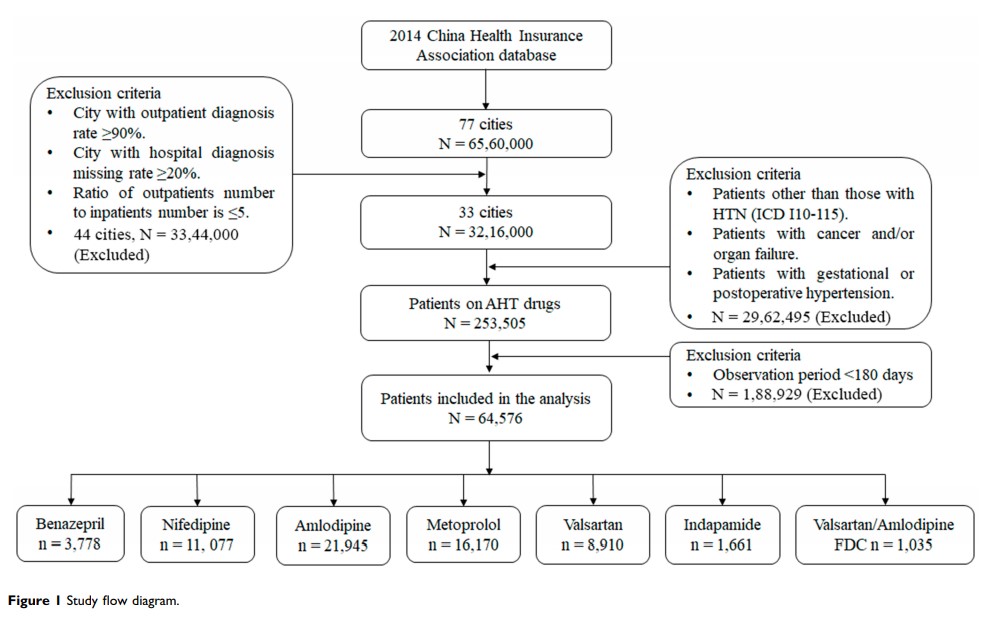
Methods: The data for this analysis were obtained from the 2014 China Health Insurance Association (CHIRA) database. The study included 64,576 patients aged ≥ 18 years who were prescribed one of the seven antihypertensive drugs included in the study in their first prescription in 2014 and were observed for ≥ 180 days. The medicine possession ratio (MPR) was calculated and taken as the measure of treatment adherence. MPR values < 0.3, 0.3 to < 0.5, 0.5 to < 0.8, and ≥ 0.8 were considered treatment adherence very low, low, intermediate, and high, respectively. Descriptive statistics were used to present baseline data and treatment adherence rate. Multiple regression models were used to determine independent factors which can affect the treatment adherence rate. P -value < 0.05 was considered significant.
Results: Among the study antihypertensive drugs, amlodipine (33.98%), metoprolol (25.04%), and nifedipine (17.15%) were the frequently prescribed drugs. Nifedipine controlled release tablet had the highest MPR (0.61), followed by valsartan (0.53), valsartan/amlodipine fixed-dose combination (0.50), indapamide (0.40), and amlodipine (0.39), whereas benazepril (0.27) and metoprolol (0.19) had the lowest MPR. Higher reimbursement ratio, regular tertiary hospitals visits, lower age, and lower daily medical cost positively affected treatment adherence, whereas longer duration of illness and higher daily average cost affected treatment adherence negatively.
Conclusion: Our study assessed that prescribing more cost-effective, long-acting antihypertensive drugs, and raising the reimbursement ratio were associated with a better treatment adherence in Chinese patients with hypertension.
Keywords: treatment adherence, medicine possession ratio, hypertension, antihypertensive treatment