115195
论文已发表
注册即可获取德孚的最新动态
IF 收录期刊
- 3.6 Breast Cancer (Dove Med Press)
- 4.3 Clin Epidemiol
- 2.6 Cancer Manag Res
- 3.2 Infect Drug Resist
- 4.1 Clin Interv Aging
- 6.1 Drug Des Dev Ther
- 4.1 Int J Chronic Obstr
- 8.7 Int J Nanomed
- 2.5 Int J Women's Health
- 3.2 Neuropsych Dis Treat
- 2.4 OncoTargets Ther
- 2.6 Patient Prefer Adher
- 2.6 Ther Clin Risk Manag
- 3.1 J Pain Res
- 3.5 Diabet Metab Synd Ob
- 4.5 Psychol Res Behav Ma
- 3.4 Nat Sci Sleep
- 2.4 Pharmgenomics Pers Med
- 2.6 Risk Manag Healthc Policy
- 4.6 J Inflamm Res
- 2.3 Int J Gen Med
- 3.9 J Hepatocell Carcinoma
- 3.3 J Asthma Allergy
- 2.5 Clin Cosmet Investig Dermatol
- 3.0 J Multidiscip Healthc

OSTA、FRAX 和 BMI 预测北京汉族人群绝经后骨质疏松症的比较:一项横断面研究
Authors Fan Z, Li X, Zhang X, Yang Y, Fei Q, Guo A
Received 6 April 2020
Accepted for publication 30 June 2020
Published 17 July 2020 Volume 2020:15 Pages 1171—1180
DOI https://doi.org/10.2147/CIA.S257166
Checked for plagiarism Yes
Review by Single-blind
Peer reviewer comments 4
Editor who approved publication: Dr Zhi-Ying Wu
Purpose: To validate the efficacies of three screening tools including the Osteoporosis Self-Assessment Tool for Asians (OSTA), Fracture Risk Assessment Tool (FRAX) without bone mineral density (BMD), and body mass index (BMI) for predicting postmenopausal osteoporosis (OP) and to define the ideal thresholds for avoidance of dual-energy X-ray absorptiometry (DXA) scanning in a Han Chinese population in Beijing.
Patients and Methods: A total of 2055 community-dwelling Han Beijing postmenopausal females aged ≥ 45 years were enrolled in this study. All participants completed a questionnaire, and BMD was measured by DXA. OP was defined by a T-score at least − 2.5 SD less than that of average young adults in different diagnostic criteria [lumbar spine, femoral neck, total hip, worst hip, WHO]. The abilities of the OSTA, FRAX, and BMI to predict OP were analyzed by receiver operating characteristic (ROC) curves. Sensitivity, specificity, and area under the ROC curves (AUC) were calculated. Ideal thresholds for identifying OP were proposed.
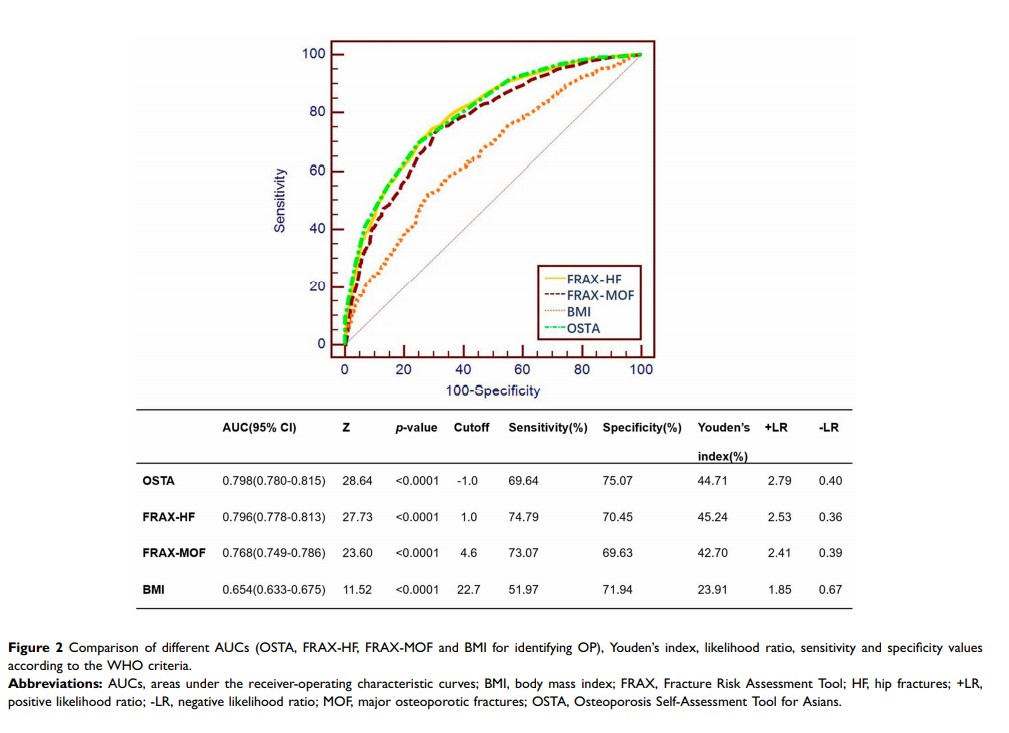
Results: The prevalence of OP ranged from 8.1% to 28.4% according to different diagnostic criteria. The AUC range for the OSTA (0.758– 0.849) was similar to the FRAX (0.728– 0.855), which revealed that both tools predicted OP reliably. The AUC range for BMI was 0.643– 0.682, suggesting limited predictive value. According to WHO criteria, the AUC values for the FRAX for hip fracture risk (FRAX-HF) and for the OSTA were 0.796 and 0.798, with corresponding sensitivities of 74.79% and 69.64% and specificities of 70.45% and 75.07%, respectively. At defined thresholds, the FRAX-HF and OSTA allowed avoidance of DXA in 42.4– 37.6% of participants, at a cost of missing only 7.2– 8.6% of individuals with OP.
Conclusion: The OSTA and FRAX-HF may be reliable and effective tools for identifying postmenopausal OP in the Han Beijing population without BMD.
Keywords: postmenopausal osteoporosis, OSTA, FRAX, BMI