115195
论文已发表
注册即可获取德孚的最新动态
IF 收录期刊
- 3.6 Breast Cancer (Dove Med Press)
- 4.3 Clin Epidemiol
- 2.6 Cancer Manag Res
- 3.2 Infect Drug Resist
- 4.1 Clin Interv Aging
- 6.1 Drug Des Dev Ther
- 4.1 Int J Chronic Obstr
- 8.7 Int J Nanomed
- 2.5 Int J Women's Health
- 3.2 Neuropsych Dis Treat
- 2.4 OncoTargets Ther
- 2.6 Patient Prefer Adher
- 2.6 Ther Clin Risk Manag
- 3.1 J Pain Res
- 3.5 Diabet Metab Synd Ob
- 4.5 Psychol Res Behav Ma
- 3.4 Nat Sci Sleep
- 2.4 Pharmgenomics Pers Med
- 2.6 Risk Manag Healthc Policy
- 4.6 J Inflamm Res
- 2.3 Int J Gen Med
- 3.9 J Hepatocell Carcinoma
- 3.3 J Asthma Allergy
- 2.5 Clin Cosmet Investig Dermatol
- 3.0 J Multidiscip Healthc

LTBP4 的破坏可诱导 TGFβ1 的活化及免疫抑制信号,并促进肝细胞癌的肺转移
Authors Yang X, Ye X, Zhang L, Zhang X, Shu P
Received 21 January 2020
Accepted for publication 22 June 2020
Published 20 July 2020 Volume 2020:13 Pages 7007—7017
DOI https://doi.org/10.2147/OTT.S246766
Checked for plagiarism Yes
Review by Single-blind
Peer reviewer comments 2
Editor who approved publication: Prof. Dr. Geoffrey Pietersz
Introduction: The current prognosis of hepatocellular carcinoma (HCC) is unsatisfactory due to high rates of recurrence and metastasis, which has led to research focused on the discovery of metastasis genes.
Methods: In this study, we combined in silico analysis and in vitro transwell experiments to identify a metastasis gene. Then, we used an in vivo experiment to validate the metastasis. Furthermore, a series of experiments such as FACS, Western blot, and ELISA were applied to explore the function of the metastasis gene.
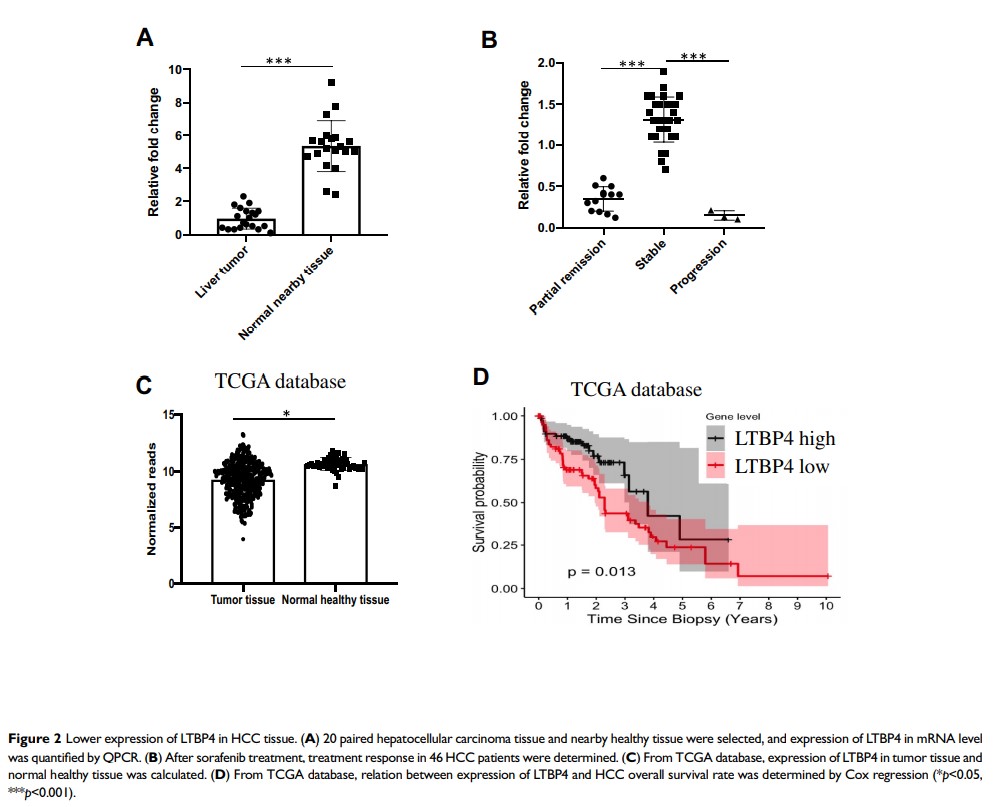
Results: LTBP4 (latent transforming growth factor beta binding protein 4) was confirmed as a metastasis gene, whose expression levels are correlated with the overall survival rate of HCC patients. We further showed that the knockout of LTBP4 in an HCC cell line increased cell proliferation, activated the cell cycle, and induced metastasis events. Moreover, we proved that LTBP4-KO could increase the percentage of active TGFβ 1 secreted by HCC cell lines, as well as the recruitment of MDSCs (myeloid-derived suppressor cells) by active TGFβ 1 (transforming growth factor beta 1), which further inhibited CD8+ T cell proliferation and activated the immune suppression signal.
Conclusion: Our results demonstrate that the LTBP4-TGFβ 1-MDSCs axis is a critical pathway for the immune suppression signals of HCC primary tumors.
Keywords: hepatocellular carcinoma, LTBP4, TGFβ 1, MDSCs, T cell proliferation