115195
论文已发表
注册即可获取德孚的最新动态
IF 收录期刊
- 3.6 Breast Cancer (Dove Med Press)
- 4.3 Clin Epidemiol
- 2.6 Cancer Manag Res
- 3.2 Infect Drug Resist
- 4.1 Clin Interv Aging
- 6.1 Drug Des Dev Ther
- 4.1 Int J Chronic Obstr
- 8.7 Int J Nanomed
- 2.5 Int J Women's Health
- 3.2 Neuropsych Dis Treat
- 2.4 OncoTargets Ther
- 2.6 Patient Prefer Adher
- 2.6 Ther Clin Risk Manag
- 3.1 J Pain Res
- 3.5 Diabet Metab Synd Ob
- 4.5 Psychol Res Behav Ma
- 3.4 Nat Sci Sleep
- 2.4 Pharmgenomics Pers Med
- 2.6 Risk Manag Healthc Policy
- 4.6 J Inflamm Res
- 2.3 Int J Gen Med
- 3.9 J Hepatocell Carcinoma
- 3.3 J Asthma Allergy
- 2.5 Clin Cosmet Investig Dermatol
- 3.0 J Multidiscip Healthc

综合分析 SiNPs 对秀丽隐杆线虫全基因组转录变化的影响
Authors Liang S, Duan J, Hu H, Zhang J, Gao S, Jing H, Li G, Sun Z
Received 25 February 2020
Accepted for publication 10 June 2020
Published 23 July 2020 Volume 2020:15 Pages 5227—5237
DOI https://doi.org/10.2147/IJN.S251269
Checked for plagiarism Yes
Review by Single-blind
Peer reviewer comments 2
Editor who approved publication: Dr Mian Wang
Background: Large-scale production and application of amorphous silica nanoparticles (SiNPs) have enhanced the risk of human exposure to SiNPs. However, the toxic effects and the underlying biological mechanisms of SiNPs on Caenorhabditis elegans remain largely unclear.
Purpose: This study was to investigate the genome-wide transcriptional alteration of SiNPs on C. elegans .
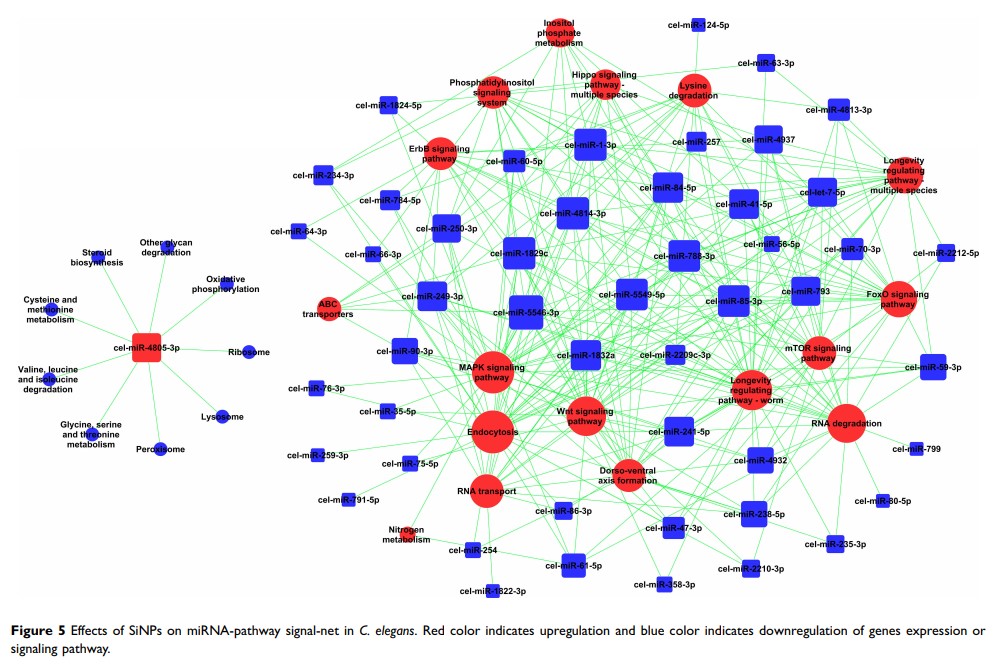
Methods and Results: In this study, a total number of 3105 differentially expressed genes were identified in C. elegans . Among them, 1398 genes were significantly upregulated and 1707 genes were notably downregulated in C. elegans . Gene ontology analysis revealed that the significant change of gene functional categories triggered by SiNPs was focused on locomotion, determination of adult lifespan, reproduction, body morphogenesis, multicellular organism development, endoplasmic reticulum unfolded protein response, oocyte development, and nematode larval development. Meanwhile, we explored the regulated effects between microRNA and genes or signaling pathways. Pathway enrichment analysis and miRNA-gene-pathway-network displayed that 23 differential expression microRNA including cel-miR-85-3p, cel-miR-793, cel-miR-241-5p , and cel-miR-5549-5p could regulate the longevity-related pathways and inflammation signaling pathways, etc. Additionally, our data confirmed that SiNPs could disrupt the locomotion behavior and reduce the longevity by activating ins-7, daf-16, ftt-2, fat-5 , and rho-1 genes in C. elegans .
Conclusion: Our study showed that SiNPs induced the change of the whole transcriptome in C. elegans , and triggered negative effects on longevity, development, reproduction, and body morphogenesis. These data provide abundant clues to understand the molecular mechanisms of SiNPs in C. elegans .
Keywords: SiNPs, genome microarrays, longevity, development, Caenorhabditis elegans