115195
论文已发表
注册即可获取德孚的最新动态
IF 收录期刊
- 3.6 Breast Cancer (Dove Med Press)
- 4.3 Clin Epidemiol
- 2.6 Cancer Manag Res
- 3.2 Infect Drug Resist
- 4.1 Clin Interv Aging
- 6.1 Drug Des Dev Ther
- 4.1 Int J Chronic Obstr
- 8.7 Int J Nanomed
- 2.5 Int J Women's Health
- 3.2 Neuropsych Dis Treat
- 2.4 OncoTargets Ther
- 2.6 Patient Prefer Adher
- 2.6 Ther Clin Risk Manag
- 3.1 J Pain Res
- 3.5 Diabet Metab Synd Ob
- 4.5 Psychol Res Behav Ma
- 3.4 Nat Sci Sleep
- 2.4 Pharmgenomics Pers Med
- 2.6 Risk Manag Healthc Policy
- 4.6 J Inflamm Res
- 2.3 Int J Gen Med
- 3.9 J Hepatocell Carcinoma
- 3.3 J Asthma Allergy
- 2.5 Clin Cosmet Investig Dermatol
- 3.0 J Multidiscip Healthc

通过集群分析确定新型的上皮性卵巢癌预后分类模型
Authors Chen K, Niu Y, Wang S, Fu Z, Lin H, Lu J, Meng X, Yang B, Zhang H, Wu Y, Xia D, Lu W
Received 29 February 2020
Accepted for publication 24 June 2020
Published 24 July 2020 Volume 2020:12 Pages 6251—6259
DOI https://doi.org/10.2147/CMAR.S251882
Checked for plagiarism Yes
Review by Single-blind
Peer reviewer comments 3
Editor who approved publication: Dr Sanjeev Srivastava
Background: Heterogeneity plays an essential role in ovarian cancer. Patients with different clinical features may manifest diverse patterns in diagnosis, treatment, and prognosis. The aim of the present study was to identify a novel ovarian cancer–classification model through cluster analysis and assess its significance in prognosis.
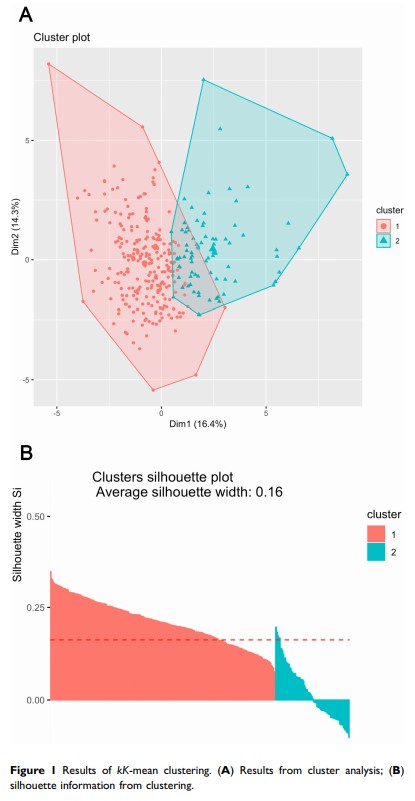
Methods: Among patients diagnosed with ovarian cancer in the Women’s Hospital School of Medicine, Zhejiang University between January 2014 and May 2019, 328 patients were included in a K-mean cluster analysis and 176 patients followed up. Major clinical indicators, overall survival, and recurrence-free survival in different subgroups were compared.
Results: Two clusters for ovarian cancer were identified and grouped as noninflammatory (n=247) and inflammatory subtypes (n=81). Compared with the noninflammatory subgroup, the inflammatory subgroup presented a statistically significantly higher level of median CRP (median (IQR) 20.4 [7.8– 47.3] vs 1.2 [0.4– 3.5], p < 0.001), neutrophil percentage (median (IQR) 76.9 [72.6– 81.3] vs 66.2 [61.0– 72.0], p < 0.001), leukocyte count (median (IQR) 8.9 [7.0– 10.0] vs 6.0 [5.1– 7.2], p < 0.001), fibrinogen (median (IQR) 5.0 [4.4– 6.0] vs 3.4 [2.9– 3.9], p < 0.001), and platelet count (median (IQR) 324 [270– 405] vs 229 [181.5– 269], p < 0.001). During a median follow-up of 52 months, 21 participants (16.3%) died in the noninflammatory group, while 14 (29.8%) died in the inflammatory group (HR 2.15, 95% CI 1.09– 4.23; p =0.024). Death/recurrence was observed in 38 (29.5%) patients from the noninflammatory group and 25 (53.2%) from the inflammatory group (HR 2.32, 95% CI 1.40– 3.85; p < 0.001).
Conclusion: Our study revealed a novel classification model of ovarian cancer that features inflammation. Inflammation predicts shorter survival and poorer prognosis, suggesting the significance of inflammation in the management of ovarian cancer.
Keywords: ovarian cancer, classification, heterogeneity, cluster analysis, inflammation, prognosis