115195
论文已发表
注册即可获取德孚的最新动态
IF 收录期刊
- 3.6 Breast Cancer (Dove Med Press)
- 4.3 Clin Epidemiol
- 2.6 Cancer Manag Res
- 3.2 Infect Drug Resist
- 4.1 Clin Interv Aging
- 6.1 Drug Des Dev Ther
- 4.1 Int J Chronic Obstr
- 8.7 Int J Nanomed
- 2.5 Int J Women's Health
- 3.2 Neuropsych Dis Treat
- 2.4 OncoTargets Ther
- 2.6 Patient Prefer Adher
- 2.6 Ther Clin Risk Manag
- 3.1 J Pain Res
- 3.5 Diabet Metab Synd Ob
- 4.5 Psychol Res Behav Ma
- 3.4 Nat Sci Sleep
- 2.4 Pharmgenomics Pers Med
- 2.6 Risk Manag Healthc Policy
- 4.6 J Inflamm Res
- 2.3 Int J Gen Med
- 3.9 J Hepatocell Carcinoma
- 3.3 J Asthma Allergy
- 2.5 Clin Cosmet Investig Dermatol
- 3.0 J Multidiscip Healthc

一种以乙二醇为基础的方法,通过培养人卵巢癌细胞系 A2780 的上清液和高级别浆液性癌患者体液来实现细胞外囊泡富集
Authors Jiao R, Sun S, Gao X, Cui R, Cao G, Wei H, Wang S, Zhang Z, Bai H
Received 26 August 2019
Accepted for publication 3 July 2020
Published 24 July 2020 Volume 2020:12 Pages 6291—6301
DOI https://doi.org/10.2147/CMAR.S228288
Checked for plagiarism Yes
Review by Single-blind
Peer reviewer comments 2
Editor who approved publication: Professor Bilikere Dwarakanath
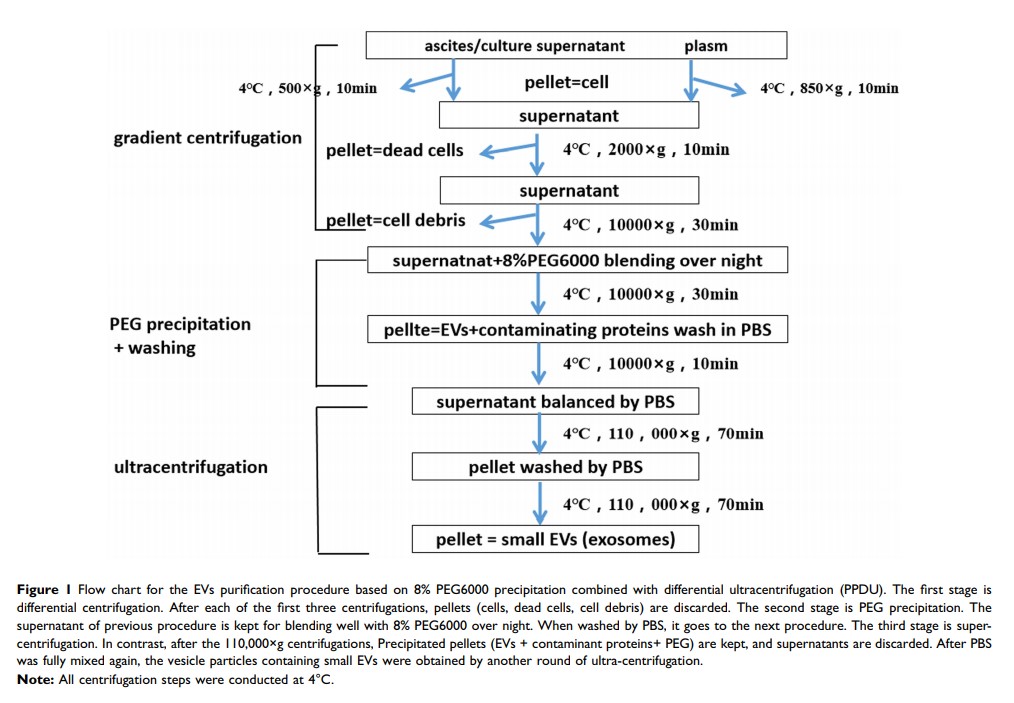
Objective: This study tried to evaluate whether 8% polyethylene glycol (PEG) 6000 precipitation combined with differential ultracentrifugation (PPDU) was an efficient and practical method for the enrichment and purification of extracellular vesicles (EVs) derived from the culture supernatant of human ovarian cancer cell line A2780 and from body fluids of patients with high-grade serous carcinoma (HGSC).
Methods: PPDU was used to enrich and purify the EVs derived from body fluids of patients with HSGC and cell culture supernatant of subclones of human ovarian cancer cell line A2780 with high/low invasive capacity (named as A-H/A-L, respectively). Transmission electron microscope (TEM) and nanoparticle tracking analysis (NTA) were used to identificate the EVs size and distribution. Western blots (WB) were used to detect the expression of CD9, CD63, Alix and Calnexin. The high-purity EVs derived from the cell culture supernatant of A-H/A-L were detected by the protein profile. Expression of integrins (ITGs) αV, β 1 and β 3 in the EVs derived from body fluids of HGSC patients was also evaluated.
Results: The diameter of EVs was about 30– 260 nm observed under the TEM. Under the NTA identification, the peak size of EVs was ranged from 70 to 159nm. EVs derived from different specimens did not significantly differ in mean size and peak size. Presence of CD9, CD63 and Alix and absence of Calnexin were confirmed in the EVs. The protein concentrations of EVs’ sample extracted from A-H/A-L cell culture supernatant were 0.36μg/μL and 0.20μg/μL, respectively. The total amount of protein obtained from 300ul EVs was 108.02ug and 61.44ug, respectively. Totally, 2397 peptides and 952 proteins were identified by isobaric tags for relative and absolute quantitation (ITRAQ). The expression of ITGαV, β 1, and β 3 in the EVs from plasma and ascites of HGSC patients was significantly higher than the control group (plasma: all P< 0.0001; ascites: P=0.036, 0.001 and 0.004, respectively). The expression level of ITGαV and β 1 in EVs of HGSC’s ascites was significantly higher than that in plasma (P= 0.004, 0.001, respectively). The expression of ITGβ 3 was also slightly elevated in EVs-derived HGSC patients’ ascites (P=0.492).
Conclusion: PPDU was an efficient and practical method to enrich EVs from body fluids and cell culture supernatant. The characteristic expression of ITGαV, β 1 and β 3 in ascites and plasma EVs of patients with HGSC provided useful information on the development of EVs in HGSC.
Keywords: EVs, PEG6000 precipitation, HGSC, body fluids, cell culture supernatant