115195
论文已发表
注册即可获取德孚的最新动态
IF 收录期刊
- 3.6 Breast Cancer (Dove Med Press)
- 4.3 Clin Epidemiol
- 2.6 Cancer Manag Res
- 3.2 Infect Drug Resist
- 4.1 Clin Interv Aging
- 6.1 Drug Des Dev Ther
- 4.1 Int J Chronic Obstr
- 8.7 Int J Nanomed
- 2.5 Int J Women's Health
- 3.2 Neuropsych Dis Treat
- 2.4 OncoTargets Ther
- 2.6 Patient Prefer Adher
- 2.6 Ther Clin Risk Manag
- 3.1 J Pain Res
- 3.5 Diabet Metab Synd Ob
- 4.5 Psychol Res Behav Ma
- 3.4 Nat Sci Sleep
- 2.4 Pharmgenomics Pers Med
- 2.6 Risk Manag Healthc Policy
- 4.6 J Inflamm Res
- 2.3 Int J Gen Med
- 3.9 J Hepatocell Carcinoma
- 3.3 J Asthma Allergy
- 2.5 Clin Cosmet Investig Dermatol
- 3.0 J Multidiscip Healthc

血浆纤维蛋白原浓度和中性粒细胞与淋巴细胞比率(F-NLR)相结合作为上皮性卵巢癌的预后因素
Authors Yang J, Ma J, Cheng S, Wang Y
Received 22 May 2020
Accepted for publication 13 July 2020
Published 27 July 2020 Volume 2020:13 Pages 7283—7293
DOI https://doi.org/10.2147/OTT.S264118
Checked for plagiarism Yes
Review by Single anonymous peer review
Peer reviewer comments 3
Editor who approved publication: Professor Gaetano Romano
Objective: Growing epidemiological evidence supports that coagulation cascades and cancer-associated inflammation are associated with recurrence and survival of epithelial ovarian cancer (EOC). This study aimed to assess the clinical significance of the combination of plasm fibrinogen and neutrophil lymphocyte ratio (F-NLR) score to predict EOC prognosis, including recurrence, disease-free survival (DFS), and overall survival (OS).
Patients and Methods: We retrospectively enrolled 281 EOC patients who underwent surgery at our institution. According to receiver operating characteristic curve, cut-off values of fibrinogen and NLR were set at 3.44 g/L and 2.46, respectively, to predict recurrence. The F-NLR score was then classified into three groups as follows: F-NLR score of 2: both hyperfibrinogenemia (> 3.44 mg/dL) and high NLR (> 2.46), F-NLR score of 1: either hyperfibrinogenemia or high NLR, and F-NLR score of 0: neither of the abnormalities. Continuous and categorical variables were compared using T-test and chi-square test among F-NLR groups. The Cox hazard regression model was used to assess prognostic factors. Both DFS and OS curves were generated by Kaplan–Meier method.
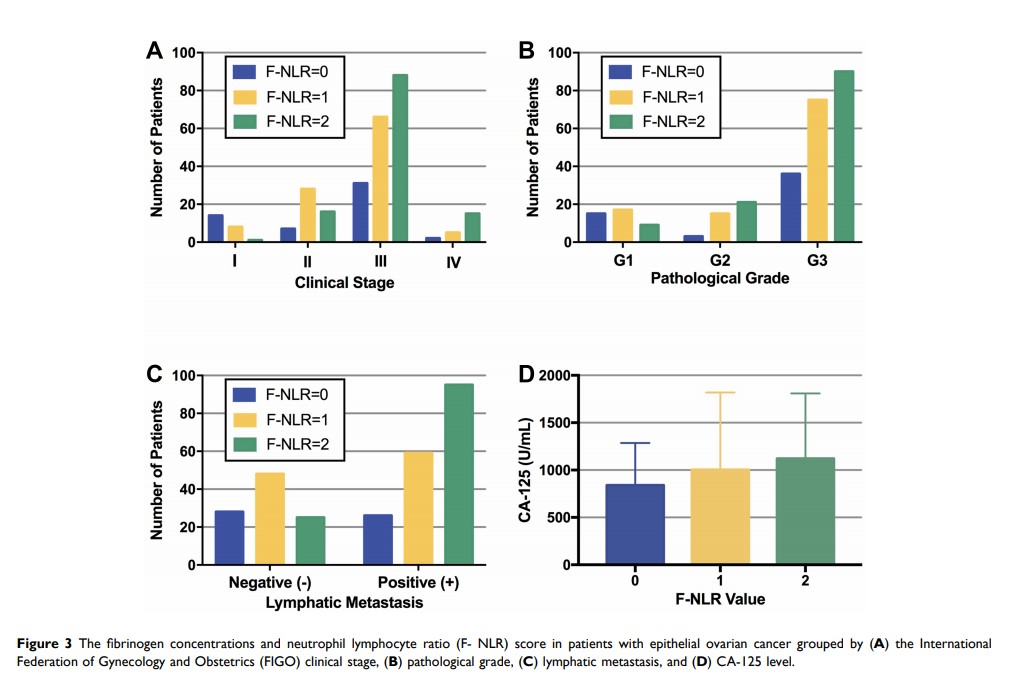
Results: The analyses showed that F-NLR was significantly associated with clinical stage (P =0.000), lymphatic metastasis (P =0.001), and carbohydrate antigen (CA) 125 level (P =0.048). The F-NLR (hazard ratio=2.211; 95% confidence interval=1.251– 6.394; P =0.002) was demonstrated as an independent prognostic factor for survival of EOC. The DFS rates in F-NLR groups 0, 1, and 2 were 68.5%, 47.7%, and 31.7%, respectively (P =0.000); the OS rates in previous groups were 75.9%, 51.4%, and 34.2% (P =0.000) and the 5-year survival times (mean±SD, months) were 64.24± 24.21, 60.27± 22.65, and 46.09± 20.32, respectively. By subgroup analysis, the F-NLR was significantly associated with DFS and OS among patients with advanced tumor stage (Stage III or IV) or lymphatic metastasis.
Conclusion: The pre-operative F-NLR score, a novel inflammation-based grading system, was a promising prognosis predictor for EOC patients, especially those with advanced clinical stage and those with lymph node metastasis.
Keywords: fibrinogen, neutrophil-lymphocyte ratio, epithelial ovarian cancer, prognosis, F-NLR