115195
论文已发表
注册即可获取德孚的最新动态
IF 收录期刊
- 3.6 Breast Cancer (Dove Med Press)
- 4.3 Clin Epidemiol
- 2.6 Cancer Manag Res
- 3.2 Infect Drug Resist
- 4.1 Clin Interv Aging
- 6.1 Drug Des Dev Ther
- 4.1 Int J Chronic Obstr
- 8.7 Int J Nanomed
- 2.5 Int J Women's Health
- 3.2 Neuropsych Dis Treat
- 2.4 OncoTargets Ther
- 2.6 Patient Prefer Adher
- 2.6 Ther Clin Risk Manag
- 3.1 J Pain Res
- 3.5 Diabet Metab Synd Ob
- 4.5 Psychol Res Behav Ma
- 3.4 Nat Sci Sleep
- 2.4 Pharmgenomics Pers Med
- 2.6 Risk Manag Healthc Policy
- 4.6 J Inflamm Res
- 2.3 Int J Gen Med
- 3.9 J Hepatocell Carcinoma
- 3.3 J Asthma Allergy
- 2.5 Clin Cosmet Investig Dermatol
- 3.0 J Multidiscip Healthc

研究 2010 年至 2019 年针灸疗法治疗膝骨关节炎的趋势:一个文献计量分析
Authors Li R, Sun J, Hu H, Zhang Q, Sun R, Zhou S, Zhang H, Fang J
Received 18 April 2020
Accepted for publication 23 June 2020
Published 27 July 2020 Volume 2020:13 Pages 1901—1913
DOI https://doi.org/10.2147/JPR.S258739
Checked for plagiarism Yes
Review by Single anonymous peer review
Peer reviewer comments 2
Editor who approved publication: Dr Michael A Überall
Background: Acupuncture has been widely applied to relieve knee osteoarthritis (KOA) in many countries. However, the bibliometric analysis of the global use of acupuncture on KOA is largely unknown. Therefore, this study aimed to explore the current status and trends of the global use of acupuncture on KOA in recent 10 years by using CiteSpace (5.6.R3).
Methods: Publications regarding acupuncture therapy for treating KOA between 2010 and 2019 were extracted from the Web of Science database. CiteSpace was used to analyze the number of publications, countries, institutions, journals, authors, cited references and keywords by using standard bibliometric indicators.
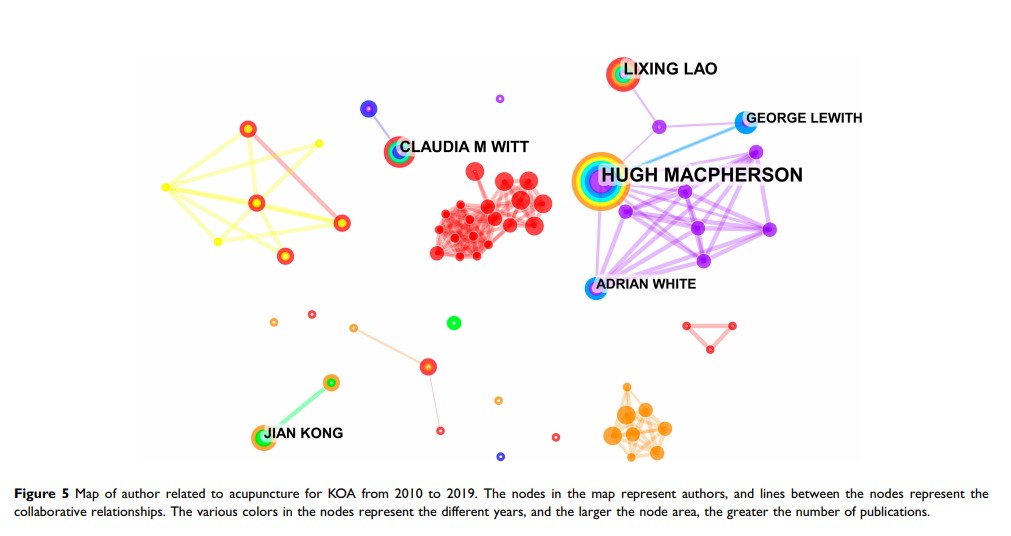
Results: A total of 343 publications were retrieved from 2010 to 2019. The total number of publications continually increased over the past four years, and the most active journals, countries, institutions and authors in the field of acupuncture therapy on patients with KOA were identified. The Evid Based Complement Alternat Med (28) was the most prolific journal, and the Ann Intern Med (202) was the most cited journal. The most productive country and institution in this field was China (115) and University of York (18), respectively. Hugh Macpherson (18) was the most prolific author and Witt C ranked the first in the cited authors. In the ranking of frequency in cited reference, the first article was published by Scharf HP (54). The keyword of ‘randomized controlled trial’ ranked first for research developments with the highest citation burst (3.9486). Besides, there were three main frontiers in keywords for KOA research, including ‘research method, ‘age’ and ‘measure of intervention’.
Conclusion: The findings from this bibliometric study provide current status and trends in clinical research of acupuncture therapy on patients with KOA over the past ten years, which may help researchers identify hot topics and explore new directions for future research in this field.
Keywords: acupuncture, knee osteoarthritis, bibliometric analysis, CiteSpace