115195
论文已发表
注册即可获取德孚的最新动态
IF 收录期刊
- 3.6 Breast Cancer (Dove Med Press)
- 4.3 Clin Epidemiol
- 2.6 Cancer Manag Res
- 3.2 Infect Drug Resist
- 4.1 Clin Interv Aging
- 6.1 Drug Des Dev Ther
- 4.1 Int J Chronic Obstr
- 8.7 Int J Nanomed
- 2.5 Int J Women's Health
- 3.2 Neuropsych Dis Treat
- 2.4 OncoTargets Ther
- 2.6 Patient Prefer Adher
- 2.6 Ther Clin Risk Manag
- 3.1 J Pain Res
- 3.5 Diabet Metab Synd Ob
- 4.5 Psychol Res Behav Ma
- 3.4 Nat Sci Sleep
- 2.4 Pharmgenomics Pers Med
- 2.6 Risk Manag Healthc Policy
- 4.6 J Inflamm Res
- 2.3 Int J Gen Med
- 3.9 J Hepatocell Carcinoma
- 3.3 J Asthma Allergy
- 2.5 Clin Cosmet Investig Dermatol
- 3.0 J Multidiscip Healthc

中国东北地区上皮性卵巢癌 p16 评估的 10 年研究:HPV 与 PD-L1 表达的相关意义
Authors Yang X, You Q, Yao G, Geng J, Ma R, Meng H
Received 7 June 2020
Accepted for publication 16 July 2020
Published 3 August 2020 Volume 2020:12 Pages 6747—6753
DOI https://doi.org/10.2147/CMAR.S262678
Checked for plagiarism Yes
Review by Single anonymous peer review
Peer reviewer comments 3
Editor who approved publication: Dr Eileen O'Reilly
Background: Human papillomavirus (HPV) is a high-risk etiological factor for cervical and ovarian carcinomas. p16 protein can be used as a surrogate biomarker for HPV infection in high-risk tumors. A strong correlation between HPV infection and programmed death ligand 1 (PD-L1) protein expression has consistently been reported.
Objective: Given this background, this study investigates the prevalence, prognostic and clinicopathologic features of HPV-related epithelial ovarian cancer (EOC) for the last 10 years in Northeast China to elucidate the involvement of p16 in the PD-L1 protein expression, tumorigenesis, and progression of EOC.
Methods: Specimens from 310 patients diagnosed with EOC collected from 2006 to 2016 were analyzed by polymerase chain reaction (PCR) for HPV DNA, and overexpression of p16 by immunohistochemistry was also evaluated. Statistical analysis was performed to estimate the significant difference between HPV positive and negative patients, the correlation among HPV state, p16 and PD-L1 expression, and clinical presentation.
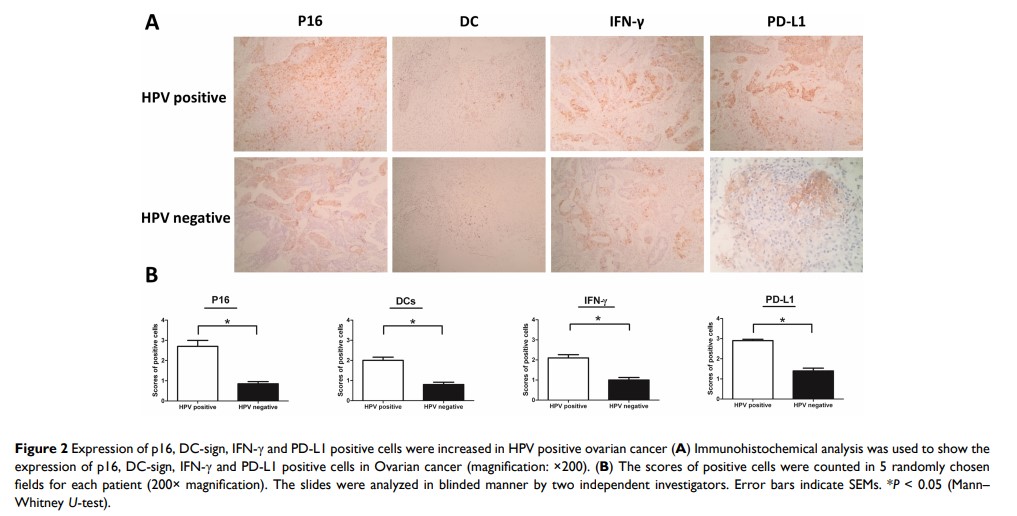
Results: Overexpression of p16 protein and HPV DNA were present in 100 (32.3%) of the 310 cases, and correlated with high PD-L1 expression. There was a good concordance between HPV positivity, p16 protein overexpression and PD-L1 expression. The etiological fraction of HPV in EOC is substantially higher in Northeast China than other cohorts previously reported.
Conclusion: Our study demonstrates that HPV infection and p16 overexpression is significantly associated with PD-LI expression in EOC, through the cooperative roles of dendritic cells (DCs) and IFN-γ, which may represent a promising strategy for therapeutic intervention in EOC.
Keywords: HPV, p16, PD-L1, ovarian cancer, pathogenesis, prognosis