115195
论文已发表
注册即可获取德孚的最新动态
IF 收录期刊
- 3.6 Breast Cancer (Dove Med Press)
- 4.3 Clin Epidemiol
- 2.6 Cancer Manag Res
- 3.2 Infect Drug Resist
- 4.1 Clin Interv Aging
- 6.1 Drug Des Dev Ther
- 4.1 Int J Chronic Obstr
- 8.7 Int J Nanomed
- 2.5 Int J Women's Health
- 3.2 Neuropsych Dis Treat
- 2.4 OncoTargets Ther
- 2.6 Patient Prefer Adher
- 2.6 Ther Clin Risk Manag
- 3.1 J Pain Res
- 3.5 Diabet Metab Synd Ob
- 4.5 Psychol Res Behav Ma
- 3.4 Nat Sci Sleep
- 2.4 Pharmgenomics Pers Med
- 2.6 Risk Manag Healthc Policy
- 4.6 J Inflamm Res
- 2.3 Int J Gen Med
- 3.9 J Hepatocell Carcinoma
- 3.3 J Asthma Allergy
- 2.5 Clin Cosmet Investig Dermatol
- 3.0 J Multidiscip Healthc

前列腺特异性抗原相关指标和成像筛查在前列腺癌诊断中的价值
Authors Bai X, Jiang Y, Zhang X, Wang M, Tian J, Mu L, Du Y
Received 10 April 2020
Accepted for publication 7 July 2020
Published 4 August 2020 Volume 2020:12 Pages 6821—6826
DOI https://doi.org/10.2147/CMAR.S257769
Checked for plagiarism Yes
Review by Single anonymous peer review
Peer reviewer comments 2
Editor who approved publication: Dr Eileen O'Reilly
Objective: The aim of this study was to explore the value of the prostate-specific antigen (PSA) levels, the ratio of free PSA to total PSA (fPSA/TPSA), the PSA density (PSAD), digital rectal examination (DRE), transrectal prostate ultrasound (TRUS), and multiparameter MRI (MP-MRI) in the differential diagnosis of benign prostatic hyperplasia (BPH) and prostate cancer (PCa).
Methods: From February 2016 to September 2019, data from 620 patients who underwent systematic transrectal ultrasound-guided prostate biopsy (STURS-PB) in our hospital were retrospectively collected, including the PSA levels, the fPSA/TPSA ratio, the PSAD, DRE, TRUS, MP-MRI, prostate volume, and other clinical data.
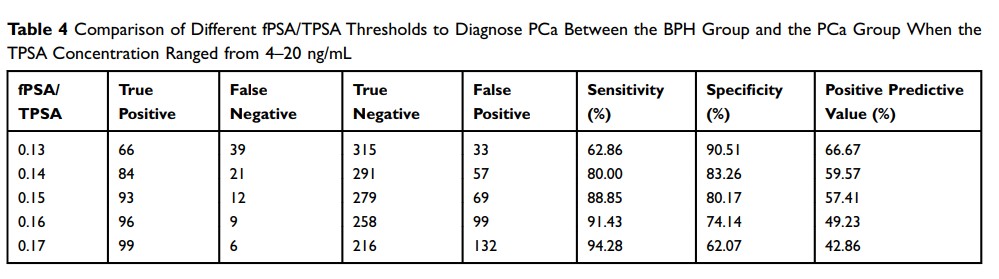
Results: Among the 620 patients, 249 patients were in the PCa group, and 371 patients in the BPH group. The positive puncture rate was 40.16%. The positive predictive values of DRE, TRUS, mpMRI, and TPSA levels for PCa were 39.91%, 39.38%, 64.14%, and 41.57%, respectively; the sensitivity of these parameters was 37.35%, 51.41%, 74.69%, and 57.43%, respectively; and the specificity of these parameters was 62.26%, 46.90%, 71.97%, and 45.82%, respectively. When the TPSA concentration was in the range of 4– 20 ng/mL, the positive puncture rate of STURS-PB was 23.18%, with a high rate of misdiagnosis. When the TPSA concentration was in the range of 4– 20 ng/mL, the fPSA/TPSA ratio was 0.15, the PSAD was 0.16, the comprehensive evaluation of PCa was optimal (the sensitivity of these parameters was 88.85% and 84.09%, respectively; the specificity was 80.17% and 67.29%, respectively; the positive predictive value was 57.41% and 51.39%, respectively). When the TPSA concentration > 4 ng/mL, the fPSA/TPSA ratio ≤ 0.15 and the PSAD ≥ 0.16, the sensitivity, specificity, and correctness index of the PCa and BPH diagnosis were 80.54%, 82.75%, and 67.07%, respectively.
Conclusion: When using DRE, TRUS, and MP-MRI to screen for PCa, MP-MRI has a relatively high sensitivity and specificity. Using these three thresholds (TPSA > 4 ng/mL combined with an fPSA/TPSA ratio ≤ 0.15 and a PSAD ≥ 0.16) is significantly better than using TPSA levels alone for the differential diagnosis of PCa and BPH.
Keywords: total prostate-specific antigen, free prostate-specific antigen, prostate-specific antigen density, prostate cancer, benign prostatic hyperplasia