119661
论文已发表
注册即可获取德孚的最新动态
IF 收录期刊
- 3.6 Breast Cancer (Dove Med Press)
- 4.3 Clin Epidemiol
- 2.6 Cancer Manag Res
- 3.2 Infect Drug Resist
- 4.1 Clin Interv Aging
- 6.1 Drug Des Dev Ther
- 4.1 Int J Chronic Obstr
- 8.7 Int J Nanomed
- 2.5 Int J Women's Health
- 3.2 Neuropsych Dis Treat
- 2.4 OncoTargets Ther
- 2.6 Patient Prefer Adher
- 2.6 Ther Clin Risk Manag
- 3.1 J Pain Res
- 3.5 Diabet Metab Synd Ob
- 4.5 Psychol Res Behav Ma
- 3.4 Nat Sci Sleep
- 2.4 Pharmgenomics Pers Med
- 2.6 Risk Manag Healthc Policy
- 4.6 J Inflamm Res
- 2.3 Int J Gen Med
- 3.9 J Hepatocell Carcinoma
- 3.3 J Asthma Allergy
- 2.5 Clin Cosmet Investig Dermatol
- 3.0 J Multidiscip Healthc

一种靶向胰腺癌并抑制肿瘤生长的新型融合肽
Authors Zheng L, Zhang B, He X, Cao G, Li Y, Cai K, Yang B, Wu Y
Received 22 January 2020
Accepted for publication 26 July 2020
Published 12 August 2020 Volume 2020:13 Pages 7865—7875
DOI https://doi.org/10.2147/OTT.S246969
Checked for plagiarism Yes
Review by Single anonymous peer review
Peer reviewer comments 2
Editor who approved publication: Prof. Dr. Jianmin Xu
Background: Pancreatic cancer is a highly malignant tumor of the digestive system. Early pancreatic cancer is often difficult to diagnosis due to its atypical clinical symptoms. Patients with pancreatic cancer have a very poor prognosis because they have lost the opportunity for radical surgical tumor resection and they are less sensitive to the clinically used radiotherapy and chemotherapy.
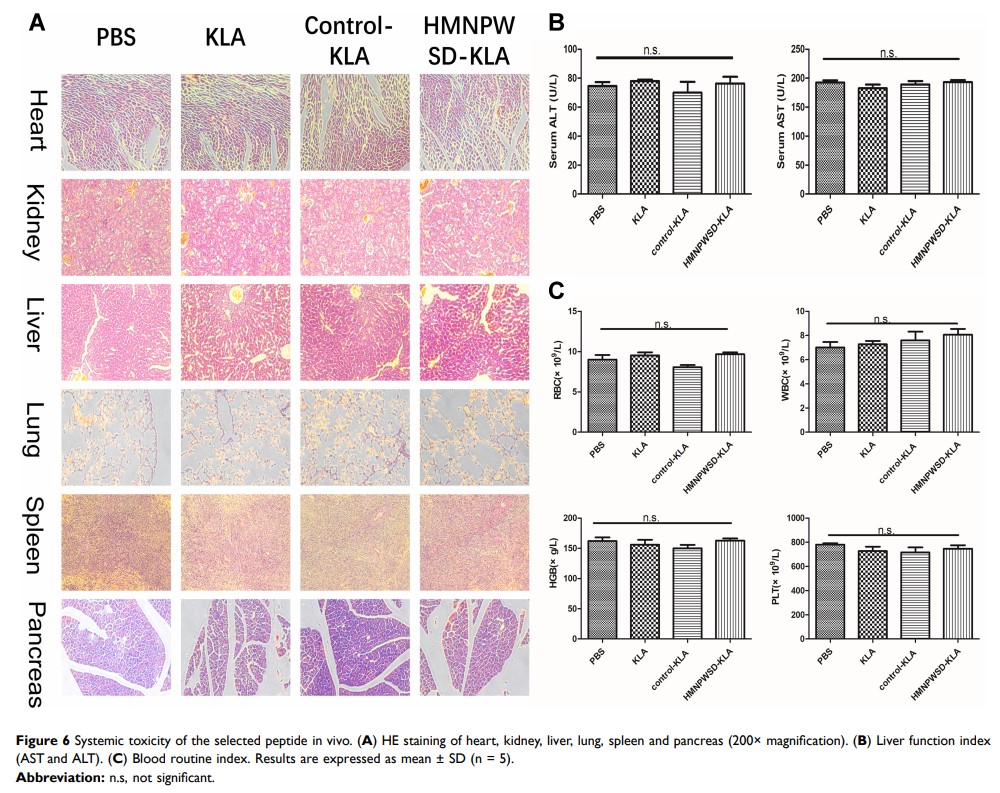
Methods: In this study, a peptide targeting pancreatic cancer cells was screened by phage display technology, and its targeting property was evaluated in vitro using PANC1 cells by fluorescence imaging and flow cytometry. Furthermore, the targeting peptide was conjugated to the pro-apoptotic KLAKLAKKLAKLAK (KLA), the fusion peptide and its targeting ability that allowing KLA to specifically enter pancreatic tumor cells in vitro and in vivo was confirmed by fluorescence imaging and in vivo imaging system (IVIS). Its mechanism was determined using flow cytometry, mitochondrial membrane potential evaluation and Western blot. The inhibitory effect on pancreatic tumor growth and toxic effects were evaluated by animal experiment.
Results: Due to the internalization facilitated by the targeting mechanism of the targeting peptide, KLA specifically entered pancreatic cancer cells, destroyed mitochondria and induced apoptosis. The fusion peptide and its targeting ability that allowing KLA to specifically enter pancreatic tumor cells and exert a significant inhibitory effect on pancreatic tumor growth with reduced toxic effects.
Conclusion: This approach possesses potential advantages in the clinical diagnosis and treatment of pancreatic cancer.
Keywords: targeting peptide, phage display technology, pancreatic cancer, KLA pro-apoptotic peptide, tumor growth inhibition