119942
论文已发表
注册即可获取德孚的最新动态
IF 收录期刊
- 3.6 Breast Cancer (Dove Med Press)
- 4.3 Clin Epidemiol
- 2.6 Cancer Manag Res
- 3.2 Infect Drug Resist
- 4.1 Clin Interv Aging
- 6.1 Drug Des Dev Ther
- 4.1 Int J Chronic Obstr
- 8.7 Int J Nanomed
- 2.5 Int J Women's Health
- 3.2 Neuropsych Dis Treat
- 2.4 OncoTargets Ther
- 2.6 Patient Prefer Adher
- 2.6 Ther Clin Risk Manag
- 3.1 J Pain Res
- 3.5 Diabet Metab Synd Ob
- 4.5 Psychol Res Behav Ma
- 3.4 Nat Sci Sleep
- 2.4 Pharmgenomics Pers Med
- 2.6 Risk Manag Healthc Policy
- 4.6 J Inflamm Res
- 2.3 Int J Gen Med
- 3.9 J Hepatocell Carcinoma
- 3.3 J Asthma Allergy
- 2.5 Clin Cosmet Investig Dermatol
- 3.0 J Multidiscip Healthc

CT 引导下的经皮椎间黄韧带切除术联合针刀治疗腰椎管狭窄症:一个病例报告和文献回顾
Authors Zhu X, Qiu Z, Liu Z, Shen Y, Zhou Q, Jia Y, Sun X, Li S
Received 25 March 2020
Accepted for publication 27 June 2020
Published 13 August 2020 Volume 2020:13 Pages 2073—2081
DOI https://doi.org/10.2147/JPR.S255249
Checked for plagiarism Yes
Review by Single anonymous peer review
Peer reviewer comments 3
Editor who approved publication: Dr Robert B. Raffa
Case: The patient was a 62-year-old woman presenting with low-back pain of 3 years’ duration and numbness in the right leg.
Diagnosis: She was diagnosed with lumbar spinal stenosis based on combined magnetic resonance imaging, physical examination, and symptoms.
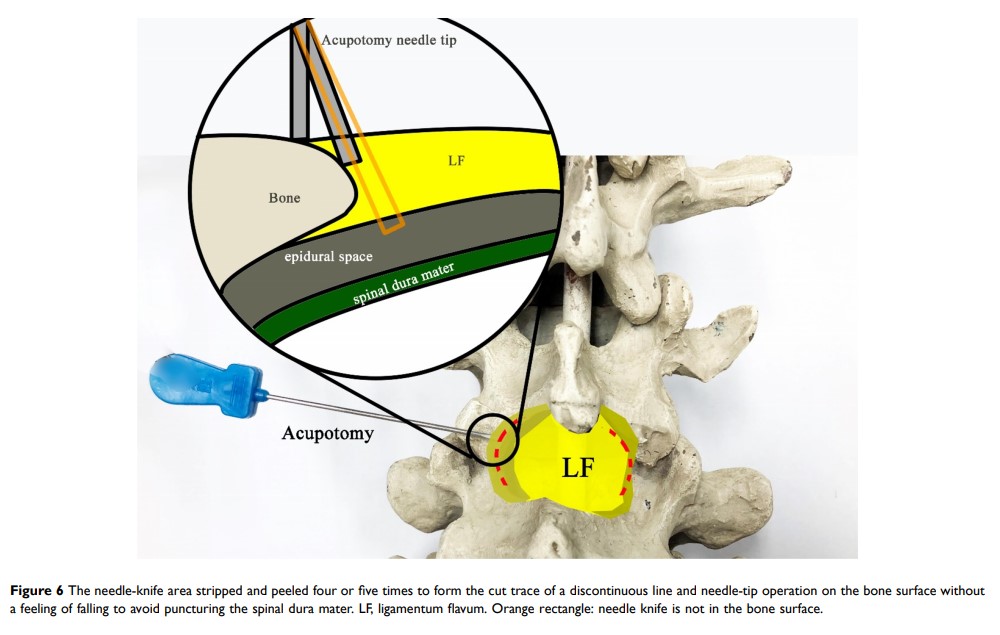
Interventions: Treatment with computed tomography–guided percutaneous release of the ligamentum flavum was delivered.
Outcomes: Relief of symptoms immediately after treatment and complete resolution of symptoms after 1 month were achieved. At follow-up, there was no recurrence of symptoms after 2, 4, 6, and 12 months.
Conclusion: Lumbar ligamentum flavum hypertrophy is an important cause of degenerative lumbar spinal stenosis. The hypertrophic ligamentum flavum can directly compress the spinal canal, squeeze the cauda equina, and simultaneously lead to a reduction in the anteroposterior diameter of the intervertebral foramen, which compresses the nerve roots and causes numbness and other symptoms of lower extremities. In clinical practice, doctors should combine imaging findings with patient symptoms for diagnosis and an individualized treatment plan for each patient with lumbar spinal stenosis, and conduct gradual stepwise treatment using conservative minimally invasive surgery to prevent excessive surgery.
Keywords: CT guidance, ligamentum flavum, lumbar spinal stenosis, minimally invasive surgery, needle knife