119661
论文已发表
注册即可获取德孚的最新动态
IF 收录期刊
- 3.6 Breast Cancer (Dove Med Press)
- 4.3 Clin Epidemiol
- 2.6 Cancer Manag Res
- 3.2 Infect Drug Resist
- 4.1 Clin Interv Aging
- 6.1 Drug Des Dev Ther
- 4.1 Int J Chronic Obstr
- 8.7 Int J Nanomed
- 2.5 Int J Women's Health
- 3.2 Neuropsych Dis Treat
- 2.4 OncoTargets Ther
- 2.6 Patient Prefer Adher
- 2.6 Ther Clin Risk Manag
- 3.1 J Pain Res
- 3.5 Diabet Metab Synd Ob
- 4.5 Psychol Res Behav Ma
- 3.4 Nat Sci Sleep
- 2.4 Pharmgenomics Pers Med
- 2.6 Risk Manag Healthc Policy
- 4.6 J Inflamm Res
- 2.3 Int J Gen Med
- 3.9 J Hepatocell Carcinoma
- 3.3 J Asthma Allergy
- 2.5 Clin Cosmet Investig Dermatol
- 3.0 J Multidiscip Healthc

确定基于生物信息学和实验分析、与骨肉瘤转移相关的基因生物标志物和潜在的靶向药物
Authors Cao MD, Song YC, Yang ZM, Wang DW, Lin YM, Lu HD
Received 7 April 2020
Accepted for publication 27 July 2020
Published 14 August 2020 Volume 2020:13 Pages 8095—8107
DOI https://doi.org/10.2147/OTT.S256617
Checked for plagiarism Yes
Review by Single anonymous peer review
Peer reviewer comments 3
Editor who approved publication: Prof. Dr. Nicola Silvestris
Background: Metastasis is the leading cause of death for patients with osteosarcoma (OS). In the present study, we explore the biomarkers for metastatic OS and provide potential therapeutic approaches.
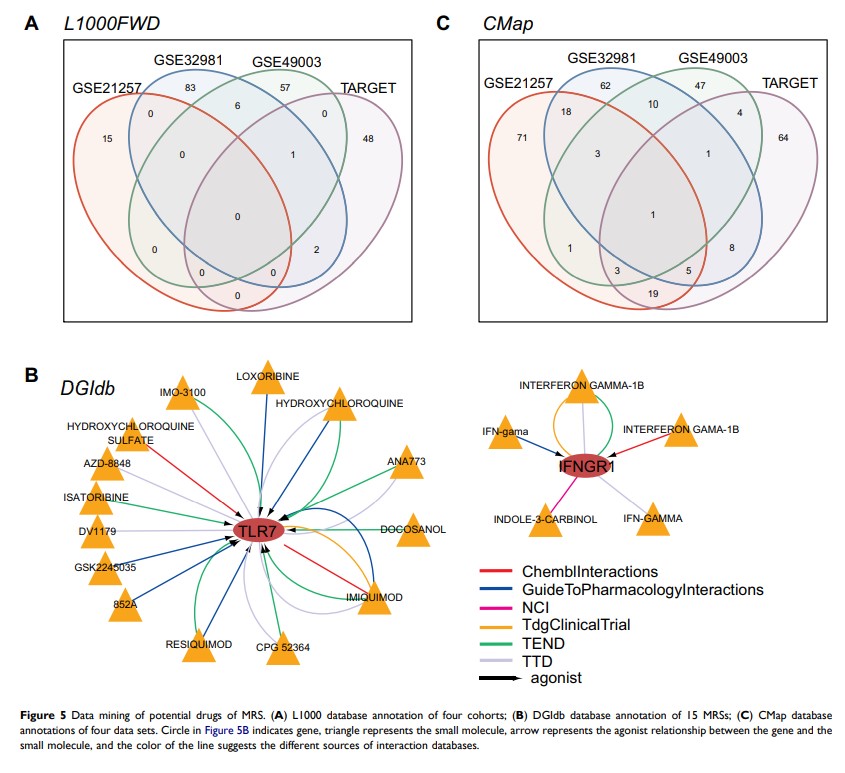
Materials and Methods: RNA-Seq data and clinical follow-up information were downloaded from TARGET and GEO databases. A Cox regression model was used to analyze metastatic events. L1000FWD, DGIdb, and CMap databases were used to identify potential drugs related to metastasis. Invasion and migration transwell assays and an adhesion assay were used to identify biological functions of genes.
Results: A total of 15 metastasis-related signatures (MRSs) were associated with the prognosis based on the TARGET or GSE21257 cohorts, among which IL10RA and TLR7 genes were especially significant. In the DGIdb drug–gene interaction database, TLR7 and IFNGR1 were found to have potential interactions with drugs. After inhibiting the expression of TLR7 , the migration, invasion, and adhesion ability of OS cells were significantly enhanced, which further promoted metastasis.
Conclusion: We identified a set of MRS that may be related to OS metastases. Among them, TLR7 plays a vital role and may be a potential target for OS metastasis treatment.
Keywords: osteosarcoma, metastatic-related signatures, drug–gene interaction, TLR7, migration, invasion